
Lend-Lease and the Arsenal of Democracy 2.0: Providing for Our Defense by Aiding Ukraine and Our Allies
Published July 24, 2024 • Read time: 9m
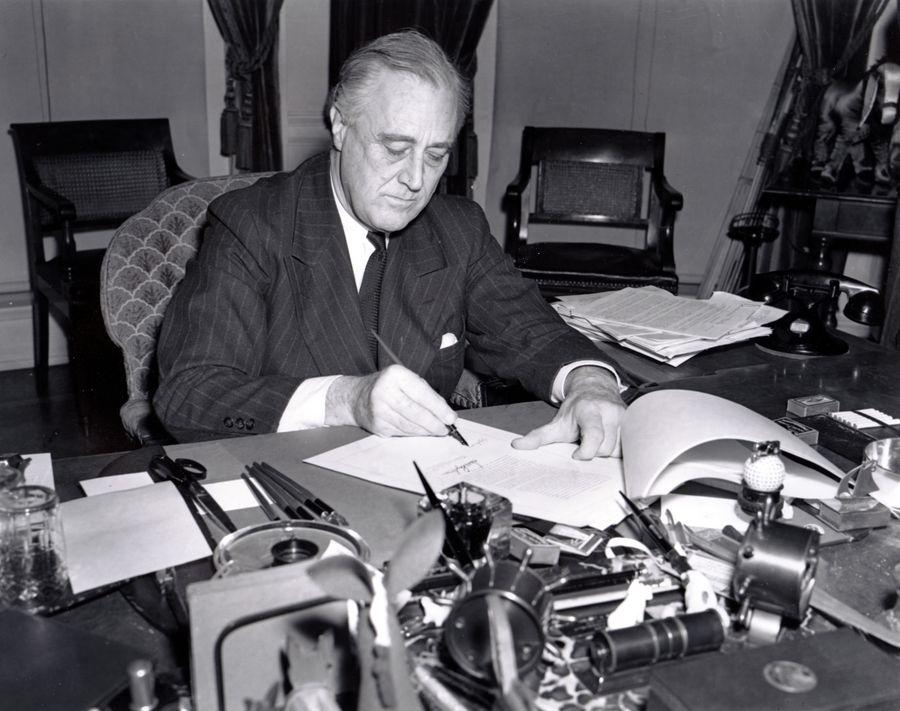
U.S. President Franklin D. Roosevelt signs the H.R. 1776 and the Lend-Lease Act at the White House in Washington, D.C. on March 11, 1941. On the desk are some of the pens used by the president in affixing his signature to the Act, which will enable Allied countries to receive U.S. aid. (AP Photo)
The dilemma facing the U.S. and its allies in sustaining Ukraine’s defense amidst competing global security threats echoed those facing Franklin Roosevelt’s administration before the December 7, 1941, attack on Pearl Harbor. Democratic friends in Europe faced existential totalitarian threats while an expansionist, revanchist regime in Asia threatened U.S. interests, friends, and possessions. In 1940 FDR, the deftest of U.S. politicians, led an American people disillusioned with the First World War’s results and wary of U.S. entanglements abroad. Roosevelt and his advisors knew the U.S. needed to aid fellow democracies while rearming. However, FDR remained constrained by the Neutrality Acts and recognized that the American people and their Congress wouldn’t simply give military aid to Great Britain and other nations, despite dire need.[1] FDR took two key actions to address the growing threats to democracy: creating Lend-Lease and deciding to make the U.S. “the arsenal of democracy.” These initiatives afforded the U.S. a crucial running start in ramping up production before Washington entered World War II, thereby helping to keep key U.S. partners in the fight and to forestall the kind of flatted-footed mobilization that had hamstrung U.S. readiness in World War I.[2]
Roosevelt recognized U.S. aid was essential to defeating Nazi Germany and his innovative Lend-Lease Program allowed the U.S. to “lend” or “lease” equipment and material to embattled friends while deferring payment. This program ultimately dispensed $50 billion in assistance to more than 30 countries.[3] It helped sustain key allies and provide part of what was needed to defeat the Axis Powers. Helping forestall Nazi victories over Britain and the Soviet Union, and injuring Japan’s efforts in China, it assisted in turning the war’s tide.
The Biden Administration passed the Ukraine Democracy Defense Lend-Lease Act of 2022, but it expired in September 2023. Gaps in U.S. industrial capacity to provision Ukraine have exposed a dangerous gap between available capabilities and outstanding commitments in defending our partners and allies. Rebooting a Lend-Lease-style program for the 21st Century could deliver comparable—all be it different—dividends by equipping Ukraine and giving it a chance to defeat Russia, at no cost in U.S. lives. Moreover, once military production ramped-up, Washington could then enable the arming of other allies and partners such as NATO members and Taiwan. The question of whether Washington can once again get a running start in closing this capacity gap before it is drawn directly into a great power conflict is likely to have significant strategic implications for its ability to prevent and, if necessary, prevail in such a conflict.
Critics will rightly contend that the U.S. currently lacks the industrial base to supply our own forces, let alone those of our allies. This was also true of the Roosevelt administration’s America. FDR’s solution: make the United States “the arsenal of democracy” and build the industrial capacity necessary to arm and equip endangered democratic partners and the United States. Foreign sales and U.S. government and private sector investment made this possible.
The Second World War’s outbreak buried America’s aircraft industry in orders from Britain, France, and many other European nations, spurring industrial expansion and technological innovation. This helped make Lend-Lease possible and provided a pillar for dramatic expansion of this industry during the war, something at times underpinned by Washington’s willingness to build the plants and lease them back to the corporations running them.[4] At the same time, orders from the U.S. Navy overwhelmed U.S. shipbuilders, leaving them without the capacity to produce the merchant shipping Great Britain and the U.S. needed to carry troops and material around the world. The Roosevelt Administration, using a mixture of public and private investment, oversaw the construction of new shipyards from scratch, and the creation of the most successful ship building programs in modern history, including that for “Liberty Ship” merchantmen. [5] Innovative approaches arose across U.S. industry. Roosevelt’s Lend-Lease Program and his decision to make the U.S. “the arsenal of democracy” granted Washington a crucial running start in ramping up its military industrial production before it entered the war. The relatively recent and bitter memory Washington’s poorly prepared industrial mobilization the First World War lent urgency to Washington’s efforts to kick start industrial mobilization before it was drawn directly into the Second World War.[6]
Russia’s 2022 escalation of its war against Ukraine and the rapid depletion of Western weapons and munitions stocks, some within weeks of Russia’s full-scale invasion, revealed the lack of U.S. and allied production capacity to sustain a large war. [7] The U.S. and its allies also lack the industrial capabilities to supply orders to Taiwan and others. The underlying systemic problem is not the West’s aid to Ukraine but its limited manufacturing abilities, combined with its fragile supply chains.[8] Moreover, the historical memory of America’s successful mobilization in World War II has long since displaced that of our failed mobilization in World War I, lending Washington to a false sense of confidence that it can mobilize its industrial capacity from a standing start.
Working with allies to create a Lend-Lease Program, while also helping and encouraging our partners in the construction of a multinational “arsenal of democracy,” would send a demand signal to industry, producing an expansion of the defense industrial capacity of democratic states.[9] This is already beginning as a result of the Ukraine war and fears of aggression from China, but the democratic states are moving slowly to reverse the generational decline in Western defense budgets since the end of the Cold War.[10] Meanwhile Russia has dramatically scaled-up production and its partners are increasingly pitching in to its war effort.
Since Kyiv recently procured $60 billion in aid from Washington and $50 billion in loans from the G-7, increasing the democracies’ defense industrial capacity will prove crucial in converting Kyiv’s new-found cash into newly fielded capabilities.[11] This is seed money. Providing for Ukraine’s defense needs would serve as a proving ground for creating and streamlining new production processes. Rebuilding and expanding the defense industrial base in democratic nations would improve the readiness and capabilities of their respective forces, and those of the United States. After years of pressing reluctant partners to bear more of their own defense burden, such a program could catalyze their rising fears for Chinese and Russian revisionism.
Though Roosvelt didn’t live to see it, by the Second World War’s end, the U.S. accounted for more than half of all industrial production and two-thirds of all Allied military equipment used in the war. [12] Likewise, new U.S.-led Lend-Lease and “arsenal of democracy” initiatives directed initially at Ukraine and later at other democratic partners, could strengthen NATO, shore-up the fraying international order, and help Ukraine defeat Russia. Moreover, such a defeat would demonstrate to Putin’s partners in Beijing, Pyongyang, and Tehran that democracies defend their own.
The Biden administration’s grand strategy of “integrated deterrence” relies upon coordination and integration with partners and allies. At present, the Ukraine War has exposed glaring gaps between Washington’s defense commitments and its available capabilities, as well as those of its allies and partners.[13] Beijing is closely monitoring the war and likely to view its outcome as a critical test of whether the world’s democracies can once again summon the will and the capabilities to defend one another.[14] Passing this test and closing this gap will likely prove crucial to Washington’s ability to rally its allies and deter its adversaries.
The views expressed herein are those of the authors and not necessarily those of Dwight D. Eisenhower School, the National Defense University, or any arm of the U.S. government.
Dr. Michael W. Campbell is an assistant professor at the Eisenhower School of National Defense University. Within the U.S. government, he has taught several courses on combatting foreign malign influence campaigns to U.S. agencies and partners around the world for the past two decades.
Dr. Donald Stoker is Professor of National Security and Resource Strategy at the Dwight D. Eisenhower School of National Defense University. His newest book is Purpose and Power: U.S. Grand Strategy from the Revolutionary Era to the Present (Cambridge University Press, 2024).
Notes:
[1] U.S. State Department, Office of the Historian, “Lend-Lease and Military Aid to the Allies in the Early Years of World War II,” Milestones in the History of U.S. Foreign Relations - Office of the Historian (state.gov).
[2] Frank N. Schubert, “Mobilization,” U.S. Army Center of Military History, https://history.army.mil/documents/mobpam.htm?t&utm, accessed July 20, 2024.
[3] U.S. State Department, Office of the Historian, “Lend-Lease and Military Aid to the Allies in the Early Years of World War II,” Milestones in the History of U.S. Foreign Relations - Office of the Historian (state.gov).
[4] Arthur Herman, Freedom's Forge: How American Business Produced Victory in World War II, New York: Radom House, 2012.
[5] Arthur Herman, Freedom's Forge: How American Business Produced Victory in World War II, New York: Radom House, 2012.
[6] Frank N. Schubert, “Mobilization,” U.S. Army Center of Military History, https://history.army.mil/documents/mobpam.htm?t&utm, accessed July 20, 2024.
[7] “The Ukraine War Shows the U.S. Military-Industrial Complex Isn’t Battle Ready,” WIRED.com, accessed June 26, 2024.
[8] “The Ukraine War Shows the U.S. Military-Industrial Complex Isn’t Battle Ready,” WIRED.com, accessed June 26, 2024.
[9] “The Ukraine War Shows the U.S. Military-Industrial Complex Isn’t Battle Ready,” WIRED.com, accessed June 26, 2024.
[10] The Economist, “American’s giant arms makers are being outgunned,” July 7, 2024.
[11] U.S. Congress passes Ukraine aid after months of delay | Reuters, Apr 24, 2024. CNN, G7 leaders agree to loan Ukraine money backed by profits from, Apr. 13, 2024.
[12] U.S. State Department, Office of the Historian, “Lend-Lease and Military Aid to the Allies in the Early Years of World War II,” Milestones in the History of U.S. Foreign Relations - Office of the Historian (state.gov).
[13] “The Ukraine War Shows the U.S. Military-Industrial Complex Isn’t Battle Ready,” WIRED.com, accessed June 26, 2024.
[14] Defense One, “What Is China Learning from the Ukraine War?” April 3, 2022.

The Army’s AI Cyber Defenders Need a Proven Stand-Down Order
By Gleb Tsipursky • RealClearDefense
After the Silence
By Chase Skylar DeMayo • RealClearDefense
Defense Chip Procurement Needs a Recovery Test
By Percy Yixuanchen Yu • RealClearDefense
FORTRESS America Must Measure Missions, Not Megawatts
By Burak Oktenli • RealClearDefense
After the Midterms, the Right Strategy Against Iran
By Lance Gordon • RealClearDefense
After the Silence
By Chase Skylar DeMayo • RealClearDefense
Underwater Arms Race Puts U.S. Naval Supremacy at Risk
By Tom O'Connor, Newsweek
New Facilities To Pump Out Upgraded F/A-18E/F Super Hornets
By Trevithick, WarZone
U.S. Navy Expands Tomahawk Warhead Production
By Naval News Staff, Naval News
SSN(X) Attack Boat Will be a Swift, Lethal Mothership for Undersea Drones
By USNI N.