
The Case For a (Future) Mutual Defense Treaty With Ukraine
Last updated 05:47 AM EDT • Read time: 5m
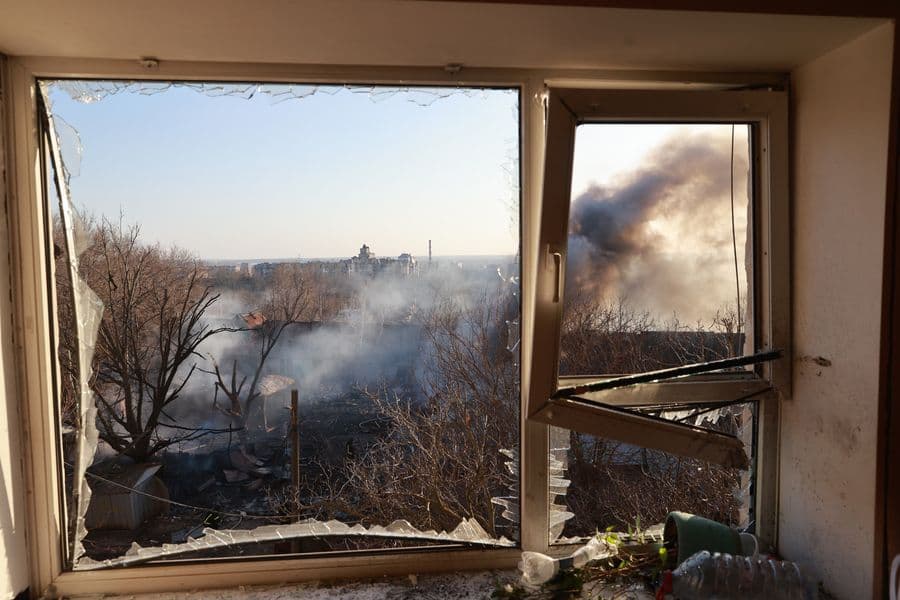
In the wake of the ongoing war in Ukraine’s recent developments, it is time for Washington to think about its future relationship with Ukraine. Recently, Washington promised iron-clad, “NATO-style” security guarantees to Ukraine, albeit with a time-limited offer of 15 years. This guarantee, while sufficient time for a future presidential administration to hammer out permanent security guarantees, is not sufficient for long-term regional stability. Russia will unlikely democratize even after Putin, and will most likely be a persistent threat to both American and European interests. China will likely also be a persistent threat to Ukraine and the rest of Europe.
Given the current instability of the international environment, there is no better time than now for the national security community in Washington to consider which security agreements the United States should extend to Ukraine. This article argues that the best guarantee is a straightforward, clear mutual defense treaty. U.S. conventional forces could be stationed in Ukraine on a rotational basis until permanent basing is arranged. Additionally, basing access for defensive operations would be a significant part of any long-standing defense treaty with Ukraine, which would aim to cement American credibility with the Ukrainian government. U.S. Forces, however, would most likely be stationed in NATO territory, rather than committing to a full-time basing agreement in Ukraine (at least in the short term). This reality would call for an operational “surge concept,” under which U.S. forces could be deployed to the country promptly.
Such a mutual defense treaty, however, would have to go beyond basing or security agreements: The United States would invest heavily in Ukraine’s Naval and Air Forces. For its aerial forces, the United States should invest in F-35 Lightning IIs over the long term as an integral part of Ukraine’s Air Force after a mutual treaty is signed. F-35s would allow Ukraine to penetrate deep into Russia relatively undetected, while integrating with American and NATO air forces and battle networks. Problems, such as corruption and democratic stability, however, would have to be addressed in the long term to secure an F-35 agreement. In the short term, Ukraine should receive highly advanced F-16s and F-15EX Strike Eagles. These aircraft are multirole and feature advanced avionics and electronic warfare capabilities. The F-16-I “Sufa”, in service with the Israeli Air Force, would be a perfect fit for the Ukrainian military, with its advanced electronic warfare and strike capabilities.
Because Israel and Ukraine face existential threats that are often hybrid in nature, Israeli variants of American aircraft, which would be redesigned for the Ukrainian Air Force, would be a perfect addition to Ukraine’s arsenal to strike into neighboring Russian oblasts and occupied territory. Therefore, both the F-16 and F15-EX would be perfect additions, with advanced avionics, stealth, and ground-strike capabilities, while excelling at air-to-air missions. Ukraine should also consider either developing a Collaborative Combat Aircraft (CCA) or purchasing an American model in a Foreign Military Sale (FMS).
Ukraine’s navy would also have to be heavily invested in. During the ongoing Russian Invasion, Ukraine used maritime, unmanned precision-mass to target and sink/damage much of Russia’s Black Sea Fleet, as well as its shadow fleet of sanctions evasion ships. However, in the long term, a blue-water navy with a hybrid fleet of both manned and unmanned vessels would be advantageous, building on Ukraine’s innovation in unmanned naval systems. However, the Ukrainian Navy will need a slate of manned, conventional warships. Ukraine should design a fleet architecture that includes corvettes, air- and missile-defense frigates, drone carriers, and diesel attack submarines. Finally, an extended guarantee of nuclear deterrence to Ukraine would discourage another nuclear crisis like the one that occurred numerous times in Ukraine. These deterrence missions could be carried out by U.S. B-21 Bombers or by Ukrainian F-35s. This should be an integral part of any treaty with Ukraine.
In return for American assistance and defense agreements, the Ukrainians could help the U.S. with counter-drone, electronic warfare, and cyber warfare threats that the United States will likely face in the future with Russia and China. Both have invested significantly across all three areas of conflict to deny U.S. forces in the area of operations in their perceived near-abroad. Furthermore, U.S. defense industrial development could occur in Ukraine, to better equip the Ukrainian military for future, high-end fights with Russia. This would cement the Department of War’s “Arsenal of Freedom” concept. An innovation, industrial, and adaptation bloc between Ukraine, America, and its allies could be better positioned to spread lessons learned in facing threats posed by the Axis of Expansion.
The urgency of Ukraine’s survival must be tackled before a mutual defense treaty with Ukraine is ratified. Ukraine must be able to secure, at the very least, most of its territory. After the war’s conclusion, however, work on a treaty that covers all the subjects listed above will be an urgent matter. American policymakers should start now.
Jack Casey Buckley is a Research Assistant at the Yorktown Institute and an MA candidate in his second year at American University, studying United States Foreign Policy and National Security with an emphasis on cybersecurity and defense policy.

ICE Is Not a Four-Letter Word
By Meda Parameswara Reddy • RealClearDefense
The U.S. Can Draw Down in the Middle East Without Going Blind
By Cudi Zerey • RealClearDefense
America Needs a Joseph Directive
By Jeff Ballabon • RealClearDefense
Partnering Decides Whether Flexible Military Construction Can Work
By Matt Russell • RealClearDefense
Eight Months of Epic Fury and Still No Internal Alternative
By Stephen D. Cook • RealClearDefense

GE Aerospace to Supply Engines for Two US Navy Flight III Destroyers
By Defense Post
U.S. Air Force Asks Industry for New Cruise Missile for Ukraine
By Michael Peck, DNews
First Flight II San Antonio-class Amphib Completes Builder’s Trials
By Mongilio, USNI N.
LGM-35 Sentinel ICBM on Track for 2030
By Kris Osborn, Warrior Maven
On American Destroyers, Avoid a Self-Inflicted Wound in Spain
By Defense News