
The Diplomatic Necessity Created by the Ukrainian Stalemate
Last updated 01:00 AM EDT • Read time: 9m
Since November 2022, the Russo-Ukraine war has become stalemated.
Now stuck, having frittered away their initial invasion force, the Russians have seemingly adopted a dual short- and long-term strategy. In the short term, they rely on frontal ground assaults against the Ukrainian army and missile strikes against civilian areas and infrastructure. The ground assaults have not materially advanced the Russian front lines, but they do wear away at Ukrainian military capability. Undoubtedly the assaults are costly in men and material, but both the Russian leadership and populace seem accepting of those losses.
The Russians also harass Ukrainian civilian morale by launching attacks of roughly 100 missiles at irregular weekly intervals. The Ukrainian air defenses shoot down approximately 70 percent of the incoming missiles. With the thirty or so remaining missiles carrying roughly 1,000-pound warheads, the ensuing barrage delivers the equivalent bomb load of a single, modestly loaded B-52. Not cowed, the Ukrainian populace views the missile bombardment as a form of Russian viciousness to be endured. Unsuccessful, the Russians will likely continue their missile strikes to avoid having their ineffectual Air Force again humbled by the Ukrainians.
In essence, the short-term strategy buys time for the Russians to rebuild their invasion force and then overwhelm the Ukrainians in the future. This multi-year project involves:
- a 2023 planned investment equivalent to $150 billion;
- the recruitment and training in 2023 of between 400,000 and 500,000 soldiers;
- the reinvigoration of the defense industrial base to produce large numbers of modern weapons; and
- obtaining international support, particularly from China.
The expansion of defense expenditures from a pre-invasion $68 billion to $150 billion will impact the economy, but the Russian populace appears tolerant of the forthcoming disruptions. Foreign investment and trade will suffer, but the Western sanctions made that inevitable. The recent modification of the Draft Law (21- to 30-year-olds are eligible) clears the way for the enticement and recruitment of more amenable 18- to 21-year-old Russians through patriotic propaganda and substantial financial incentives.
The reinvigoration of the defense industrial base in less than five years seems ambitious. The Russian economy produces energy, commodities, and agricultural products but not the high-tech or manufactured goods (particularly electronics and semiconductors) that the defense sector needs. Currently, Russian weapons technology badly lags behind the West, as evidenced by the inability of the much-hyped—but long-in-development—Armata tank and Sukhoi Su-57 stealth fighter to make any significant contribution to the Russian cause in the Ukrainian conflict.
The Russian leadership seeks outside assistance in revitalizing its defense industrial base. Iran is delivering drones, and Belarus has announced it will supply microelectronics. However, the big fish for the Russians to catch is Chinese production and technical assistance. However, already facing American and European ire, China must cautiously approach providing Russia with the help it desires, lest such aid provoke Western trade and technology sanctions. Nevertheless, the prospect of long-term, large Russian orders may prove too enticing for Beijing to reject.
The Russian timeline appears to be as follows: Hold on to current gains in 2023, begin winning in 2024, and triumph in 2025.
The Ukrainian leadership has announced that it intends to launch a major offensive in late spring or summer of 2023. The Ukrainian leadership, armed forces, and citizenry are optimistic about regaining control over much of the currently Russian-occupied territory. Many observers have commented on the solid commitment of the Ukrainian military and people to defeating the Russians, the skill of the Ukrainian armed forces, and the superiority of NATO-supplied weapons. Conversely, those pundits have observed that the Russian troops are poorly led, poorly trained, suffer from poor morale, employ inferior elderly, Soviet-era weapons, and lack the required logistics support. Summing up all these factors, many believe that the Ukrainian offense will succeed.
Despite the 2023 Ukrainian offensive's positive prospects, it does face two significant hurdles. First, the Russo-Ukrainian War has seen the ascendancy of the defense over the offense. When the offense succeeds, it does so in a slow grinding manner of artillery bombardments followed by infantry assaults for limited objectives. Man-portable missiles have proven effective against tanks and armored vehicles, making World War II-style armored warfare impractical. Likewise, air defense missiles have blunted the expected aerial bombardment. The superiority of defense over offense has given the conflict a World War I character of armies mired in trench warfare.
Second, the Ukrainian armed forces rely heavily on weapons shipments from Western nations. Those nations have distinguished between defensive weapons, which they have provided readily, and offensive weapons, which they have grudgingly supplied, if at all. This emphasis on defensive weaponry works well when the Ukrainian military is defending against Russian assaults. However, when on the offense, the Ukrainian army will need weapons that can dislodge Russian troops from their defensive positions.
Consider the First Gulf War: the Americans and their allies deployed a force similar in numerical size to the 700,000-person Ukrainian army. However, the Americans deployed with that force 2,300 Abrams tanks, 1,900 Bradley fighting vehicles, and a correspondingly large amount of artillery. Contrast that deployment to the small numbers of offensive weapons supplied to Ukraine for its 2023 offensive.
Successful or not, the 2023 Ukrainian offensive will have international political consequences. If the Ukrainians advance and start taking back large amounts of Russian-held territory, the question will arise: Where should the Ukrainians stop? At the 1992 Russia-Ukraine boundary or where the 2014 Russian invasion halted. Will NATO give Ukraine the green light to seize what it can? Or will NATO insist that Ukraine stop advancing before totally humiliating Russia?
If the Ukrainian offensive bogs down, falling short of expectations, should NATO up the ante with more military aid, hoping for success in the future? Alternatively, should NATO counsel the Ukrainian leadership to negotiate a combat-ending settlement?
And what if the Russians, regardless of the Ukrainian success, large or small, persist in their maximalist goals? Will Ukraine fight on? Will NATO fund an endless war, a forever stalemate?
Someday the Russo-Ukraine conflict will end. The likelihood that either side will defeat the other and emerge triumphant seems remote. There are two more possibilities: One outcome, the two combatants, exhausted by an unbreakable stalemate, will negotiate an armistice like what happened on the Korean peninsula in 1953. The other, the War expands with more countries participating and becomes a regional or global struggle.
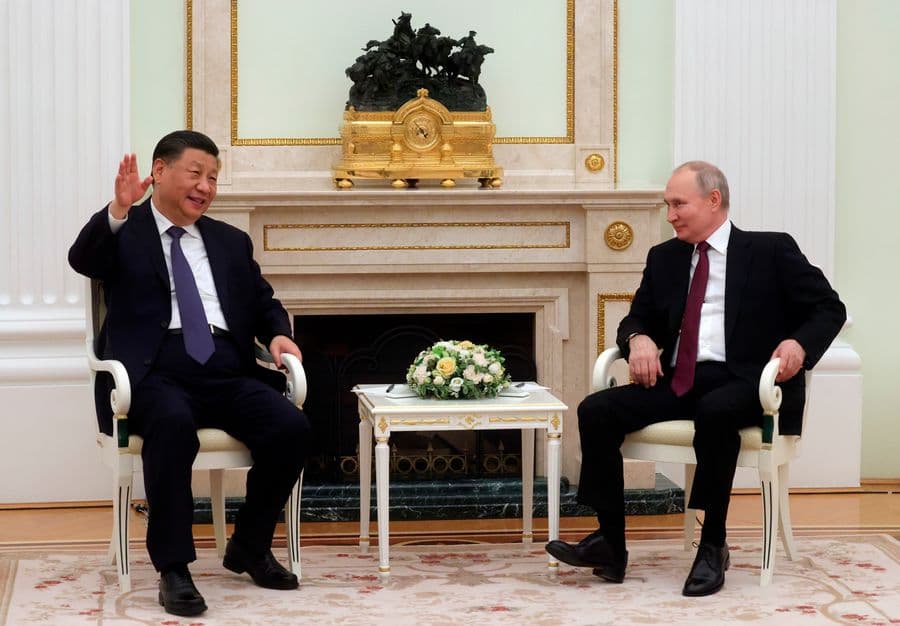
In March 2023, the General Secretary of the Chinese Communist Party and China's national leader Xi Jinping visited Moscow to meet with President Vladimir Putin. Previously, the Chinese Foreign Ministry had released a Chinese peace proposal. While Ukrainian President Volodymyr Zelensky tried to adopt a positive tone toward what the Chinese had suggested, American Secretary of State Antony Blinken rejected the Chinese ideas, warning China not to become more involved in Russia's war effort.
After their talks, the Chinese and Russian leaders announced they had concluded agreements strengthening the Chinese-Russian relationship. Contradicting numerous previous Russian threats, Putin announced in Xi Jinping’s presence, “No winners in a nuclear war.”
Echoing Blinken's apprehensions, Western analysts expressed their concerns about possible/probable Chinese involvement in the Russo-Ukraine War. Unknown was: Did the two leaders agree on the Chinese providing munitions and weaponry, as Blinken fears, or did Xi Jinping dash Putin's hopes of that possibility? More promisingly, did Xi Jinping express skepticism about Russia's maximalist war aims, and did he pressure Putin to move toward a negotiated peace?
Whatever their private conversations have concluded, no matter what understandings Xi Jinping and Vladimir Putin have reached, NATO will continue to back Ukraine diplomatically, financially, and with weapon transfers while not militarily participating in the conflict. However, more is needed. The Putin-Xi Jinping meeting has placed the diplomatic ball in the NATO-Ukraine court. Regardless of how the 2023 Ukrainian offense plays out, NATO cannot limit itself to supplying money and arms to and cheerleading for Ukraine. NATO must respond with its alternative vision to Vladimir Putin and the Russian government's maximalist Russo-Ukraine War aims. The West cannot accept the imposition of a most virulent form of Russian imperialistic conquest on Europe and the World.
For centuries, the United States has played a crucial role in influencing the course of international diplomacy, as evidenced by the following:
- The 1816 Monroe Doctrine saved the Western Hemisphere from 19th-century European imperialism and the ravages of the World Wars.
- The 1899 American-initiated 'Open Door' policy kept Imperial China from dismemberment by the Japanese and the European imperialists.
- President Wilson's '14 Points' defined the Allies' First World War aims and served as the basis for the 1919 Versailles Peace Treaty.
- The 1941 Atlantic Charter, numerous diplomatic conferences leading to the 1945 United Nations Charter, the Marshall Plan, and the rebuilding of Japan established the post-World War Two world order.
The impact of all these past initiatives shows, once again, the decisive role that America can play.
In 1815, at the Conference of Vienna, European diplomats negotiated a European international order that ended the 18th century's almost continuous wars and initiated nearly one hundred years of largely peaceful world progress. In 1945, American diplomats, in cooperation with diplomats from around the world, established a framework and a diplomatic apparatus that kept the Cold War from becoming a cataclysm and allowed unprecedented progress for the world's peoples.
These efforts to create new orders between nations only sometimes succeed. The 'war to end wars' and its 1919 Versailles Peace Treaty, so initially promising, led to the rise of international Fascism, the Nazi horror, revolutionary Soviet Communism, and, eventually, World War II. The formulation of a new relationship between nations risks failure. However, the alternative of not attempting such a needed reformulation often results in a worse outcome. Consider the unaddressed problems occasioned by the collapse of Soviet Communism and the end of Maoist Communism that the World is now experiencing.
In the 21st century, Russia has pursued its cruel, heinous neo-imperialistic aggression in Chechnya, Georgia, and now Ukraine. To date, America and the West have challenged this abomination with unity, sanctions, and transfers of weaponry. Now the Western coalition should go further and define its vision of an opposing new world order based on the principles of liberal democracy.
Robert (Bob) Purssell is a Massachusetts Institute of Technology graduate, Bob worked in the defense and semiconductor industry first as an engineer and subsequently as an engineering manager. Currently retired, he writes novels and gives talks on military and historical events.

The Services Do Not Need a Four-Star Autonomous Warfare Command
By Steven Wills • RealClearDefense
Honor Them While There Is Still Time
By Jeffrey Rosales • RealClearDefense
From Siberia to Fairford: How Operation Spider’s Web Has Changed the Rules of Airpower
By Frank A. Rose • RealClearDefense
Faster Simulations, Better Defense Decisions
By Rut Lineswala • RealClearDefense
Will HASC Have an Oversight Subcommittee in the Next Congress?
By Christopher J. Bright • RealClearDefense
Hegseth Barred Trans Troops. Military Boards Are Rejecting Those Orders.
By NYT
Closing the Sea: Lessons from Ancient Mediterranean Blockades
By DeCasien, CIMSECFrom Siberia to Fairford: How Operation Spider’s Web Has Changed the Rules of Airpower
By Frank A. Rose • RealClearDefenseFaster Simulations, Better Defense Decisions
By Rut Lineswala • RealClearDefense
Bombers Could Have a Major Air-to-Air Combat Role
By Joseph Trevithick, The WarZone