
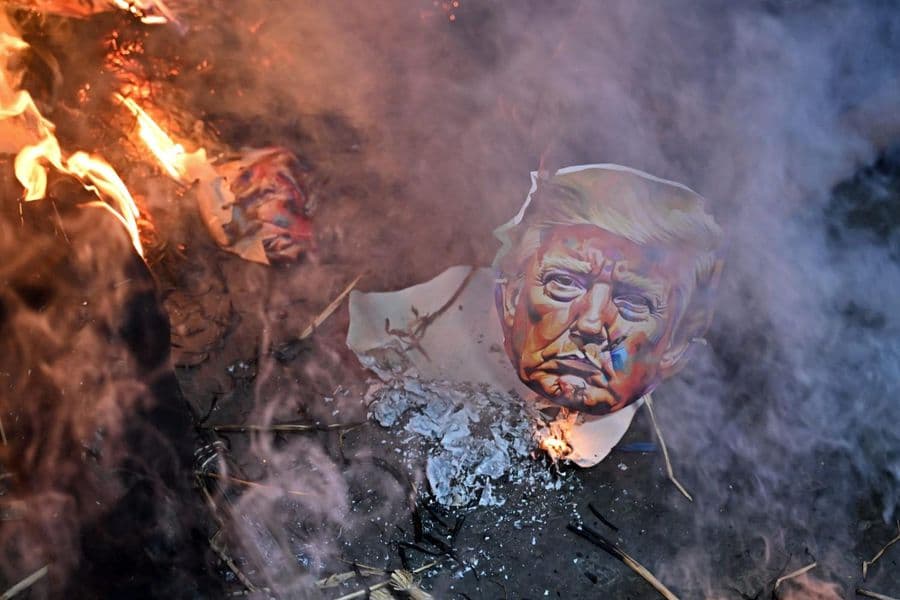
Trump's Method Is Not Madness
Last updated 03:47 PM EDT • Read time: 6m
Deliberate disruption and manufactured tensions have proven
surprisingly effective in advancing U.S. interests across multiple fronts.
Critics of Donald Trump’s policies, and that includes almost everyone with a voice in public space, have created an echo chamber powerful enough to drown out any counter-opinion. Yet, the question remains an interesting one – is there a method in Trump’s madness? Paulo Coelho’s words remind us about the pitfall of being a slave to expected behaviour, “If someone isn’t what others want them to be, the others become angry.” Fear and helplessness are the usual creators of anger. What is Trump threatening and what makes his detractors feel helpless?
Trump is using the tactic of “creating a crisis to solve a problem” to handle intractable issues. Starting a war is part of this strategy; wars, including economic wars, enlarge the sphere of permitted actions beyond what is allowed in peacetime.
Joe Biden imposed sanctions on Russia when it invaded Ukraine. These sanctions were ineffective against the Russian economy or its war efforts because of weapons support from Iran and North Korea, technological and trade support from China, and oil imports by India. The Ukraine war drifted into a war of attrition draining U.S. and European resources. It benefited China in every possible way, from taking a dominant position in Sino-Russian relationship to creating a rift in NATO as well as a trust deficit between the United States and the European Union. Trump’s policies have pushed NATO nations to agree to a defence budget increase while China, after a bout of tariffs and counter-tariffs, is back to negotiations with the United States.
President Donald Trump meets with Secretary of State Marco Rubio and Vice President JD Vance before a call with Russian President Vladimir Putin, 18 August 2025, in the Oval Office (Daniel Torok/Official White House Photo)
Or take the case of India. Successive U.S. presidents watched helplessly as India maintained its barriers on imports from the United States while enjoying the U.S. markets for its exports, resulting in huge trade imbalance. Trump got an opportunity to create a trade crisis when India dramatically increased imports of Russian oil, ignoring U.S. sanctions. For Trump, the apparent crisis in Indo-U.S. relations may be the means for confronting head-on the old policy of ignoring the differential trade policies of the two democracies towards each other.
Take the even more surprising case of Pakistan, with the United States having twice played host to the military chief from the Islamic country that has shifted from being a protégé of Washington to that of Beijing over the years. Trump, giving up the pretence of dealing with the de jure but ineffective civilian leaders, has recognised the de facto situation in Pakistan that it is Field Marshal Asim Munir who is deciding the policies of the country. Distancing Pakistan from China may be vain hope, but luring the military leader with promises of oil and mineral exploration is better than a policy of acquiescence to a “given situation”. China’s investments in the China-Pakistan Economic Corridor, part of the Belt and Road Initiative, slowed down in the last few years, but Xi Jinping, not being one to give up easily, has offered “CPEC II” to diversify China’s entanglement in Pakistan from economy to agriculture, resource access and market penetration. Pakistan’s Prime Minister Shehbaz Sharif is expected to visit China to sign the CPEC II agreement, and Trump’s overtures will contribute to a trust deficit in such talks.
Trump’s disruptive policies have met with considerable success with countries in China’s increasingly antagonistic neighbourhood. Japan has finalised a trade deal with the United States, settling tariffs at 15% with Japan’s PM calling it a “new Golden Era for Japan and the United States”. Shares of Japan’s auto makers surged after the deal. The agreement with South Korea also sets tariffs at 15% with its new President Lee Jae-myung singing praises for Trump and seeking his help in dealing with Kim Jong-un of North Korea. Trump met with the Philippines’ Marcos and settled tariffs at 19% promising to “work together militarily”. A deal with Indonesia lays down a 19% tariff, with President Prabowo Subianto calling it a “new era of mutual benefit.” The deal with Vietnam for 20% tariffs has been called a “balancing act between the United States and China”.
Elsewhere, Australia celebrated its success in remaining at 10% tariff, calling it an outcome of “the cool and calm way we have conducted diplomacy with the United States.” The European Union had a “handshake trade deal” with Trump, settling tariffs at 15% for EU exports to the United States while agreeing to pass legislation for zero tariff on imports from the United States. While the final deal with Canada is still in the pipeline, Prime Minister Mark Carney has agreed to drop some of the retaliatory tariffs on the United States.
Even regarding non-tariff issues in foreign policy, Trump can count as his success the setting back of the Iranian regime’s nuclear ambitions. His unwavering support for Israel has further weakened Iran’s position in the Middle East, in the aftermath of the fall of Assad’s regime in Syria and with Hezbollah and Hamas chastised and in disarray.
Domestically, the crisis creation approach has helped cut down the Biden-era illegal immigration rates drastically. Though the exact amounts remain debatable, Elon Musk’s DOGE did find and eliminate substantial wasteful expenditure. The anti-hydrocarbon movements were enriching China by enabling its near-monopoly over solar panels and wind turbine manufacture, even as China was frantically adding new coal-based power generation. Trump’s unabashed support for continued use of hydrocarbons will weaken that contradictory approach. Trump’s deal with the Houthis in Yemen has not worked out as intended but has shown that this terror group is vulnerable under U.S. attacks.
The world still has more than three years of Trump’s tenure as the U.S. President and his unorthodox policy of problem solving through crisis creation. World leaders had better keep reminding themselves that they cannot expect any more free lunches from the United States.
Born in 1949 in India and living there ever since, R. N. Prasher has post-graduate degrees in physics and economics and a degree in Law. His work experience varied from teaching physics in a college to 34 years in the highest civil service of India, the Indian Administrative Service (IAS).
This article appeared originally at Lowy Institute's the interpreter.

The Services Do Not Need a Four-Star Autonomous Warfare Command
By Steven Wills • RealClearDefense
Honor Them While There Is Still Time
By Jeffrey Rosales • RealClearDefense
From Siberia to Fairford: How Operation Spider’s Web Has Changed the Rules of Airpower
By Frank A. Rose • RealClearDefense
Faster Simulations, Better Defense Decisions
By Rut Lineswala • RealClearDefense
Will HASC Have an Oversight Subcommittee in the Next Congress?
By Christopher J. Bright • RealClearDefense

Hegseth Barred Trans Troops. Military Boards Are Rejecting Those Orders.
By NYT
Closing the Sea: Lessons from Ancient Mediterranean Blockades
By DeCasien, CIMSECFrom Siberia to Fairford: How Operation Spider’s Web Has Changed the Rules of Airpower
By Frank A. Rose • RealClearDefenseFaster Simulations, Better Defense Decisions
By Rut Lineswala • RealClearDefense
Bombers Could Have a Major Air-to-Air Combat Role
By Joseph Trevithick, The WarZone