
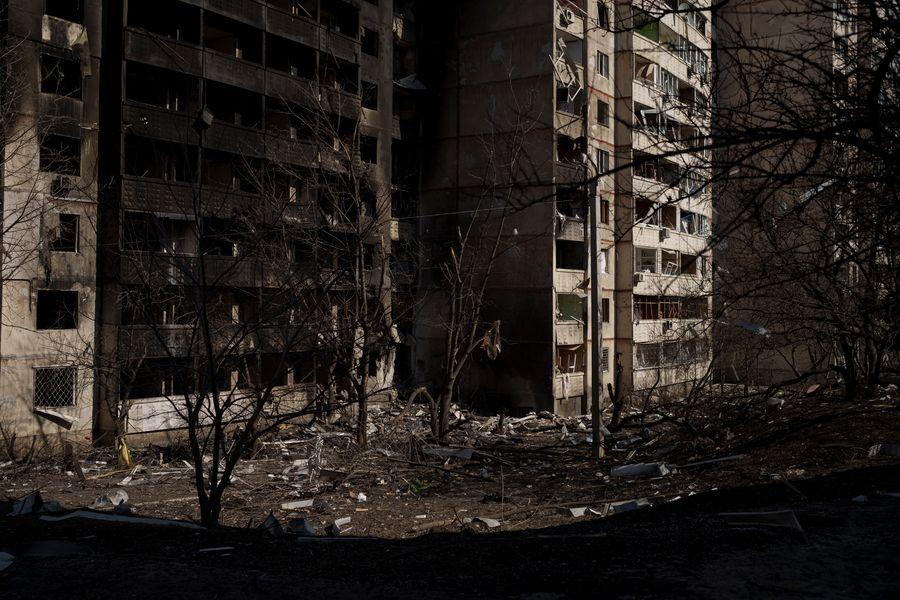
War in Ukraine: How This Might End
Published March 25, 2022 • Read time: 6m
There are many ways Putin’s invasion could pan out. All of
them ultimately involve Ukraine accepting concessions.
A month since Russia invaded Ukraine, the conflict has ground to a bloody stalemate. Yet there seems little prospect, at this point, of the conflict stopping any time soon. But how might it eventually end?
Complete military victory by Russia is looking increasingly unlikely, at least in terms of Moscow’s avowed objectives: demilitarisation of Ukraine and the overthrow of the Zelensky government (depicted as de-Nazification – a catch-all Kremlin slogan for uprooting its adversaries).
Ukrainian forces have performed much better than expected. They have proved tactically adroit in defence, despite ostensible Russian military superiority. Bolstered now by Western supplies of equipment, it is hard to see Ukraine being crushed militarily – unless Russia ups the ante again by using chemical weapons or tactical (battlefield) nuclear weapons.
If demilitarisation of Ukraine currently looks improbable, so too does the ouster of President Volodymyr Zelenskyy, who has proved a more capable and popular leader of his people at war than in peacetime.
But if Moscow remains far from achieving its original goals, Kyiv still has its back to the wall, fighting for national survival. Russia might not be able to subjugate its near neighbour, yet Ukraine lacks the capabilities to forcibly eject Russian forces from its territory.
That suggests then, the warring parties, at some point, either having to accept a ceasefire and negotiated settlement or digging in for a protracted military standoff.
Such an impasse would amount to a “frozen” conflict, as prevailed for decades between Armenia and Azerbaijan over the contested territory of Nagorno-Karabakh, with ongoing low intensity clashes across disputed lines of control. Such standoffs, leaving key underlying differences unresolved, are inherently unstable – as events in the South Caucasus showed.
The Missing Seats at the Table
Russia Says Its Defenses Intercepted Over 1,300 Ukrainian Drones
How Seoul’s Break With Kyiv Serves Trump’s Russia Turn
The First Test of Peace Lies in Ukraine's Borderlands
How realistic, then, is the prospect for a ceasefire and negotiated settlement? Not encouraging, at this stage anyway.
Russia and Ukraine are already engaged in officials talks, although little real progress is evident. Meanwhile, Turkey and Israel have attempted to mediate at the political level – so far, to no avail.
There are understandable doubts about Moscow’s sincerity. Russia may be feigning interest in a diplomatic solution in order to stave off further sanctions (and possibly appease China), using the time to regroup and fight its way into a better negotiating position.
And there are big differences for the two sides to bridge. Russian demands include Ukraine forswearing any ambition to join NATO, and instead accepting neutral status; acceptance of Crimea’s incorporation into Russia; and recognition of the Donetsk and Luhansk independent “statelets”.
Ukranian President Volodymyr Zelenskyy has proved a more capable and popular leader of his people at war than during peacetime. Pictured during an address on 20 March 2022 (President of Ukraine/Flickr)
None of these demands is palatable for Kyiv. And indeed, there’s no talk of surrender in Kyiv, but rather continued defiance.
Yet, in expressing his readiness to talk to Moscow, Zelensky has acknowledged that Ukraine is not going to become part of NATO anytime soon, thereby implicitly accepting that Ukraine will be a neutral state.
And to stop the war, and prevent further destruction, Kyiv may eventually have to accept Ukraine’s limited partition, at least de facto. This would involve swallowing as an unpalatable reality (for now, anyway) Russia’s annexation of Crimea and the “independence” of Donetsk and Luhansk – and, as well, possible loss of the land bridge linking them along the Sea of Azov (assuming Mariupol falls under Russian control).
Yet, besides a ceasefire and the withdrawal of Russian forces, Ukraine will understandably demand robust security guarantees in return for accepting neutrality – and this could prove the real sticking point.
To have any credibility – since Russia has already breached earlier formal undertakings to respect Ukrainian sovereignty and territorial integrity (embodied in the 1994 Budapest Memorandum, not to mention the UN Charter) – Kyiv will insist that such security guarantees are legally binding, enforced by its Western supporters, especially the United States.
This, though, would be problematic, since it would effectively require offering Ukraine the kind of ironclad security guarantee promised to allies under NATO’s Article 5 – a quasi-NATO membership status which Moscow would certainly not countenance.
Drawing on the Austrian model, Ukraine might instead adopt armed neutrality status backed by political undertakings from the United States, United Kingdom and France guaranteeing its security – but coupled with the carrot of eventual European Union (but not NATO) membership, thereby enmeshing it more into Europe. Whether or not Moscow would accept this would depend on the circumstances in which any deal is struck.
Surveying this unpalatable range of options, optimists see the answer lying instead in a change of leadership in Moscow. Currently, though, there seems little prospect of this.
Popular discontent among Russians may grow as economic hardship deepens – along with grief at Russia’s mounting casualties. But the Kremlin’s enormous repressive force can be relied on to keep any unrest in check.
More significant is the mood within the ruling elite around Putin – and this is harder to discern. Putin’s recent public comments on Ukraine have shown signs of “bunker mentality”, reflecting his relative (and self-imposed) isolation over the past two years. And his public Stalin-esque humiliation of key security advisers ahead of the Ukraine invasion was sobering. This may reflect Putin’s confidence in his own power, yet it could breed growing resentment among erstwhile allies in the Kremlin – with political implications.
In the opaque world of Russian politics, change could come quickly – or not at all.
Ian Hill is a retired senior career diplomat in the New Zealand foreign ministry. In the course of his 42 years in the diplomatic service, Mr Hill served three times in Moscow, twice as Ambassador (2009–12 and 2016–20). He also served as Deputy Head of Mission for five years in Washington DC, and held other senior foreign service roles in London and the Pacific. Mr Hill served in several senior foreign ministry positions in Wellington, including as Director for European Affairs, and was also the Prime Minister’s foreign affairs adviser from 1993–95. He is currently Adjunct Professor in the Centre for Defence and Security Studies at Massey University.
This article appeared originally at Lowy Institute's the interpreter.

When Losing Control of AI Becomes a Weapon
By Yunus Emre Tumen • RealClearDefense
International Allied Reliability of States: Criteria and Evolution
By Sergey E. Ivashchenko • RealClearDefense
Your Military Paycheck Has an End Date
By Sean Ofeldt • RealClearDefense
Masters of Command
By Travis A. Karnes • RealClearDefense
A Sweet American Original
By Greg Maresca • RealClearDefense

Monty: Riding the Pendulum
By Zachery Thomas, DODReads
Sign of the Times: CCAs Dominate a Major Fighter Conference
By Bill Sweetman • The Strategist (ASPI)
Marines Want Naval Strike Missiles With Double The Range
By The WarZone
U.S. Navy Targets 79 New Cutter-Based FF(X) Frigates
By A. Servaes, Global Defense
The Hegseth Grenade: A Sea Change at Newport
By Robert C. Rubel, CIMSEC