
Who Is Winning the Drone Arms Race?
Last updated 07:45 AM EDT • Read time: 6m
On 4 September 2025, China held a large parade showcasing their advanced military equipment, including a variety of combat drones. They included land drones such as “Robowolves”, small quadcopters, “wingman” air drones (that accompany jet fighters), naval drones, and a AJX-002 giant submarine prototype. China claims that many of these drones have advanced Artificial Intelligence (AI) capability, meaning they can operate independently of human controllers.
How do other nations compare?
FPV (First Person View) Drones
In the Ukraine war cheap FPV drones destroy expensive tanks and armored vehicles and carry supplies to the frontline. Ukrainian quadcopter drones programmed with AI target recognition cost about $US500 per unit.
According to Forbes, Russian maker Frobotics produce an entry-level drone for $315 and heavy lift (20-pound warhead) for $756.
The price of Chinese drones are not known, but comparative American drones are expensive - RQ-28A systems cost about $25,000 per unit, and the Skydio X10D drone costs about $34,000. Even the small, backpackable Switchblade 300 drones, equipped with a missile, averages about $70,000 per unit. The United States is trying to catch up, including training with 3D-printed drones, apparently with mixed results.
Russia also has developed drones that are operated by attached thin fiber-optic cables that are over six miles long. With no radio signal the drone is hard to detect, and impossible to jam.
Both sides in the Russian/Ukraine conflict use cheap 3D-manufactured drones to confuse and confound sophisticated radar systems. The drones are often used in conjunction with more sophisticated drones and ballistic missiles.
New Russian “Shahed” drones are no longer of Iranian origin. Each one now contains a camera, antenna and communication equipment made in China. They are being skilfully co-ordinated by a dedicated Russian drone unit called Rubikon.
Both Russia and Ukraine produce about four million homegrown drones of various types every year. Russia plans to manufacture about 32,000 Shahed drones this year.
Surveillance drones
America has invested a lot in high flying surveillance drones such as the MQ-9 Reaper drone (costing around $30 million) and dominate this airspace. The Chinese have numerous CASC Rainbow Drones that are cheaper, but seem more vulnerable to attack because they fly at a lower altitude.
On September 7, America’s first official autonomous combat drone, the YFQ-42A, was launched. China revealed stationary protypes at their military parade.
The Russian company KB Valkyriya recently demonstrated a RD-8 mothership drone controlled through Starlink. Meanwhile, Germany and Ukraine combined to produce a “Twister” surveillance drone that can detect artillery fire from up to 10 miles (15 km) away.
A special mention to the Austrian manufacturer Schiebel, who are producing powerful combat and surveillance Camcopter drones.
Artificial Intelligence
Military drone makers worldwide are competing to develop drones with AI capability that cannot be electronically jammed. In January 2025, the arrival of the Chinese-built Deepseek-R1, shocked America because it had been developed for only $6 million using cheaper, semiconductor chips, rather than California’s tech company Nvidia’s newest, fastest graphic processing units.
Most AI drone models demand high-performance graphics and specialized AI chips. Currently most drones have limited onboard computing capabilities, despite claims to the contrary.
Nevertheless, Ukraine is rapidly developing swarms of drones that use AI and have little human oversight at all.
Drone Interception
There is no guaranteed method to intercept and destroy combat drones, even those without AI capability. Russia and Ukraine employ a variety of techniques, that are more expensive than the drones themselves.
The American Patriot Air-Defense System is one of the most effective, but at cost of over a billion U.S. dollars per unit it is prohibitive. Russia’s Pantsir SMD-E at $US15million is more cost-effective, but doesn’t always effectively identify its targets – having already shot down a commercial airliner and a Russian helicopter.
Both Russia and Ukraine use drones to intercept other drones. Ukraine has developed a three-stage plan for interceptors, including the high-speed, modular “Bagnet” Drone.
Many countries are racing to develop anti-drone lasers. Ukraine’s “SlimBeam” laser prototype drone is being manufactured to counter small drones. Larger laser systems require vast amounts of power.
Portable anti-drone systems
Soldiers wielding anti-drone MANPADs (Man-portable air-defense systems) will soon be a feature of every army platoon. Even Russian President Putin’s bodyguard was pictured carrying one at a recent outdoor event.
The American Stingers ($130,000 plus missiles) have been around for decades and the Russians have tried to reverse-engineer them. Currently the most effective of new MANPAD is the Polish Piorun ($US2million each) which has shot down Russian jets and helicopters. Obviously, they are not economically viable against much cheaper drones - for now. In the meantime, troops on both sides in Ukraine carry shotguns.
Ground Drones
The United States has extensive experience using robot ground drones in Afghanistan and Iraq. This included the Talon military robot and the MARCbot. They have now manufactured a large range of ground machines, including the sci-fi robot dogs, such as those videoed patrolling the grounds of Mar-a-largo.
China has tried to integrate their Robowolves into training exercises with platoons, but they have severe limitations, including the inability to travel over rough ground.
Ukraine also has an entire unit of ground assault robots. They recently developed a multipurpose unmanned vehicle called “Berserk” which can travel about two miles and effectively jam an assortment of air drones.
Sea Drones
Both America and China are developing large, sophisticated unmanned submarines, including the Manta Ray and the AJX-002, respectively The Chinese AJX-002 is currently jet-propelled but may be developed as a nuclear submarine.
Russia claims to have a nuclear-powered unmanned Status-6 Oceanic Multipurpose Submarine, nicknamed Poseidon.
Australia just penned a deal with Anduril to supply a fleet of “Ghost Shark” autonomous submarines. Other nations including Japan, Türkiye and Sweden have manufactured small, but very capable unmanned submarines.
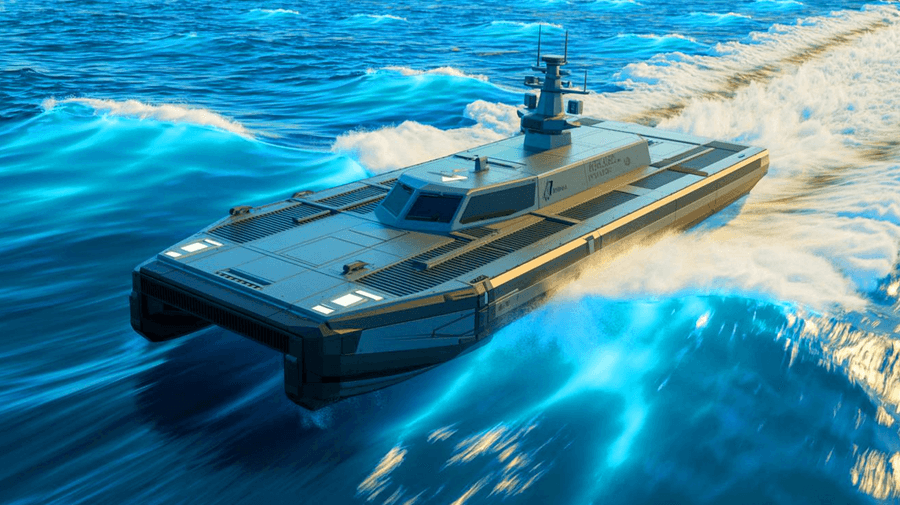
Recently the United States unveiled an incredible unmanned ship, the AIRCAT Bengal MC, capable of carrying 44 tons and travelling at around 50 knots. It has an autonomous navigation system and is armed with Tomahawk and Naval Strike Missiles.
Ukraine has an array of battle-tested sea drones including the famed Magura which has destroyed Russian warships and shot down Russian helicopters.
In summary the major powers including China and the United States are developing some advanced high-powered drones, especially naval drones. Ukraine has the largest array of cheap, combat-proven naval drones and quadcopter attack and surveillance drones. Western nations would do well to work alongside them, rather than disengage.
Patrick Drennan is a journalist based in New Zealand, with a degree in American history and economics.

ICE Is Not a Four-Letter Word
By Meda Parameswara Reddy • RealClearDefense
The U.S. Can Draw Down in the Middle East Without Going Blind
By Cudi Zerey • RealClearDefense
America Needs a Joseph Directive
By Jeff Ballabon • RealClearDefense
Partnering Decides Whether Flexible Military Construction Can Work
By Matt Russell • RealClearDefense
Eight Months of Epic Fury and Still No Internal Alternative
By Stephen D. Cook • RealClearDefense

GE Aerospace to Supply Engines for Two US Navy Flight III Destroyers
By Defense Post
U.S. Air Force Asks Industry for New Cruise Missile for Ukraine
By Michael Peck, DNews
First Flight II San Antonio-class Amphib Completes Builder’s Trials
By Mongilio, USNI N.
LGM-35 Sentinel ICBM on Track for 2030
By Kris Osborn, Warrior Maven
On American Destroyers, Avoid a Self-Inflicted Wound in Spain
By Defense News