
Why Does Putin Persist?
Published March 3, 2023 • Read time: 6m
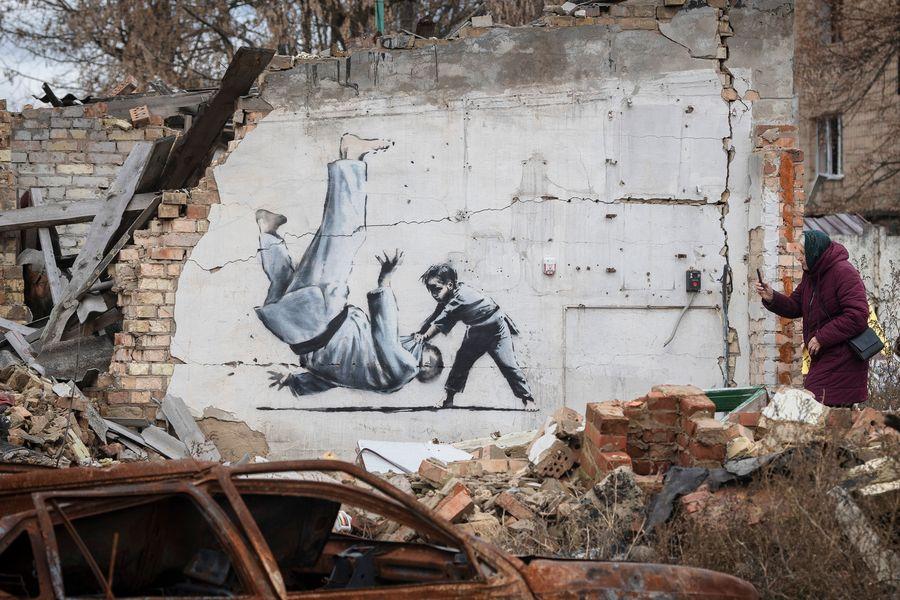
A woman takes a picture of artwork that might have been made by British street artist Banksy on a building destroyed by fighting in Borodyanka, Kyiv region, Ukraine, Sunday, Nov. 13, 2022. Another mural in Borodyanka was confirmed to have been made by the artist on his Instagram account. (AP Photo/Andrew Kravchenko)
For all his mistakes, the Russian leader knows the objectives
of Ukraine and its Western backers don’t exactly coincide.
Already it’s clear the invasion of Ukraine has proved a colossal miscalculation by Vladimir Putin and entirely counterproductive for Russia.
Putin wanted to pull Ukraine back into Russia’s orbit but instead has consolidated Ukraine’s national identity and alienated Ukrainians. He wanted to divide and weaken Europe but has ended up revitalising NATO and encouraging Western security cohesion. And as Moscow’s estrangement from Western states has widened, its dependence on China has deepened.
Coercive diplomacy would likely have yielded Putin more at much lower cost than this tragic war he unleashed.
However, when this war eventually ends, it will leave Russia, and Russians, poorer and weaker.
Why then does Putin persist?
Because he’s convinced that time is on Moscow’s side, and that Russia will eventually prevail.
And he remains obsessed with Ukraine – for reasons of national identity, nostalgic irredentism, fear of democratic contagion from a neighbouring democratic and increasingly Western-oriented Slavic state, and his determination to redraw Europe’s post-Cold War security architecture, curbing the further eastward expansion of NATO, restoring Russia’s strategic depth and reclaiming its sphere of influence around its western borders.
The Missing Seats at the Table
Russia Says Its Defenses Intercepted Over 1,300 Ukrainian Drones
How Seoul’s Break With Kyiv Serves Trump’s Russia Turn
The First Test of Peace Lies in Ukraine's Borderlands
Bear in mind Putin’s consistent overarching objectives: domestically, to consolidate the Kremlin’s centralised political authority; and internationally, to rebuild and assert Russia’s power, status and influence, both in its neighbourhood and beyond.
Russia’s leaders see the world through a lens of suspicion and insecurity. And the Kremlin elite bitterly resents the West, claiming it took advantage of Russia and ignored its interests after the dissolution of the USSR.
Coercive diplomacy would likely have yielded Russian President Vladimir Putin more at much lower cost than this tragic war he unleashed (kremlin.ru)
The Kremlin has cultivated a siege mentality and narrative of grievance. This myth of victimhood allows Putin to frame the Ukraine war as one of necessity, not choice: of Russia under assault from a hostile collective West.
The prospects, then, are for a long war. It will be difficult for either side to deliver a decisive military knock-out blow: both armies are strongly dug-in defensively. Yet both are determined to carry on fighting: it’s an existential struggle for Ukraine and, very likely, also for the Putin regime
Yet there’s little prospect of an early negotiated end to hostilities.
Neither side is ready or willing to compromise: indeed, their positions have hardened.
Ukraine’s war aims have expanded. Initially focused simply on surviving, Kyiv is now more confident, and understandably intent on recovering its full territorial integrity and sovereignty.
Meanwhile, Moscow has doubled down, and made plain it’s in Ukraine for the long haul.
It’s not entirely clear how Russia is now defining victory. But there has certainly been no retreat from the ambition to subjugate Ukraine. At a minimum, Putin will want to occupy the four provinces in eastern Ukraine that Russia illegally annexed last September.
Putin is calculating that he can out-wait Ukraine and its Western backers, thinking they will eventually grow weary of war and put pressure on Kyiv to settle.
That doesn’t seem likely right now. Last week, US President Joe Biden pledged America’s “unwavering support” for Ukraine “for as long as it takes”.
The unspoken question, though, is what ”it” means. Because the interests and objectives of Ukraine and of its Western backers don’t exactly coincide. While strongly backing Ukraine’s struggle to resist Russian aggression, the United States and Europe don’t want to find themselves at war with Russia.
This ambiguity is something Moscow might seek to exploit.
It could happen, say, if Russia comes under intense military pressure, and threatens to escalate and widen the conflict. Alternatively, Russia might cynically propose a ceasefire, seeking to sow division among Ukraine’s Western supporters.
This might lead some Western countries to press Kyiv to be realistic and pragmatic, settling for less than full recovery of all lost territories for now – especially Crimea.
Yet a ceasefire would only work for Russia – not Ukraine. It would leave Moscow controlling those parts of Ukraine it already occupies. It would keep Ukraine in play as another ”frozen conflict”. This wouldn’t give Moscow the subservient Ukraine it wants longer-term. But a divided and dysfunctional Ukraine would serve Russia’s interests meanwhile.
Where does China’s peace initiative fit into this?
There’s understandable scepticism in Western capitals about Beijing’s credibility as potential mediator, given its close strategic partnership with Moscow, and implicit support for Russia’s position on Ukraine. That key provisions of the broad-brush Chinese plan undoubtedly favour Russia, especially calls for a ceasefire and ending sanctions without demanding withdrawal of Russian forces, does nothing to allay such doubts.
China doesn’t want to see Russia defeated in Ukraine. But it’s probably not dismayed at the prospect of ongoing conflict there, keeping the United States and Europe preoccupied, while rendering Russia more dependent on China, giving Beijing increased leverage over its large continental neighbour.
The purpose of China’s peace plan is essentially political.
It burnishes Beijing’s global peacemaker credentials. The target audience is the Global South, of which China presents itself as champion, and many of whom anyway are ambivalent about the Ukraine war. Beijing might also be trying to appeal to those elements of European government and public opinion susceptible to calls to end the conflict.
But whether China will try to use its influence with Russia to nudge Moscow towards ending the Ukraine war, and how effective this might be anyway, is questionable.
Ian Hill is a retired senior career diplomat in the New Zealand foreign ministry. In the course of his 42 years in the diplomatic service, Mr Hill served three times in Moscow, twice as Ambassador (2009–12 and 2016–20). He also served as Deputy Head of Mission for five years in Washington DC, and held other senior foreign service roles in London and the Pacific. Mr Hill served in several senior foreign ministry positions in Wellington, including as Director for European Affairs, and was also the Prime Minister’s foreign affairs adviser from 1993–95. He is currently Adjunct Professor in the Centre for Defence and Security Studies at Massey University.
This article appeared originally at Lowy Institute's the interpreter.

When Losing Control of AI Becomes a Weapon
By Yunus Emre Tumen • RealClearDefense
International Allied Reliability of States: Criteria and Evolution
By Sergey E. Ivashchenko • RealClearDefense
Your Military Paycheck Has an End Date
By Sean Ofeldt • RealClearDefense
Masters of Command
By Travis A. Karnes • RealClearDefense
A Sweet American Original
By Greg Maresca • RealClearDefense

Monty: Riding the Pendulum
By Zachery Thomas, DODReads
Sign of the Times: CCAs Dominate a Major Fighter Conference
By Bill Sweetman • The Strategist (ASPI)
Marines Want Naval Strike Missiles With Double The Range
By The WarZone
U.S. Navy Targets 79 New Cutter-Based FF(X) Frigates
By A. Servaes, Global Defense
The Hegseth Grenade: A Sea Change at Newport
By Robert C. Rubel, CIMSEC