

The Gulf of Finland’s Forgotten Islands
By Ben Poulin • RealClearDefense
NATO’s New Spending Pledge Must Buy Real Energy Resilience
By Chuck Dockery • RealClearDefense
The Army Needs a Data Logistics Discipline Before the Next Surge
By Steve Ferenzi • RealClearDefense
2949 Marine Prisoners, Hostages, and Peacetime Governmental Detainees Since Our Corps' Founding
By Jon Couch • RealClearDefense
America Must Win the Biotech Race Against China
By Rob Maness • RealClearDefense
U.S. Air Force To Arm C-17 Cargo Aircraft With Cruise Missiles
By C. Jones, Defence Blog
How Marine Vet Ernest Langdon Became a Renowned Shooter & Gunsmith
By WATM
In First, Two CCAs Fly Air Combat Maneuvers Using Autonomy Software
By A&SF
Space Force Launches Mission Operations Center
By Jon Harper, DefenseScoop
Pentagon Mulls Placing Fleet of Military Satellites Around the Moon
By Ars Technica
Results for
Military Technology
Treasury's New Biotech Restrictions Could Hurt U.S. Security
China
China’s Epic Campaign To Steal America’s Secrets
China’s efforts, both legal and illegal, to acquire America’s intellectual property (IP) have long been a central theme in the U.S.–China relationship. A new book, The Great Heist: China’s Epic Campaign to Steal America’s Secrets, by David R Shedd and Andrew Badger, both formerly of the U.S. Defense Intelligence Agency, offers a welcome and up-to-date forensic analysis of the issue.
The authors cite the FBI estimate of IP theft (mainly by China) which has cost the U.S. economy up to U.S. $600 billion (A$860 billion) a year over the past decade. Industrial espionage has been a driving catalyst for the rise of China, even if other factors have also played a role. According to some estimates China may already have a technological edge against the United States. ASPI’s Critical Technology Tracker estimates that China now publishes the most high-impact research in 69 of the 74 technologies tracked, with the U.S. leading in the remaining five.
How did China, which just a few decades ago was a technological backwater, make such rapid technological progress?
A pivotal moment in the great heist story was China’s membership of the World Trade Organisation in 2001, according to Shedd and Badger. China’s membership became a global apparatus for collecting IP – and not the hoped-for transformation of China into a rule-abiding member of the international trading system.
In 2015, China launched an unprecedented industrial roadmap to foster technological self-sufficiency – the ‘Made in China 2025’ strategy. The goal was to progressively lift Chinese production towards self-sufficiency in ten technology sectors, especially electric vehicles, information technology, aerospace and aeronautical equipment, and biopharma and advanced medical devices. And espionage was a critical part of the toolkit for this strategy.
It wasn’t that long ago that Chinese spies were rank amateurs at industrial espionage, the authors say. No longer. The capabilities and resources of the Ministry of State Security – the lead organisation for industrial espionage, with some 300,000 people – swamp the U.S. intelligence community and its 100,000 people. The ministry even penetrated the CIA by recruiting a former case officer who informed on CIA agents in China, who were then assassinated.
China has a whole-of-society approach to collecting intelligence. All Chinese organisations and citizens must support, assist and cooperate with state intelligence efforts, according to Article 7 of China’s National Intelligence Law. In other words, there is no clear line between the public and private sectors when it comes to intelligence – a situation sometimes referred to as military–civil fusion.
The book discusses many startling cases, such as Tesla’s investment in China, which was uniquely achieved without a requirement to partner with a Chinese company. Tesla’s chief executive, Elon Musk, brushed aside the risk of its IP being stolen. As it turned out, a top Tesla engineer copied the Autopilot source code, which seemingly found its way to Xpeng.
Another case is that of what’s nicknamed the Los Alamos Club, the 162 or more scientists who returned to China after working at the the Los Alamos National Laboratory – a government-funded research facility known for its work on nuclear weaponry. The scientists then worked on Chinese research and development programs, such as hypersonic weapons, a field in which China now dominates the West. And the authors also point to the data breaches of the U.S. Office of Personnel Management and at Equifax, an American multinational consumer credit reporting agency.
Shedd and Badger feel despondent about inadequate attention by government, business and academia to China’s epic campaign to steal America’s secrets. They say that inattention stands in sharp contrast to China’s aggressive, take-no-prisoners approach to harvesting American IP.
The authors suggest a number of factors for this. First was America’s strategic distraction while it focused on the war on terror following the 9/11 terrorist attacks. Second, there was hubris, meaning that the U.S. did not consider China to be a serious adversary until very recently. Third is America’s dependency on economic cooperation with China, an important source of profitability for U.S. business. Fourth, in contrast to China, America’s private and public sectors are distinct universes, so it’s not always easy to get the private sector to take strategic competition seriously. Fifth, cultural sensitivities mean that the U.S. government wants to avoid accusations of racial discrimination.
The book finishes with an epilogue of a suggested seven pillar ‘counter strategy’. But the authors argue that what’s most important is a change of mindset. The Chinese view industrial espionage as part of an existential struggle. The U.S. needs to get over its passive defensive mindset in defending its IP.
John West is the author of Asian Century … on a Knife-edge and executive director of the Asian Century Institute. His career has included major stints at the Australian Treasury, the OECD, the Asian Development Bank Institute and Tokyo’s Sophia University.
Image of the inside of the Los Alamos National Laboratory as researchers work on a nuclear testing project in 1974: Atomic Energy Commission.
AI contributed no ideas to this article – John West.
This article appeared originally at The Strategist (ASPI).
China
Is the PLA Rehearsing To Keep U.S. Forces Out of a Taiwan Conflict?
China
America Must Win the Biotech Race Against China
U.S. Air Force
F-16s Build on Iran Combat Lessons to Prepare for China Threat
China
America Must Win the Biotech Race Against China
For years, American leaders have warned about the dangers of depending on China for products that are critical to our economy and national security. Semiconductors, rare earth minerals, telecommunications equipment, and energy technologies have all received well-deserved scrutiny. The medicines and biotechnology that underpin public health deserve the same attention, and the competition in that field is moving faster than many policymakers realize.
Today, China occupies a central position in the global pharmaceutical supply chain, particularly with regards to the key starting materials used to manufacture many essential medicines. Hundreds of drugs approved for use in the United States rely on at least one chemical produced solely in China, in part because Beijing has heavily subsidized its chemical and drug-ingredient producers, allowing them to sell at prices competitors elsewhere struggle to match. This creates a vulnerability that impacts not just healthcare but also our national security.
The United States has spent decades building military capabilities designed to deter conflict and respond to crises. But military power alone cannot eliminate every threat. In a major geopolitical confrontation or another large-scale emergency, access to medicines would be just as important as access to fuel or food. A nation without a resilient supply of essential pharmaceuticals might be exposed at a time when reliability matters most.
Beijing has repeatedly shown a willingness to use supply chain dominance in other sectors as a tool of statecraft, which is why building more resilient medicine supply chains at home and with our allies matters. But the challenge is no longer confined to pharmaceutical manufacturing. The CCP has also made biotechnology a national strategic priority, and it is treating it like one.
China has spent years investing heavily in biotechnology and is moving well beyond its traditional role as a low-cost manufacturer. Through streamlined regulation, centralized clinical trial networks, and deliberate investment in manufacturing and talent, China has built the world's fastest-growing drug innovation pipeline.
Chinese researchers are now producing innovative breakthroughs such as the world's first CAR-T cell therapy for solid tumors, and global pharmaceutical companies increasingly look to Chinese firms for promising new drug candidates. The value of biotechnology licensing deals originating in greater China reached nearly $138 billion last year, nearly ten times the level recorded just four years earlier. That is a measure of how far China has come, and a reminder that American leadership cannot be taken for granted.
Biotechnology is no longer simply a commercial enterprise but a strategic asset that will help shape economic, technological, and geopolitical power in the decades ahead. How America chooses to respond to this challenge will be one of the most important questions policymakers will face in the years to come.
China's unfair trade and intellectual property practices are real, and Washington should continue to hold Beijing accountable for them. But it would be a mistake to assume that theft is the sole reason for China's rise. Its regulators have built a system designed to move innovations from the lab to patients more quickly. America's answer should be to respond in kind.
The United States still holds the advantage. It remains the world’s leading source of new medicines and the largest destination for early-stage clinical research. But keeping that lead depends on leveraging not just our own research and development, but that of other countries. Last year, China accounted for nearly one-third of global clinical trial starts and it is rapidly closing the gap with the United States. Rather than ceding that ground, America should put China’s growth to work for our own biotech sector. That means clearing the way for promising early-stage research conducted in China to feed into the American drug development pipeline.
Early trials abroad can help identify the most promising treatments sooner, and licensing agreements give American companies the rights to turn those discoveries into finished medicines developed, tested, and approved on American terms. Those trials, and the data drawn from them, must meet the same regulatory and ethical standards we demand at home, and supporting domestic research and development should always come first. But writing off valuable data simply because it was generated in an adversarial nation would put the United States at a needless disadvantage. Beijing has never hesitated to capitalize on American innovation. We should not hesitate to capitalize on theirs.
At the same time, policymakers should make it faster and simpler to launch clinical trials in America, building on coordinated efforts like Operation TrialBlazer. They should also clear the permitting and inspection bottlenecks that slow new American plants, work with industry and allies to rebuild capacity for the chemical inputs essential medicines depend on, and protect the strong intellectual property rights that make long-term investment possible.
There is growing bipartisan recognition that leadership in medicines and biotechnology is a strategic matter. Policymakers should meet that moment by strengthening domestic innovation, investment, and production. In the competition for biotechnology leadership, preserving America's innovative edge is not simply good economic policy. It is a national security necessity.
Col Rob Maness (U.S. Air Force, ret.) is a geostrategic analyst, the former wing commander of Kirtland Air Force Base, and host of The Rob Maness Show.
U.S. Air Force
F-16s Build on Iran Combat Lessons to Prepare for China Threat
Iran war combat lessons are driving a faster pace of modernization for the U.S. Air Force’s F-16s.
The F-16s have been in the thick of the action during Operation Epic Fury, and will be again if strikes against Iran resume. Night take-offs, anti-drone missions, aerial refueling, and air dominance patrols are just a few of the missions prominently highlighted on X by U.S. Central Command. Not pictured: the specialized capability to kill any air defenses that go active with the radar-homing High-speed Anti-Radiation Missiles, or HARMs, an F-16 “Wild Weasel” specialty.
Behind the scenes, the U.S. Air Force is racing to incorporate Iran war combat sortie lessons into modernization plans to equip the F-16 fleet to take on China, or any future threats. From killing drones to fighting spectrum warfare, the next decade could place heavy demands on the F-16 fleet.
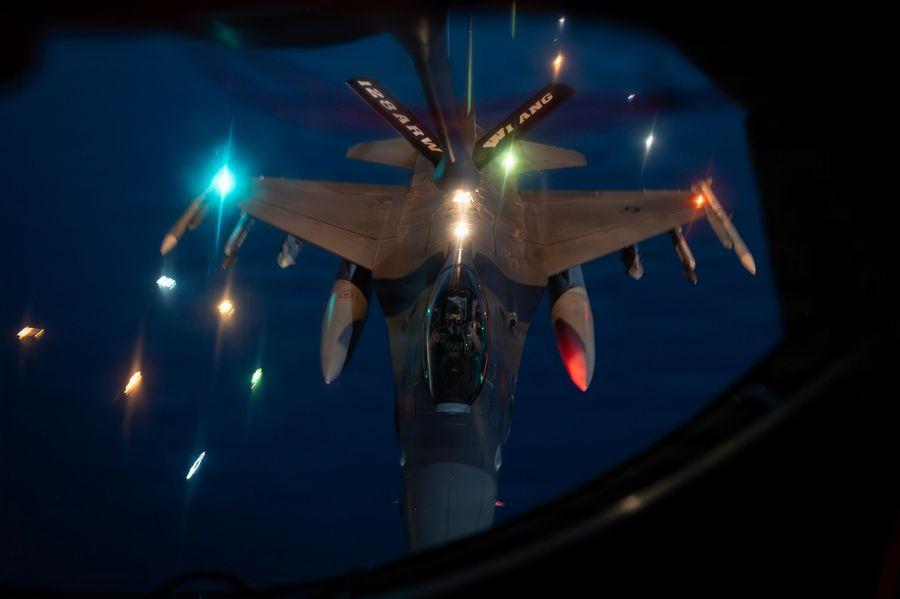
Priority one was to update the F-16 as a drone killer. CENTCOM showcased the latest anti-drone configuration in an August 25, 2026 photo of the F-16 on a twilight mission laden with extra fuel tanks, wingtip missiles, a targeting pod and two dispensers for small rockets carried on an underwing hardpoint. This was the result of almost two years of intensive work. For example, F-16s have been armed to take on drones with weapons like the AGR-20F Advanced Precision Kill Weapon System (APKWS), a precision-guided rocket specially modified in 2024 to enhance the F-16 anti-drone mission.
F-16s jumped in during a complex attack in November 2024 as the Houthis fired ballistic missiles, suicide drones and land-attack missiles toward the USS Abraham Lincoln and her strike group operating in the Red Sea. F-16s shot down multiple suicide drones heading for the Navy ship and, under the tactical guidance of USS Spruance, also shot down a land-attack missile.
“While the Viper has been equipped to carry up to 42 rockets for decades, the newest Standard Conventional Load (SCL) equips the F-16 to do so while also carrying four heat-seeking AIM-9X missiles,” said U.S. Air Force Maj. James Gregory, 77th Fighter Squadron Viper weapons officer, in September 2025. “These rockets have been used dozens of times to shoot down one-way attack drones in the Red Sea, doing so without using the more costly and longer-range AIM-120 missiles.
Full, detailed lessons from Operation Epic Fury are still close-hold due to ongoing operations. Simply follow the Air Force’s money trail to see how the service is feeding lessons from Iran and its proxies into its bold plans for the F-16 fleet.
Take the example of IVEWS, the Integrated Viper Electronic Warfare Suite. IVEWS is a major upgrade that provides a near fifth-generation quality of detection and targeting capabilities while inside a jamming environment. This is an internal EW system interoperable with the F-16’s AN/APG-83 active electronically scanned array radar, designed to the standard of Open Mission Systems Tier I. The job of IVEWS is to provide constant situational awareness for identification and geolocation of threats. These advanced capabilities enable the F-16 to use its AESA radar to track multiple targets at once, and to jam an active threat while targeting it for destruction. Think of it as a fifth-generation targeting capability aboard a fourth-generation fighter.
First flight of the new system took place on an F-16 at Eglin AFB in September 2024. Since then, Congress has responded to an urgent operational need request by the Air Force to speed up testing and fielding of IVEWS. Initial plans called for about 200 F-16s to receive IVEWS. However, the core of the F-16 fleet consists of about 608 later-block F-16s. The demand signal for F-16s is so strong that the wiser move now under consideration by the Air Force is to equip all the advanced blocks of F-16s with IVEWS.
Two F-16s caught by sudden Houthi air defense missile fire show why upgraded detection is vital. On March 27, 2025, two F-16s were flying alongside a larger strike package hitting Houthi ballistic missile manufacturing facilities in Yemen. As they departed, the Houthis unexpectedly fired six surface-to-air missiles at the pair of “Wild Weasel” F-16s. “You see this bright white light, and you see the rocket with the first missile launch, and it’s essentially directly underneath our position,” one of the pilots, Lieutenant Colonel William “Skate” Parks, told Air & Space Forces Magazine. The job of the Wild Weasels was to draw fire, and they employed high-G maneuvers and chaff to evade the ad hoc Houthi shots. Both pilots were awarded the Silver Star for their actions.
Pacific scenarios will plunge the F-16 into an intense electronic warfare environment. The F-16s will be active in hunting and killing Chinese aircraft and air defenses on land and at sea aboard China’s People’s Liberation Army Navy ships. Every tail needs to be ready to fight in a peer environment.
The F-16 is also a testbed for the Family of Affordable Mass Munitions, or FAMM – a new, affordable standoff cruise missile family first designed as a munition for palletized launch from large aircraft. In March, the test team at Eglin AFB completed a round of tests for a “lugged” munition, including loading, fit and function, high-risk envelope expansion, and live fire from an F-16. Anduril, CoAspire, and Zone 5 are all listed as vendors, and the Air Force plans to buy as many as 27,000 of the missiles over the next five years. “When you have a lot of them,” Air Force Chief Gen. Kenneth Wilsbach said of FAMM while testifying before Congress in June, then adversaries “will end up using their exquisite defenses to shoot those weapons down, and eventually we’re going to get some through.”
The upgraded capabilities of IVEWS, FAMM, and other programs such as inertial navigation and onboard computing build on lessons from the war with Iran to prepare F-16s for all future threats. Then there is combat attrition to consider. A ballistic missile attack by Iran against an airbase in Jordan lightly damaged eight F-15Es and one A-10. Regional commanders count on more F-16s to surge. That is why the Air Force is reportedly considering purchases of new F-16s in 2028 – the first new buys in 20 years. At this point, the nation can’t afford a penny-pinching approach to equipping the F-16 fleet.
Rebecca Grant, Ph.D., is a national security analyst based in Washington, DC specializing in defense and aerospace research and national security consulting. She has over 20 years experience working with the United States Air Force, United States Navy, and top aerospace clients.