
Die-Hards and a Lost Cause: Exploiting the New IRA's Legitimacy Problem
Last updated 06:59 AM EDT • Read time: 6m
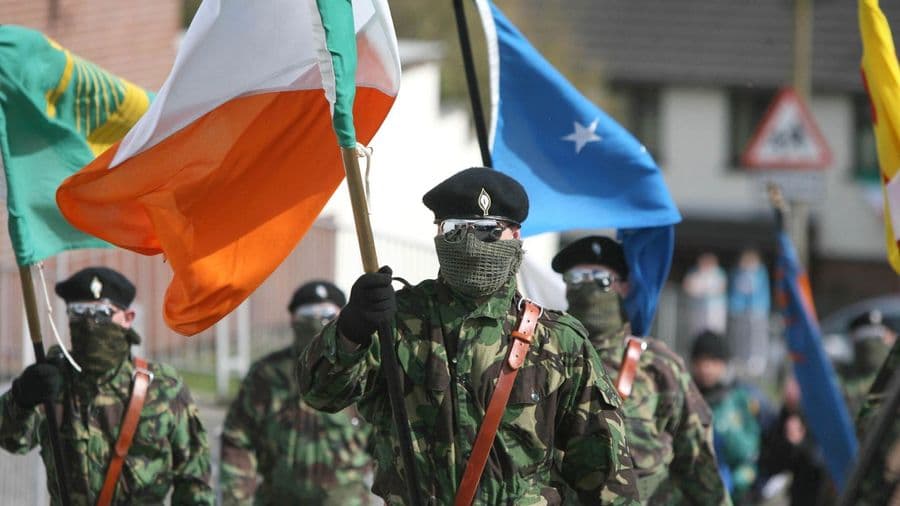
The New Irish Republican Army (New IRA) represents the largest threat to the still fragile peace of Northern Ireland. While President Biden’s trip to Belfast this past spring for the 25th anniversary of the Good Friday Agreement, which coincided with Northern Ireland’s terrorism threat-level being raised to severe and a spoiled New IRA bomb-plot, may have been the first time Americans heard of the New IRA, the group has plagued Northern Ireland for over a decade.
What is the New IRA?
The New IRA formed in 2012, when several violent dissident republican (VDR) factions, largely fragmented since the 1994 ceasefire, merged under one banner. In the merger, the Real IRA (RIRA), Republican Action Against Drugs (RAAD), and other VDRs formed a common IRA, popularly referred to as the New IRA. Shortly after, the New IRA claimed responsibility for its first attack, the murder of a prison officer. Since then, Northern Ireland has seen a significant increase in VDR attacks, with two police officer, two prison officers, and two British soldiers killed by 2017. The following years saw more attacks, with over 20 bombings and 40 shootings between April 2019 and March 2020, that continue to this day.
While these statistics are a far-cry from ‘The Troubles,’ the New IRA remains a substantial threat. What it lacks in destruction, it makes up for in extremist ideology. Unlike much of Irish republicanism since the dawn of the peace process, the New IRA remains committed to the ideology and tactics of the original IRA, justifying the use of political violence to achieve its long-term goals of (1) rejecting of the peace-process, (2) fighting to end “British rule,” and (3) unifying Northern Ireland with the Republic of Ireland.
Though it may share the goals and beliefs of the IRA, the New IRA does not share the strength or support of its predecessors. Because the group recognizes that it lacks the capability to achieve these goals, the New IRA has resorted to a long-term campaign of sporadic and small-scale attacks with the short-term objective of undermining the peace process to “ensure that Northern Ireland never exists in a state of peace.” While it’s unclear how, the New IRA envisions this approach may galvanize support for a full-scale armed rebellion, targeting police and security services to undermine the PSNI, the peace process, and gain notoriety and support.
A Fragile Legitimacy and a Questionable Mandate
The New IRA’s recognition of its limited tactical approach is coupled with insecure legitimacy. Due to the long-history of division within the VDR movement, the New IRA, like many of its predecessors, has consistently sought to establish its legitimacy by arguing for its “historical mandate” to claim the IRA banner and carry on the struggle. This self-proclaimed right to lead the VDR movement, though, is perhaps the New IRA’s greatest weakness.
Despite displaying the ability to strike targets throughout Northern Ireland, and even in Glasgow and London with letter-bombs, the New IRA is nowhere near as strong as the IRA of ‘The Troubles.’ Previous IRA contingents, such as the Provisional IRA, dwarf the New IRA in terms of size and capability. While the group has ample firepower, including hundreds of small arms, explosives, and bomb-making materials seized from weapons dumps throughout the country, its supply is largely limited to what it can steal. Most of all, the New IRA lacks perhaps the most crucial element of armed insurgency: support.
First, as the group has no significant state-sponsor or foreign-backers, it lacks any substantial financial or material support, unlike the IRA of the 20th century, forcing the group to rely on pretty crime to fund its operations. Most importantly, the New IRA lacks the legitimacy within Irish republicanism it so desperately seeks and needs in order to sustain any meaningful armed campaign.
Many old standard-bearers of Irish republicanism and the VDR movement see the New IRA’s calls to continue the struggle as nothing more than pointless violence in the name of a war long over. The former president of Sin Fein, for instance, has deemed the New IRA’s campaign as unrealistic and called instead for legitimate political participation as the “best for advancing republican goals.” This disillusionment extends to the dissident republican base, calling on the New IRA to stop its attacks and questioning its legitimacy as a continuation of the Provisionals.
Leveraging Weaknesses
For counter-terror professionals, these fractures in the VDR and republican bases, and the New IRA’s questionable legitimacy, present an opportunity to starve the group of oxygen. These divisions must be deepened, not by British or even PSNI authorities, but primarily by Irish republicans themselves, who, by in large, have turned away from political violence. This will not only sow further discord in the already divided VDR base, which, in turn, will limit its violent capabilities, but also detract from the supporters and sympathizers necessary for the group to sustain itself and grow. Finally, the base of a terrorist movement is often unmovable die-hards committed to the cause; this is not the case for the New IRA. Many of its members are unemployed youth, not radicals, making them easier to peel away if they, too, question the group’s legitimacy and prospects for success.
The New IRA’s potential and existing destruction demand attention. To ignore them would only allow three toxic mixtures to fester and possibly explode: a fragile peace, a few die-hards, and a lost cause. But they also should not be given the potent title and dangerous mandate they so desperately need to reignite armed struggle, that of the IRA. Rather, they should be called out for what they are: terrorists fighting a war that is already over, killing for a lost cause. If this, rather than the bitter history and lingering resentments they seek to revive, is the New IRA’s mandate, then they will follow the history of their predecessors: a slow death by gradual exhaustion, fracture, and dissolution.
Cam McMillan served as a field artillery officer in the U.S. Army and is an Iraq combat veteran of Operation Inherent Resolve. He is currently a Master’s candidate in global studies & international relations at Northeastern University focusing on conflict resolution. Cam's work has appeared in Real Clear Defense, 19FortyFive, The War Horse News, and Task & Purpose. The views expressed in this article are solely those of the author and do not represent any institutional affiliation.

Eight Months of Epic Fury and Still No Internal Alternative
By Stephen D. Cook • RealClearDefense
The Readiness Cliff: Pacific Lessons Drawn from the Middle East
By Brian McSorley • RealClearDefense
The Pentagon’s Real Modernization Problem Is Time, Not Technology
By Bruce Allen Lubbering • RealClearDefense
The World His Mother Opened
By Carlo J.V. Caro • RealClearDefense
Wake Island Lessons for Expeditionary Advanced Base Operations
By Brian J. Dunn • RealClearDefense
Wake Island Lessons for Expeditionary Advanced Base Operations
By Brian J. Dunn • RealClearDefense
U.S. Navy Expands Unmanned Mine Hunting
By Global Defense News
MRF-SEA Will Maintain Continuous Presence in the Philippines
By Mahadzir, USNI News
Space Force Weighs Proliferated Cislunar Satellite Constellation
By C. Albon, A&SF
America-Class Amphibs Enable New Ship-to-Shore Attack Strategies
By Warrior M.