
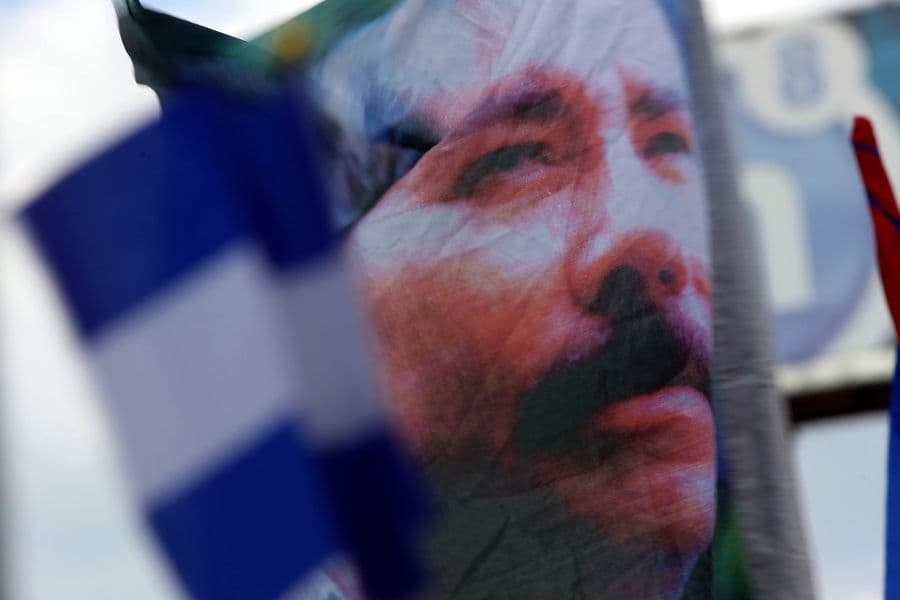
There's a Battle Between Autocracy and Democracy in America's Backyard and Democracy Is Losing
Last updated 06:59 AM EDT • Read time: 6m
Daniel Ortega, the former Sandinista revolutionary, has devolved Nicaragua into an authoritarian state at the expense of Nicaraguans and the region. His repressive grip began upon regaining the presidency in 2007 and slowly eroding the rule of law to ensure he could stay in power. His efforts increased after his brutal crackdown of anti-government protests in 2018, blatantly attacking any political opposition, free-press, and international NGOs. The result is, as one opposition lawyer put it, a state that “not even Orwell could have dreamed up," with virtually no free-press, organized political opposition or anti-corruption or human rights NGOs remaining. The people of Nicaragua carry the burden of this oppressive regime, but Ortega’s actions and policies are also a threat to the hemisphere. They range from exacerbating the existing migrant crisis in Central America to malign Russian influence in the region. To face this hemispheric conflict that threatens American interests, the U.S. must lead a coalition of partners in the region to empower Ortega’s democratic opposition and undermine his regime. Without a cohesive opposition and an effective subversion of Ortega’s consolidation of power, there is no way forward in Nicaragua beyond the Orwellian state that exists today.
Many observers point to the Sandinista revolution and contra wars of the 1980s as the root of Nicaragua’s contemporary strife. But it is important to recognize that Ortega is no more than one strongman in a long history of caudillos that have dominated Latin American politics. Ortega’s anti-U.S. rhetoric is not unique either, as decrying “Yankee-imperialists” has carried many authoritarian leaders to power, from Castro to Maduro. This rhetoric is not unfounded, as U.S. Marines occupied Nicaragua for over a decade, supporting the dictatorial regime that birthed the Sandinista revolution. But Ortega’s authoritarianism represents a significant backsliding in the political progress of the region. Following Ortega’s first presidency during the Sandinista era, Nicaragua operated a relatively stable democracy, with internationally observed free and fair elections and peaceful transfers of power between 1990-2001. Once Ortega returned to power, however, he began a measured strategy of eroding democratic institutions, checks and balances, and political opposition. His authoritarian nature became overwhelming in 2018 with his brutal crackdown against social security protests that transformed it into a movement against the repressive regime. The movement was crushed, with over 300 killed, 2,000 injured, and unknown numbers imprisoned, and Ortega unleashed the crackdown that led to the Orwellian Nicaragua today.
Outside of Nicaragua, Central American neighbors, many of whom are experiencing their own migrant crises, are saddled with some 200,000 refugees. Russia has capitalized on another authoritarian in the region by forming a military partnership with Ortega, in coordination with its regional malign influence in Cuba and Venezuela, that threatens hemispheric security. In addition to assisting Ortega with surveilling his population, Russia uses Nicaragua as a platform to launch cyber campaigns to create discord in democracies of the hemisphere. Furthermore, Russia has stationed troops, ships, and even nuclear capable bombers in Nicaragua to intimidate the U.S. and its partners. These moves represent a growing relationship between authoritarian states of the region and Russia at the expense of U.S. and regional interests.
At present, there is no viable path to resolution between the regime and opposition with Ortega still in power and the opposition in dismay. The U.S. must pursue a dual policy of supporting democratic opposition and a coercive campaign to undermine Ortega. The U.S. has many willing partners, including regional allies, much of the OAS, and countless Nicaraguan journalists, human rights workers, and opposition politicians. With this coalition, the U.S. must significantly increase support for pro-democratic Nicaraguans. The $15 million the U.S. has allocated to civil society, human rights organizations, and the free press is not enough. Many are in exile, and they need the financial backing of the U.S. to organize and gain credibility. Likewise, the U.S. must welcome political refugees from the Nicaraguan diaspora, not only to support victims of Ortega’s regime, but also to give safe harbor to democratic activists and highlight the oppressiveness of the regime on the world stage. Additionally, the U.S. must fund efforts that combat Ortega’s monopoly over information in Nicaragua to reach the population, affect public opinion, and revive the 2018 opposition. An effort as significant as the Radio Free Europe in the cold war may needed to meet the Orwellian state. This should mirror efforts used to penetrate disinformation and propaganda in other authoritarian countries, like Russia.
The U.S. must also increase its coercive campaign of financial and travel sanctions against Ortega and his closest allies both within and outside of Nicaragua. While the U.S. has levied sanctions against Ortega himself and much of Nicaraguan industry, regional partners must join these efforts. The OAS has been willing to condemn Ortega’s regime, but a more forward role for OAS members would reorient the conflict away from the “Yankee-imperialist” war that Ortega counts on. An international sanctions coalition would signal that Ortega’s regime is a threat to the peace and stability of the region, not just the U.S.. Again, the aggressive and comprehensive sanctions campaign against Russia can serve as a model. It is also vital that these sanctions continue to target parts of the Nicaraguan economy that do not impact humanitarian assistance. In fact, humanitarian investment should be increased by the U.S. and its partners to further show the support of the Americas for the rights of ordinary Nicaraguans.
These efforts should be similarly championed by public diplomacy to display the values of the U.S. and its partners in stark contrast to the repression of the Ortega regime. This coalition of American states is also vital in creating a bulwark against malign Russian influence that seeks to destabilize the region’s democracies. With this coordinated campaign, the U.S. and its partners can undermine Ortega’s rule and empower democratic opposition members. Mexico could be a good third-party arbitrator in any future negotiations, as it shares many U.S. policies and once backed the Sandinistas, but that is for a later time when negotiations are viable. It is only when the people of Nicaragua can have a voice that reconciliation can be achieved. Until then, the best we can do is support those who share our interests and our values.
Cam McMillan served as a field artillery officer in the U.S. Army from 2018-2022 and is an Iraq combat veteran. Cam is an assistant director of program administration at The Fletcher School of Law & Diplomacy at Tufts University and a Master candidate in global studies & international relations at Northeastern University. The views expressed in this article are solely his own.
Eight Months of Epic Fury and Still No Internal Alternative
By Stephen D. Cook • RealClearDefense
The Readiness Cliff: Pacific Lessons Drawn from the Middle East
By Brian McSorley • RealClearDefense
The Pentagon’s Real Modernization Problem Is Time, Not Technology
By Bruce Allen Lubbering • RealClearDefense
The World His Mother Opened
By Carlo J.V. Caro • RealClearDefense
Wake Island Lessons for Expeditionary Advanced Base Operations
By Brian J. Dunn • RealClearDefense
Wake Island Lessons for Expeditionary Advanced Base Operations
By Brian J. Dunn • RealClearDefense
U.S. Navy Expands Unmanned Mine Hunting
By Global Defense News
MRF-SEA Will Maintain Continuous Presence in the Philippines
By Mahadzir, USNI News
Space Force Weighs Proliferated Cislunar Satellite Constellation
By C. Albon, A&SF
America-Class Amphibs Enable New Ship-to-Shore Attack Strategies
By Warrior M.