
The Ankara NATO Summit: Europe's Moment of Strategic Responsibility
Published July 4, 2026 • Read time: 5m
The NATO summit in Ankara could become one of the most significant meetings in the alliance’s history. More than simply, another gathering of allied leaders, it is likely to reveal whether NATO can adapt to a fundamentally changed strategic reality. If it succeeds, the summit will mark the start of a stronger, reconfigured alliance. If it fails, it might signal the beginning of NATO’s gradual strategic decline.
For nearly twenty years, the debate over transatlantic security has centered on burden-sharing and, more recently, burden-shifting. Donald Trump’s first administration argued that European allies should boost their defense spending while retaining America’s primary role as Europe’s main security provider. However, during the second Trump administration, Washington is moving toward something more fundamental: burden-shedding in Europe to conserve our limited resources for Asia. How the allies respond to this change will determine NATO’s future.
Burden-sharing asks allies to contribute more, while burden-shifting expects them to take on greater responsibility. Burden-shedding goes a step further, shifting the primary responsibility for Europe’s conventional defense to European NATO allies, while the United States concentrates its limited military power where it matters most — the Indo-Pacific, where the threat is greatest. America will still provide the NATO nuclear umbrella, strategic intelligence, logistics, advanced capabilities, and key enablers, but Europe needs to become the main provider of conventional defense within the alliance. This shift is not due to frustration with Europe or political rhetoric, but to arithmetic – when it comes to America’s usable military power, the numbers don’t add up. The strategic assumptions guiding the country’s defense planning after the Cold War are no longer valid.
As Allies' Capabilities Grow, They Need To Work With U.S. on Nuclear Signalling
President Kennedy: MAD & the Lessons of Berlin and Cuba
The Pope of FEMA
Over-Feminization of Journalism and Modern Woke Reporting
For thirty years, U.S. strategy effectively rested on conflict sequencing. Although the United States no longer had enough forces to fight multiple major wars at once, planners could count on diplomacy, deterrence, alliances, and swift reinforcement to prevent simultaneous crises. Sequencing made up for reduced force size and allowed Washington to keep security commitments in the four key regional theaters outside the Western Hemisphere: Europe, the Middle East, the Korean Peninsula, and the Indo-Pacific.
That assumption is quickly falling apart. Today, the United States faces more coordinated threats from China, Russia, Iran and its proxies, and North Korea. The chance of simultaneous crises across four regions is no longer just a possibility. If conflict sequences go wrong, America can't just rapidly increase its combat power. Europe has realized that large-scale conventional war still remains possible, while Western defense industries have struggled to restock artillery ammunition, missile interceptors, and armored vehicles. The war in Ukraine has highlighted this reality. Every shipment sent to one theater reduces what's available for another. Strategic scarcity has become an operational reality.
Meanwhile, Russia learns lessons on large-scale combat operations, China continues building up its military, North Korea expands its nuclear and missile programs, and unrest in the Middle East keeps taxing American combat power. The challenge for U.S. strategy is no longer choosing which theater to prioritize but finding a way to maintain credible deterrence across all theaters simultaneously. In this context, shifting Europe’s priorities to conventional defense within NATO makes sense. This is not America’s withdrawal from NATO but an effort to strengthen the alliance by aligning responsibilities with strategic realities. European NATO allies have the economic capacity and population size to field sufficiently large conventional forces if they demonstrate political will. The United States cannot keep covering European shortfalls forever while preparing for a potential conflict with China.
That is why Ankara could be transformative. The summit will assess whether Europe is prepared to assume primary responsibility for NATO’s conventional defense, while the United States continues to provide capabilities only it can supply: nuclear deterrence, long-range power projection, intelligence, logistics, and high-end enablers. Such a division of labor would bolster rather than weaken the alliance. This strategic shift would allow the United States to concentrate its military resources on deterring China in the Indo-Pacific.
If European governments truly accept this responsibility, NATO can become more sustainable, resilient, and better equipped to face an era of multiple threats across multiple theaters. If they fail, the alliance risks weakening as American military resources are shifted to Asia. The choice facing NATO is therefore not between solidarity and abandonment. It is between adaptation and obsolescence. America’s military resources are limited, and its adversaries are increasingly coordinating across regions. There is no longer the luxury of assuming wars can be neatly sequenced. As strategists know, the enemy always gets a vote.
If NATO leaders truly embrace these new strategic realities, Ankara will be remembered not as the summit that weakened NATO, but as the moment the alliance reinvented itself and adapted to a far more dangerous world.
Andrew A. Michta is Professor of Strategic Studies at the Hamilton School at the University of Florida, a Nonresident Senior Fellow at the Atlantic Council in Washington, D.C., and a Visiting Fellow at the Hoover Institution at Stanford University. The views expressed here are his own.
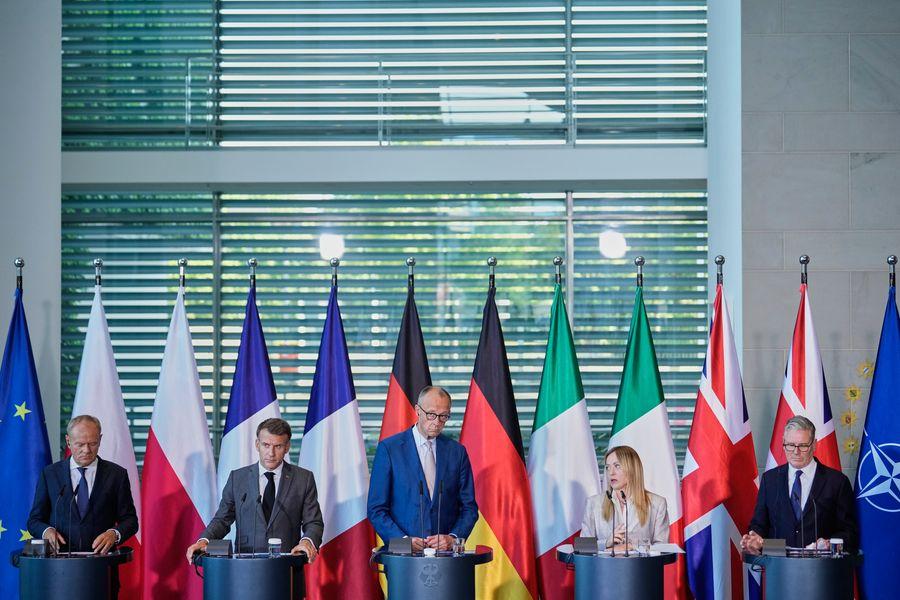
image: From left to right, Poland's Prime Minister Donald Tusk, French President Emmanuel Macron, German Chancellor Friedrich Merz, Italian Prime Minister Giorgia Meloni and Britain's Prime Minister Keir Starmer attend a press conference at the E5 NATO Summit in Berlin, Germany, Wednesday, June 24, 2026. (AP Photo/Ebrahim Noroozi)
Ending the Conflict with Iran
By Anthony Cowden • RealClearDefense
Going After the Cyprus Money Laundering Hub
By Lise Korson • RealClearDefense
Don’t Bet Against CMMC
By Thomas Graham • RealClearDefense
When Losing Control of AI Becomes a Weapon
By Yunus Emre Tumen • RealClearDefense
International Allied Reliability of States: Criteria and Evolution
By Sergey E. Ivashchenko • RealClearDefense
Coast Guard’s Updated Force Design Plan Includes Maven Smart System
By DS
F-22 Raptor Commands MQ-20 Avenger From the Cockpit
By K. Osborn, Warrior M.
ULA’s Vulcan Rocket Is Grounded for Third Time
By I. Klotz, V. Machi, Aviation Week
Tragedy That Convinced the Coast Guard It Needed Rescue Swimmers
By WATM
USAF Contracts Final KC-46 Lot of Original Production Deal
By Satam, The Aviationist