
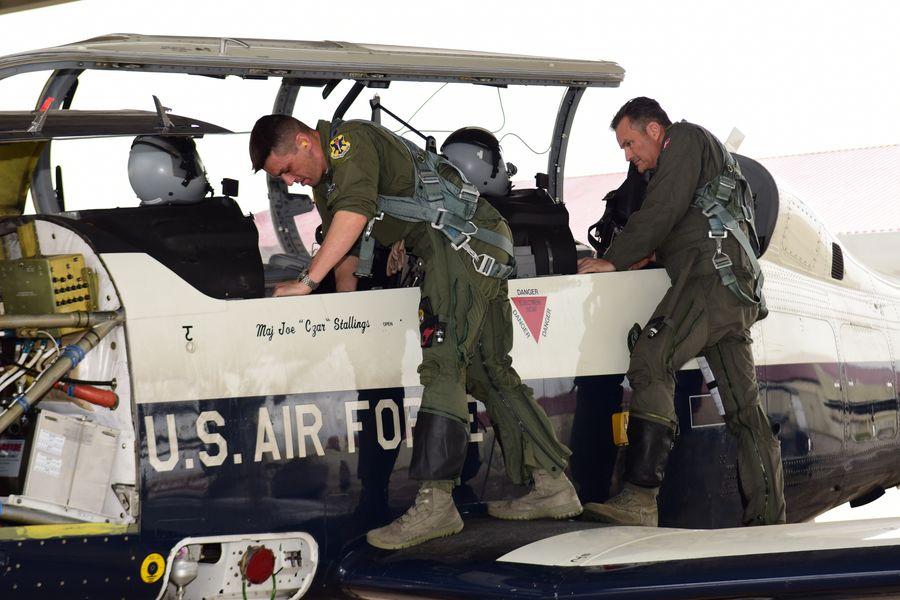
Instructor Pilots Wanted: Air Force Pilot Training Has Not Lowered Standards but It Needs Help
Published June 1, 2021 • Read time: 6m
The Air Force faces a pilot shortage that has been in the making for a decade. To combat the shortage, senior leaders have two tools: pilot production and pilot retention. The Air Force has made strategic policy choices over the last four years to abandon retention initiatives and increase pilot production. These policy decisions decreased student pilot training hours to produce more graduates and maintained the number of instructor pilots below requirements. Remarkably, Air Education and Training Command (AETC) held its standards for pilot training. Yet, policy proposals for the next iteration of the pilot training syllabus jeopardize instructor pilot retention and pilot production.
A recent article lamented the Air Force setting lower standards for pilot training, but this does not reflect the truth. Air Force pilot training maintains the same standard as in the past; students must demonstrate competence in all areas of flying before pinning wings on their chest. However, there have been shifts in airmanship and experience.
Over the past two decades, Air Force pilot training graduates fell in a tight band of quality. There was little difference between most graduates, with rankings closely clustered around the class average. Students were "overtrained" because most of the class reached minimum proficiency before the end of training. Trainees then used the remaining training hours to perfect airmanship and situational awareness. The pilot training syllabus allowed struggling student pilots to catch up to their peers in basic skills. At the same time, the remainder of the class worked on perfecting their airmanship and situational awareness. By the end of pilot training, most students finished with similar grades and skills, resulting in new pilots possessing both airmanship and limited experience.
Sign of the Times: CCAs Dominate a Major Fighter Conference
F-16s Build on Iran Combat Lessons to Prepare for China Threat
From Siberia to Fairford: How Operation Spider’s Web Has Changed the Rules of Airpower
The Revitalized Eagle: The Story of the F-15EX Procurement Surge
In 2018, the Air Force told AETC to produce more students without additional resources. To accomplish this goal, leadership cut the pilot training syllabus by 13% to the minimum sorties needed for a student to reach proficiency. This experiment resulted in three impacts.
First, some students continued to excel despite the shortened syllabus. Compared to the historical mean, some students outperformed their past peers and did so in less time. Pilot training slowly shifted toward updated technology, modern teaching methods, and tailoring flights to students' individual needs. Further, the Air Force invested heavily in accessions. Air Force programs such as the Rated Preparatory Program provide flying opportunities for those interested in becoming pilots. The Air Force also reviewed its selection criteria to find the highest correlation factors to pilot training success amongst the largest pool of candidates possible. The result leads to some graduates exceeding the standard, even with a shortened syllabus.
Second, struggling students do not catch up to their peers and gain airmanship. The pilot trainees who need help with the demanding pace of learning have only enough flight hours to reach competency. The failure rate is trending higher than in the past decade. From 2008 until 2018, about 8% of students per year failed to complete pilot training. For 2020 it was 11%, and the trend for 2021 points to the failure rate being even higher. There is a minimum accepted standard which the Air Force is unwilling to compromise, and rightly so. Yet, the below-average students who do graduate are not given the proper foundation of airmanship and experience, through no fault of their own, simply because they graduate with a shortened syllabus.
The above two impacts demonstrate AETC is maintaining standards. Still, the overall quality of pilot training graduates is no longer a tight band. The above-average students are slightly better than in the past, but the below-average students trend towards the minimum competency. Meaning, the average pilot training graduate's quality is more varied. Student pilots do not have time to gain airmanship and experience after they learn the basics of flying, which leads to the most significant impact of this pilot training structure.
Third, training costs have shifted from cheap training aircraft to more expensive operational ones. Pilot training graduates now require more sorties to qualify in their operational aircraft due to limited airmanship and experience resulting from the shortened syllabus. An estimate of the increased cost to the Air Force stands around $40 million based on the higher number of training sorties needed in the F-16, F-15, F-35, C-17, and KC-135.
The Air Force, to its credit, recognizes this structure is not sustainable and is already moving toward a solution. In the next iteration of the pilot training syllabus, the Air Force will increase the flight hours for trainees to give them airmanship and experience beyond the minimum competency. The Air Force expects a return to the tight band of quality and savings on follow-on training costs. But, there are still no additional resources given to pilot training, especially instructors.
When AETC implements the new syllabus, students will receive more flying hours. Consequently, either fewer students will graduate, or more instructors are needed to keep pace with the number of graduates the Air Force requires. As stated above, the Air Force faces a pilot manning crisis and must hold a steady, high rate of pilot production. If the Air Force is serious about maintaining pilot production, it must increase the number of instructor pilots assigned to pilot training.
The Air Force must also address the retention of instructor pilots. There are two main problems. First, an AETC assignment is perceived as detrimental to a career because a pilot will be out of their primary aircraft for at least three years. Moreover, there is a stigma that once you go to AETC, you will stay in AETC, which many instructors are unwilling to do. Second, instructor pilots are producing at max capacity with the current syllabus; therefore, an increase in training hour requirements without an increased instructor pilot pool will add work to the already overloaded instructor pilots.
To solve the stigma surrounding pilot training, the Air Force should incentivize instructors to choose pilot training assignments by offering them preferential placement afterward. Leaders should market this to allow pilots to volunteer for AETC assignments. Currently, only Mobility Air Force gives instructors preferential placement after pilot training; this should be a policy for all the major commands. Further, if operational units want consistently good pilot training graduates, those units must offer some of their best instructors to AETC.
One viable solution left to solve for the capacity and quality of pilot training is to increase instructor pilots. The Air Force has already tried to produce more pilots without increasing instructors, leading to inefficiencies with lower airmanship and experience for graduates. Once the new syllabus starts, the Air Force again faces a strategic choice between quality and quantity, and it does not have to sacrifice either.
The Air Force has maintained standards necessary for the foundation of its future pilot force. Still, it is not cost-effective to shift airmanship and experience onto expensive aircraft. For a sustainable solution to pilot training, the Air Force must remove the career stigma associated with AETC and increase the instructors available for pilot training.
Brian Kruchkow is a T-6A Instructor Pilot at Laughlin AFB, TX.
The views in this article are the author's own and not officially that of the U.S. Government or U.S. Air Force.

Batteries Can Power a Win for America in Super Intelligence
By Manisha Singh • RealClearDefense
Poland’s Fighter Fleet Is Growing: Can Its Training System Keep Up?
By Bruce Allen Lubbering • RealClearDefense
Why Iran is Not Vietnam
By Kevin Brown • RealClearDefense
Closing the Missile (Defense) Gap
By Jason Camilletti • RealClearDefense
Part of a Larger Secret, Hidden World
RealClearDefense
Sign of the Times: CCAs Dominate a Major Fighter Conference
By Bill Sweetman • The Strategist (ASPI)Closing the Missile (Defense) Gap
By Jason Camilletti • RealClearDefense
U.S. Navy Prepares for Third Zumwalt Hypersonic Upgrade
By C. Johnston, Naval N.
Pearl Harbor Hero Doris Miller Will Stay Namesake of CVN-81
By Mongilio, USNI News
Navy CCA Plans Will Not Wait For F/A-XX Next Generation Fighter
By The WarZone