
The U.S. Army's New A4 Bradley Variant Could Be a Killer
Last updated 10:29 PM EST • Read time: 3m
The A4 is an excellent stop-gap until the new Optionally Manned Fighting Vehicle goes into serial production.
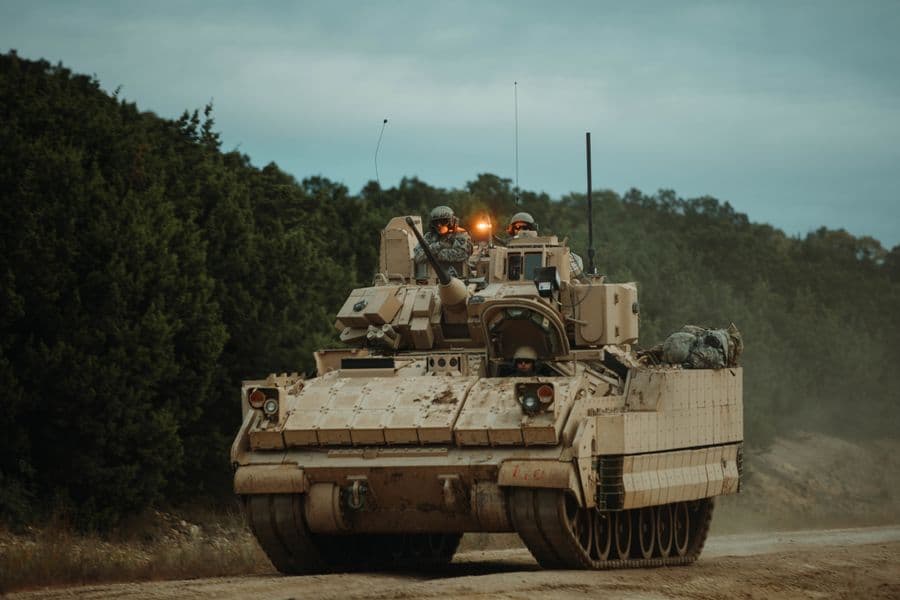
Despite being operational now for decades, the U.S. Army’s Bradley Infantry Fighting vehicle lives to fight another day, as evidenced by the continued arrival of newly-upgraded “A4” variants of the platform intended to bring new warfighting technologies to combat and help bridge the time gap until the Army’s new Optionally Manned Fighting Vehicle infantry carrier emerges in coming years.
BAE Systems has now delivered its seventy-fifth Bradley A4, a development which speaks to the continued combat relevance and viability of the war-tested infantry carrier. The newest A4, according to a BAE statement includes new digitized electronics, new networking systems and jamming components, among other things.
“Leveraging the lethality functionality from its predecessor, the Bradley A4 consists of full ballistic fire control hosted on a new central processing unit, aided dual-target tracking, automatic gun target adjustment, automatic bore sighting and hunter-killer capabilities,” a BAE Systems document on the Bradley A4 writes.
The new Bradley variant also has added acceleration potential due to having more horsepower and vehicle maneuverability technologies. It is armed with a Bushmaster 25mm cannon that fires explosive and armor-piercing rounds as well as the tank-killing TOW missile.
Interestingly, the A4 represents the latest iteration in a longstanding Army-BAE effort to sustain Bradley functionality and combat effectiveness over a period of many years. Previous upgrades have included the addition of reactive armor, new armor configurations and materials, a commander’s independent thermal viewer for targeting and data sharing and advanced ammunition able to tailor its explosive or targeting effects.
One conceptual focus for Army weapons developers upgrading the Bradley has, for many years, been the engineering of newer “multi-function” sensors which not only increase range but also fuse camera input from 360-degrees around the vehicle to optimize surveillance and targeting. These newer sensor systems, Army weapons developers have told The National Interest, often draw upon advanced computer algorithms and automation to augment targeting. Some of these algorithms include infrared search and track with both active and passive technical mechanisms with which to track targets
Using multi-pixel focal plane array technology and infrared detection, the sensors in development are designed for what one senior Army weapons developer called Hostile Fire Detection, or HFD; computer automation, or algorithms created to help organize and communicate incoming sensor data, then assists a human combat vehicle operator in locating targets and significant objects such as approaching enemy drones.
Other advantages to advanced, multi-functional integrated sensing on the Bradley include an ability to track multiple targets at once such as incoming enemy attacks from drones, armored vehicles or even artillery fire and anti-tank missiles. More consolidated, multi-functional sensors able to perform several otherwise separately performed tasks also bring the advantage of decreasing the hardware footprint on a combat vehicle, thereby increasing mobility and deployability.
Kris Osborn is the defense editor for the National Interest. Osborn previously served at the Pentagon as a Highly Qualified Expert with the Office of the Assistant Secretary of the Army—Acquisition, Logistics & Technology. Osborn has also worked as an anchor and on-air military specialist at national TV networks. He has appeared as a guest military expert on Fox News, MSNBC, The Military Channel, and The History Channel. He also has a Masters Degree in Comparative Literature from Columbia University.
This article appeared originally at The National Interest.

The First Test of Peace Lies in Ukraine's Borderlands
By Dennis T. Cosgrove • RealClearDefense
The VFW’s Gambling Addiction Victimizes Veterans
By Jack Yoest • RealClearDefense
Superintelligence Exposes a Gap in the Law of Delegated Authority
By Sue Ghosh Stricklett • RealClearDefense
When the Network Goes Dark, Who Controls the Battlefield?
By Jonathan K. Corrado • RealClearDefense
We Cannot Build Tomorrow's Weapons With Yesterday's Alloys
By Joseph F. Krause • RealClearDefense
When the Network Goes Dark, Who Controls the Battlefield?
By Jonathan K. Corrado • RealClearDefense
Air Force Should Buy 250 Blended-Wing Tankers, as 2027 Demo Looms
By A&SF Mag.
Long Deployments to Be Navy Standard For Next Couple Years
By Mongilio, USNI NewsWhen the Network Goes Dark, Who Controls the Battlefield?
By Jonathan Corrado, RCD
Marines Deploy Neros Archer Drone in Live Fire Exercise for First Time
By USNI News