
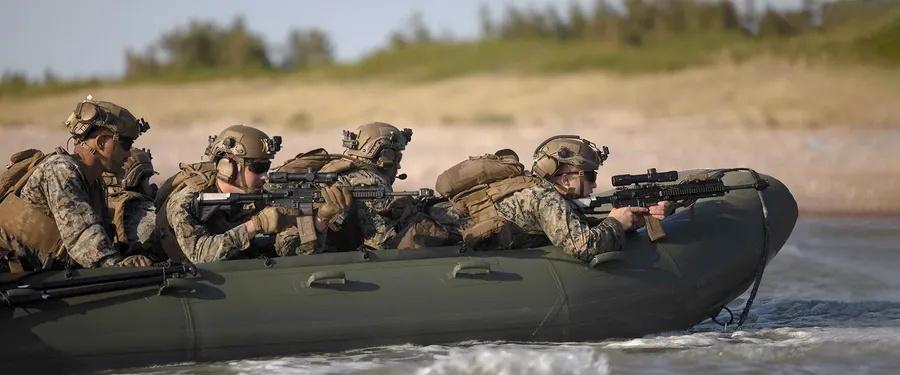
Marines conduct small-boat operations from HMS Albion into Latvia during the 2023 NATO Baltic Operations exercise.
Making Maneuver Great Again
Published Nov. 28, 2026 • Read time: 7m
Military history is replete with false Cassandras who proclaimed gloom and doom only to be proven wrong. Usually, these are armchair strategists whose predictions are noted and ignored by the active duty planners trying to forecast the next conflict. Occasionally, however, a modern-day Chicken Little reaches a position of real power and can act on their unsupported ideas.
General David Berger was one of those dangerous individuals. Upon becoming Commandant of the Marine Corps Berger sonorously declared that amphibious maneuver, tanks, heavy engineers, and most tubed artillery were dead.
His Force Design concept proved unattainable and the equipment he envisioned to implement it will soon be obsolete, even before being fully fielded. That has left the Marine Corps out of step with the joint force and incapable of fulfilling its statutory requirement of three ready Amphibious Ready Groups/Marine Expeditionary Units.
Force Design centered around placing marines on islets and sand spits in the first island chain of the South China Sea (SCS). Armed with anti-ship missiles, these small Marine Corps units would sink Chinese warships during a potential conflict assisting the U.S. Navy in gaining sea control in the SCS.
Independent war games such as those conducted by the Center for Strategic and Budgetary Analysis (CSBA) have shown the concept to be of marginal value in a SCS conflict.
Worse still, Chinese hypersonic missiles and AI driven sensors will be able to quickly locate the radars as soon as they are turned on and would likely neutralize the missile systems before they can get off their first shot.
Creating a MEF Insurance Policy
Wake Island Lessons for Expeditionary Advanced Base Operations
AI, Robotics, and Marines
This is Secretary Hegseth's Best Idea
Berge attempted to use the Russo-Ukrainian was as validation for his poorly conceived Force Design. Russian tank columns had been destroyed by Ukrainian hand-held precision Guided Munitions (PGMS) and the battlecruiser that was the pride of the Russian fleet was sunk by anti-ship missiles similar to the Marine Corps' NMESIS.
But unexpected things happened on the way to war termination. By late 2026, the Ukrainians were able to use tanks and heavy engineers to maneuver to gain ground in battles such as Operation Vivaldi. Granted, many of these tanks and engineers are robots but hybrid human-robotic teams were restoring maneuver to the battlefield in ways that Berger deemed obsolete. In addition, tubed artillery lags only behind suicide drones as a killers on the Ukrainian battlefields. Both sides are envisioning the use of hypersonic missiles both in the defense and attack.
As Berger's vision collapses, the Marine Corps will have some hard decisions to make before it becomes totally irrelevant on the modern battlefield.
Many among the future Marine Corps leadership, including some senior future leaders, avidly follow Marine Corps Compass Points (MCCP) which is the unofficial dissident publication of the Corps.
For several years, MCCP has pointed out the logical and military inconsistencies of Force Design and many of the future leaders quietly concur. They have not been vocal, because if they were, they would no longer be future leaders; that is the sad of the state of the Marine Corps today.
The hard reality is that by stripping the Corps of all of its tanks, almost all of its assault bridging and obstacle breaching capability, as well as much of its tubed artillery assets, Berger eradicated both its amphibious assault capability and its ability to participate meaningfully in a peer or near-peer conflict at or above the level of Desert Storm or Iraqi Freedom.
There is, however, one bright spot on the horizon should the Marine Corps decide to rebuild itself back to pre-2019 capabilities.
Robotics and AI give us the possibility of creating new tanks, and engineer units more affordably, and with less need for manpower than more traditional units with conventional capabilities. Engineers are a good example. Robotized breaching plows have been possible for a long time as has the possibility of autonomous bridging vehicles.
The Army and Marine Corps have been using small UGVs for counter IED work for two decades. However, there are some high-risk maneuvers that still require human dexterity such as assault crossings in inflatable boats and scouting for fording sites, but can be better enabled by autonomous systems.
China and Japan are ahead in this concept of human-machine teaming. Their ageing populations have forced them to implement robotics and autonomous systems in their workforce, which more readily translates into a force multiplier in military capabilities.
The United States has yet to reach that point, meeting with heavy resistance in the civilian sector to autonomous systems that might replace large sections of the workforce has become a divisive political issue.
The lack of commercial use of autonomous systems should not preclude the U.S. military from modernizing and learning from allies such as the Japanese and lessons learned on the Ukrainian battlefield.
The Ukrainians are proving that with autonomous systems, maneuver is still a vital component of modern warfare.
Instead of Force Design which isolated Marines in vulnerable positions in China’s first island chain, Gen Berger should have referred back to the Marine Corps’ own concept called Operational Maneuver from the Sea (OMFTS), developed in the 1990s.
OMFTS called for multiple littoral penetrations in column at a number of remote candidate sites such as boat ramps, fishing villages and coves with vehicle capable tracks leading inland to disrupt enemy command and control, logistics and indirect fire systems. OMFTS already considered the possibility of our forces being attacked by suicide drones and were exploring capabilities to counter drones.
OMFTS would eliminate the need for large, easily identified beaches such as Normandy and Salerno. Once a reasonable beachhead could be cleared, more traditional infantry units could be brought ashore to expand them and hold terrain for follow-on forces. If larger beaches became needed for follow-on logistics, they could be taken from the rear rather than costly traditional Iwo Jima-like frontal assault. Maneuver Warfare often requires coming from unexpected directions at times inconvenient to the enemy.
Some of us envisioned the initial assault forces would be autonomous systems. Although the technology wasn’t matured, we knew it was coming in the 2020s.
The Global War on Terrorism (GWOT), unfortunately, displaced OMFTS in order to support counterinsurgency operations in Iraq and Afghanistan, leading Gen Berger to believe that amphibious operations were no longer possible, thus killing off OMFTS experimentation completely.
The Russo-Ukrainian War and conflicts around the world, along with the demand for ARGs and MEUs by combatant commanders are evidence that amphibious operations and maneuver are making a striking comeback.
History provides a great example. When the Treaty of Versailles forbade the Post World War I German Army from having tanks, heavy artillery, and aircraft, but allowed the Reichswehr to imagine new weapons and new methods of employing them whereas the allies were stuck with legacy systems and doctrine.
That doesn't excuse General Berger from being terribly wrong, but it does clear the way for new thinking in the Marine Corps.
The real challenge for reintroducing maneuver warfare in the Marine Corps will be in overcoming the defensive "Maginot mentality" that has inflicted the organization for almost eight years. Maneuver warfare calls for individual initiative at all levels of command and a firm grasp of military theory based on the study of history. At the present time, the Marine Corps University is systematically scrubbing military history from its curriculum in favor of technology. An intellectual sea change is needed if Maneuver Warfare is going to make a comeback.
Gary Anderson retired as Chief of Staff of the Marine Corps Warfighting Lab. He served as a Special Advisor to the Deputy Secretary of Defense and is the author of Beyond Mahan, a Naval Strategy for the 21st Century.
Making Maneuver Great Again
By Gary Anderson • RealClearDefense
Ending the Conflict with Iran
By Anthony Cowden • RealClearDefense
Going After the Cyprus Money Laundering Hub
By Lise Korson • RealClearDefense
Don’t Bet Against CMMC
By Thomas Graham • RealClearDefense
When Losing Control of AI Becomes a Weapon
By Yunus Emre Tumen • RealClearDefense
Making Maneuver Great Again
By Gary Anderson • RealClearDefense
Coast Guard’s Updated Force Design Plan Includes Maven Smart System
By DS
F-22 Raptor Commands MQ-20 Avenger From the Cockpit
By K. Osborn, Warrior M.
ULA’s Vulcan Rocket Is Grounded for Third Time
By I. Klotz, V. Machi, Aviation Week
Tragedy That Convinced the Coast Guard It Needed Rescue Swimmers
By WATM