
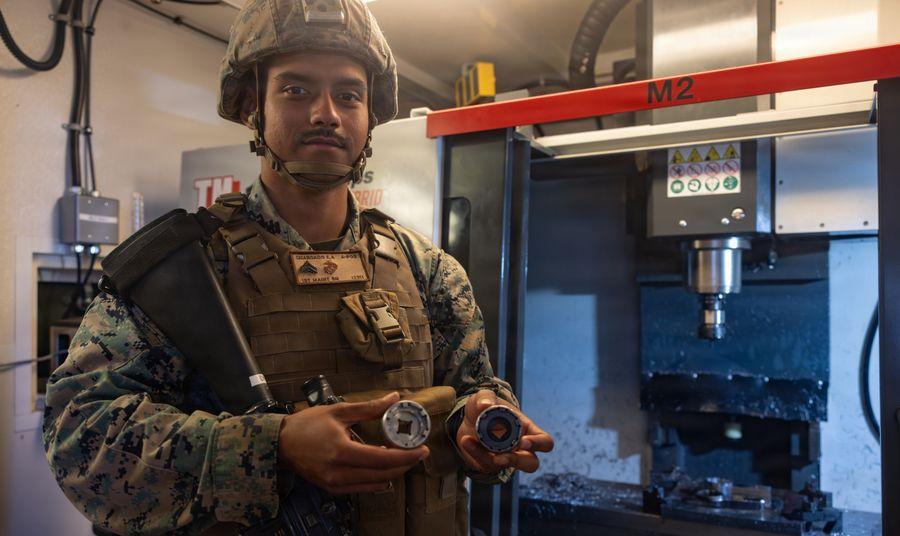
U.S. Marine Corps Cpl. Eliel Guardado, a machinist with 1st Maintenance Battalion, 1st Combat Readiness Regiment, 1st Marine Logistics Group, displays 3D printed equipment during a field exercise on Marine Corps Base Camp Pendleton, California, May 5, 2026. The FEX focused on increasing proficiency in tactical communication networks, analog processes, field intermediate maintenance and supply operations, as well as refining Marine combat skills in an expeditionary environment in order to prepare for Exercise Steel Knight 27 at the end of the year.
Creating a MEF Insurance Policy
Published Nov. 19, 2026 • Read time: 13m
Join the Conversation
0- Jennifer Bailey
America faces a conflict with China. To win, America must navigate three challenges: the Pacific’s vast distance, insufficient naval forces, and a contested environment. Similar hurdles faced the Nation in December 1941, when Japan attacked the Philippines, isolated the combined American-Filipino force from reinforcement, and forced 20,000 Americans to surrender in May 1942. If current challenges are unaddressed, they could produce a similar result. When China severs the joint force sea lines of communication (SLOCs), how does the Marine Corps sustain a combat-capable Marine Expeditionary Force (MEF) in the First Island Chain (FIC) during contested logistics windows of 90-120 days? As I discussed in my first article, the Deployed Manufacturing Element (DME) concept answers many of these questions. MEFs require an organic capability that ties into domestic and foreign industrial bases to create their own attritable mass and maintain lethality, survivability, and sustainment.
Operating Environment
After “thirty years of deferred modernization,” the MEF faces sustainment uncertainty during conflict. As a tactical unit focused on winning battles, it depends on joint force sustainment. That dependency enables expeditionary advanced base operations (EABO) and stand-in forces (SIFs) concepts. As Major Benjamin Van Horrick warns, SIFs “generate numerous joint dependencies that the joint force has yet to fully understand,” creating risk from “a dual reliance on the nascent concept and a concurrent failure to appreciate the associated demands.” His concern is that the joint force does not know what the MEF requires. Mine is that the joint force could not deliver it. Without support, MEFs ashore are isolated.
Given war’s immutable nature and ever-changing character, a Sino-American conflict will be protracted, stretch across the Pacific, incorporate advanced technologies like long-range sensors and drones, and have no American sanctuary. Geographically, China is 6,500 miles from the Homeland. Measured in time, that is a 15-hour nonstop flight or 20-30 days by sea. In a conflict, China retains advantages in time, geography, and initiative—it decides when to annex Taiwan, while we respond.
Another characteristic is maritime power. China’s fleet is over 500 vessels, including its Navy, Maritime Militia, and Coast Guard. That excludes its uncrewed vessels, maritime mines, and Q-Ships—commercial cargo ships with containerized missiles. Additionally, its anti-access/area denial network is designed to deny American “freedom of movement” in the Pacific. The Stimson Center highlighted that Chinese missiles can damage U.S. runways in Japan, constraining American air superiority for more than 30 days.
Compounding the threat is the poor state of America’s fleet and maritime industrial base. The Navy operates 291 battle force ships and, according to the Chief of Naval Operations’ (CNO) Fighting Instructions, generates force using a “three to make one” cycle—meaning about one-third of the fleet is at sea. Currently, more than 20 vessels, or about 20% of the at-sea force, are blockading Hormuz. Today’s Navy is smaller than in the 1980s, which built toward a 600-vessel fleet but still had “an escort shortage of 65 to 103 ships.” Further, in 1989, CNO Admiral Trost concluded that “even a 600 ship navy is not sufficient to accomplish every required wartime task simultaneously.”
A 2017 Naval Postgraduate School (NPS) study modeled a 7:10 escort-to-cargo ratio against naval threats. Even assuming air superiority, it resulted in an attrition rate of over 30%. That ratio is 4-6 times more escort-intensive than the Navy’s World War II data. MEFs deploy with 60 days of sustainment, while the Maritime Prepositioning Force (MPF) can support a Marine Expeditionary Brigade—about one-third the size of a MEF—for 30 days with a six-vessel squadron. Using the NPS ratios, and assuming a 2-3 MPF squadron sustainment requirement for a MEF ashore, the result is a 25-38 escort requirement. Given the Navy’s size and CNO’s Instruction, that is 25-40% of the at-sea fleet.
America’s flagged commercial cargo and oil tankers are no better, only totaling 190, alongside 140-plus in service to include the Ready Reserve Force, Military Sealift Command, and other programs. For comparison, the December 1941 support fleet was 1,340; by 1945 it was over 4,300. Even more concerning, China’s reported shipbuilding tonnage capacity is about 230 times that of America’s, with the 2026 Maritime Action Plan stating that the U.S.-flagged fleet is “insufficient to meet long-term contingency requirements or withstand attrition in a prolonged conflict.”
Ukraine’s Operation Molochka in the Black Sea Region provides a chilling example of attrition. In 11 weeks, Ukraine claims it disabled 300 unescorted Russian ships. If China replicated a fraction of that attrition on American shipping, it would isolate a MEF from its sustaining SLOCs. The Heritage Foundation’s TIDALWAVE wargame concluded that China will target American SLOCs and hubs to “sever logistics flows and catalyze operational failure within [120 days].” These threats and structural limitations mean sustainment is not guaranteed, requiring each MEF to have organic manufacturing capabilities to remain lethal.
Paradigm Shift
America’s traditional sustainment system requires a U.S.-based production, distribution, and sustainment network rooted in sanctuary, and global SLOCs connected to secure overseas hubs. It enabled power projection and expeditionary operations for 80 years, when uncontested sustainment passed through protected Middle Eastern, Asian, and European countries. Its limitations were not from an adversary; they were legal, administrative, and diplomatic, focused on gaining host-nation access, basing, and overflight rights. However, Operation Epic Fury changed that paradigm. Iranian salvos destroyed or degraded American hubs like U.S. Naval Support Activity Bahrain.
Recently, the DoW pivoted to modernizing the Defense Industrial Base (DIB)—a broad term that includes traditional and non-traditional industries and companies, as well as government-owned facilities with skilled workforces that supply defense needs, including materials, equipment, and services. Industry and policymakers often divide the DIB into specific sectors, including commercial, maritime, submarine, and other industrial bases. Within the DIB is the Title 10 mandated Organic Industrial Base—a nationwide manufacturing and production network of government-owned facilities, operated by the Services or through commercial contracts with Defense Working Capital Funds. It maintains core logistics capabilities, expertise, and resources for national defense, wartime mobilization, Service-specific readiness, and emergencies.
The Pentagon has attempted to reform the system while addressing the time-distance-precision problem—the time and distance from requirement to delivery, balanced against the closest factory that can produce the item with the required precision. Its 2024 Regional Sustainment Framework uses foreign industrial bases to shorten SLOCs. Additionally, Congress recognized the strategic challenges and, in the 2026 National Defense Authorization Act, authorized the Civil Reserve Manufacturing Network—a nationwide, standing, pre-committed commercial manufacturing network to support national mobilization and wartime production.
While all these changes are overdue, they still rely on thin SLOCs. For example, Manila is approximately 1,900 miles from Tokyo, 1,000 miles from Okinawa, and 1,500 miles from Guam. These distances matter because any item made outside the Philippines still has to travel 1,000 miles or more to reach the warfighter. China’s geographic proximity to Taiwan gives it a manufacturing and logistics advantage. Simply put, Chinese delivery is faster and safer than America’s. The Army reached the same conclusion in its 2026 How the Army Fights: forward-deployed units need organic additive manufacturing (AM) capabilities to “bypass vulnerable transoceanic supply lines.”
As a result, I draw three underlying assumptions that drive my concept. First, as currently designed, joint operational-level logistics cannot sustain a MEF in the FIC. Second, the Navy lacks sufficient capacity to escort and secure SLOCs between America and the FIC while simultaneously executing its various global missions. Third, America lacks the commercial vessel capacity to sustain joint forces in the FIC during prolonged, high-intensity conflict. Therefore, each MEF must have an organic AM capability to retain an advantage.
Employment Concept
The DME is a trained, manned, equipped, and educated unit organic to a Combat Readiness Regiment, with a general support command relationship to a MEF. The 253-Marine unit has four platoons: short- and long-range air, sea, and ground. Each supports specific requirements within its technical scope, helping alleviate the time-distance-precision problem. High-precision weapons systems are outside of the unit’s scope of competence. However, with technological advances, programs like the Defense Advanced Research Projects Agency’s Rapid Reconstitution could make feasible what is not yet technically possible. The DME employs AM and super-intelligence (SI) to create a predictive, responsive system within a comprehensive logistics common operating picture.
The concept focuses on producing and assembling low-cost drones, small parts, 3D-printed boat hulls, and other items. Each purpose-built platoon supports its functional area with mobile AM cells using multi-material printers, advanced robotics, computer numerical control (CNC) machines, and integrated material recycling capabilities.
The short-range air platoon supports infantry formations. Through co-location and collaboration, drone operators and Marine manufacturers can tighten the innovation and adaptation cycle to improve designs and increase tactical effects. Currently, Ukraine’s operator-informed analysis approach between soldiers and manufacturers exemplifies a tactically focused ecosystem designed to drive rapid adaptation. Similarly, long-range air, sea, and ground platoons manufacture and assemble limited-use drones, hulls for distribution, and other missions.
New, non-traditional companies like CEAD, Phillips Federal, Makers Equipment, and others offer modular cells, 360-degree robotic arms, movable printer beds, and large-format printers, using proven technology packaged in deployable, standardized containers. This concept is a tailored logistics solution that produces attritable mass and repair parts for a MEF while simultaneously leveraging other industrial bases and frameworks. Because of technological advances and strategic constraints, MEFs must become battlefield producers to remain lethal.
Advantages
The concept offers four advantages: local procurement, enhanced readiness, drone adaptation, and increased resiliency. By locally procuring metal powders, polymer spools, and other items, combined with 21st-century foraging, the concept reduces the volume and frequency of external resupply. I studied Philippine AM and found 23 commercial companies across 17 cities in eight regions, selling 23 printer brands across five types (e.g., filament/extruder, material jetting, liquid-resin, metal wire/powders), and various feedstocks. To maximize the concept’s benefits, planners must conduct a thorough physical network analysis to identify supporting energy sources and distribution methods; AM companies, sellers, and warehouses; port terminals; and import sources and routes. Local knowledge ensures the DME connects with the local AM network so the unit can manufacture the necessary products.
Second, it enhances combat readiness through on-site or near-site tactical-level manufacturing, reducing exclusive reliance on SLOCs. For instance, if a unit operating near the Luzon Strait needs an item, the DME could produce it and the autonomous vessel that delivers it. This illustrates the advantage of local feedstocks over maintaining a warehouse of pre-made products. Feedstocks offer near-limitless potential to create required items, from drones to amphibious combat vehicle parts or other systems not yet conceived.
Third, it enables the creation, modification, and iteration of drones within the “low” category of the high-low mix—a balanced approach between a few, exquisite weapons (“high”) and several, cost-effective systems (“low”). Further, educating combat engineers and explosive ordnance disposal technicians to manufacture explosives from local materials lets Marines tailor weapons. Based on my research, and assuming proper resourcing, a DME can assemble over 19,000 small and about 370 long-range strike drones, and around 65 ground vehicle conversions every 30 days, plus ten eight-meter boats. Against my planning factor of 3-4 small drones per squad per day for roughly 325 squads, the DME can manufacture about half of a MEF’s requirement. My estimations are design quantities that need official experimentation and validation through exercises. If a MEF creates its own “low” attritable-mass needs, it frees up shipping space for its “high” needs, like anti-ship missiles.
Fourth, it creates a resilient, adaptable network that withstands disruptions and change while meeting warfighter needs. It is resilient because it moves the factory forward, safeguarding lift and speeding sustainment throughput. At the same time, it is adaptable because feedstocks support a variety of items without maintaining a large warehouse of pre-shelved components. It alleviates the time-distance-precision problem by making on-site items, reducing time to need, and keeping pace with warfighting. Manufacturing at the right level, in the right location, and within the concept’s technical expertise supports a MEF’s needs. Essentially, this concept is a semi-distributed, mini mobile DIB.
Disadvantages
Implementing the concept presents four challenges: power production, pre-staged stocks, training and education, and costs. The primary concern is power. The Service’s current expeditionary power networks are tactical and not designed to support large numbers of industrial-grade printers. Supporting it requires the Portfolio Acquisition Executive to procure more 60-kilowatt generators, renewable energy systems, industrial batteries, and multi-fuel generators. If the Service invests in diverse generation systems with 21st-century foraging in mind, it can overcome many energy hurdles.
Second, pre-positioned stockpiles, like the MPF, must grow to include AM printers, CNC machines, feedstock, drone-making materials, and autonomous conversion kits. This includes expanding host-nation agreements like the Enhanced Defense Cooperation Agreement. Since not everything is printable, items like brushless motors, outboard engines, and wiring harnesses require pre-staging and local procurement through expeditionary contracting.
Third, the concept requires new training, education, and skills for Marines, including logistics chain management, AM processing, data analysis, quality control, vehicle autonomy, and basic materials science. These skills are uncommon in the Marines, requiring the Service to seek assistance from the commercial sector. Future Marines must manage and maintain an extensive digital library and know how to use SI models. Something the Marines can emulate is the Army’s new 390A Robotics Technician, which educates and trains soldiers in robotics and autonomous systems.
Fourth, funding and billet resourcing from the DoW and Congress. My research shows equipment procurement for one DME is $14 million. With the DoW asking Congress for over $70 billion for drones, the DME is a perfect candidate under the Drone Dominance Program. There are two options for billets: Congress approves another 759 Marines specifically for tactical-level manufacturing as part of Force Design, or the Corps repurposes existing units. Recent Service-level changes created capacity gaps in engineering, logistics, and ground aviation units that hinder EABO.
Conclusion
Avoiding 1941-1942 failures requires adapting our current sustainment concepts to the Pacific’s vast distance, insufficient naval forces, and a contested environment. The DME shrinks the logistics guessing game and extends capacity, allowing the MEF to build what it needs, where it needs it, from materials already in-country. It partially addresses the time-distance-precision problem and enables a MEF to make its own “low” in the required high-low mix so it can continually adapt to combat innovations. It is not a substitute for the supply chain, but a MEF-level insurance policy when operational-level logistics does not arrive. It cannot solve contested logistics; it buys the MEF a window that the three challenges deny. The estimated equipment cost for three DMEs is $42 million. The next step is to test the concept’s production rates in an exercise to validate that it can support a deployed MEF’s endurance requirements. What remains is a decision: ask the DoW and Congress for more or repurpose limited resources. Compared to failure, either choice is a cheap premium for lethality, survivability, and sustainability. We should buy the policy before the war.
LtCol Steven Bancroft is an active-duty Marine Corps Officer and currently serves as the Commandant of the Marine Corps’ representative to the Hoover Institution at Stanford University as a Robert and Marion Oster National Security Affairs Fellow. He has served in Iraq and Afghanistan and has 10 years of experience in the Pacific theater, including two cumulative years in the Philippines.
The views in this article are those of the author and do not represent the policy of the Marine Corps, the Department of War, or the U.S. Government.
South Korea’s Nuclear-Powered Submarines After the Midterms
By Jihoon Yu • RealClearDefense
Why Build a Billion-Dollar Warship if a Cheap Drone Can Sink It?
By Ege Can Gün • RealClearDefense
Megaspeed Proves: Congress Must Act on Chip Security
By Michael Groen • RealClearDefense
Creating a MEF Insurance Policy
By Steven Bancroft • RealClearDefense
Operation Epic Fury and the Illusion of Victory
By Stephen D. Cook • RealClearDefense
South Korea’s Nuclear-Powered Submarines After the Midterms
By Jihoon Yu • RealClearDefenseWhy Build a Billion-Dollar Warship if a Cheap Drone Can Sink It?
By Ege Can Gün • RealClearDefenseCreating a MEF Insurance Policy
By Steven Bancroft • RealClearDefense
Five Takeaways From Navy Nominee’s Rocky Hearing
By Seligman & Weisgerber, WSJ
U.S. Air Force Taps Anduril for Containerized Launcher
By Global Defense News