
AUKUS: How To Help the US Navy As It Helps Australia
Published May 19, 2025 • Read time: 5m
There’s a way for Australia to strengthen its case for the U.S. presidential certification it will need for acquiring Virginia-class submarines. It should do so by accelerating construction of a planned shipyard in Western Australia and using it to help get U.S. submarines out of a long maintenance queue.
Australia’s acquisition of three submarines from the United States’ stretched fleet and building yards could be offset by the additional operational availability of three U.S. boats. The Australian yard would also improve support for U.S. submarine operations in the Indo-Pacific.
By law, the U.S. president will have to certify to Congress that transferring Virginia-class submarines to Australia will not degrade the U.S. Navy’s undersea warfare capability. That certification will have to be provided no later than 270 days prior to the first transfer, which is scheduled for 2032.
The president will have to certify that the U.S. and Australia are sufficiently investing in the submarine production and maintenance base to meet the requirements of both nations. This will require the current building rate of 1.2 Virginias a year to rise to 2.3 boats a year by 2032, which Australia will help achieve.
Australia could go further. It could reinforce the argument for certification by bringing forward the building of the shipyard planned for Henderson, Western Australia. Better still, Australia could establish this shipyard, by treaty, as a joint Australian-U.S. facility, in recognition of its vital role in the alliance, which could be at least as significant as the contribution of the Pine Gap satellite ground station.
Why would such a joint facility be of value to the U.S.? While Australians see AUKUS as a vehicle by which to acquire nuclear-powered submarines, the U.S. sees it as a means for unlocking access to a vital operating location for its own submarines. This will be achieved by the rotational deployment to HMAS Stirling of four U.S. submarines from 2027 under the Submarine Rotation Force—West (SRF-W) program.
Being able to operate routinely in the Indian Ocean without having to transit the congested littoral waters of Southeast Asia and in the Western Pacific in times of tension and conflict is of immense strategic value to the U.S.. Being able to operate from HMAS Stirling with assured access to a nearby submarine maintenance facility at Henderson would, for the U.S., be better still. The U.S. has no naval shipyard of its own west of Hawaii where it can maintain its submarines.
The Joint Defence Facility Henderson would be a maintenance, not building, yard for the U.S. Navy. It would perform much deeper work than the support that HMAS Stirling will provide for SRF-W deployments.
It would become the U.S. Navy’s fifth naval shipyard, adding to those in Maine, Virginia, Washington State and Hawaii. From Australia’s perspective, we have to build the shipyard at Henderson for our own purposes, anyway. Offering to operate it as a joint facility would ensure continuous workflow (as the facility would be the site for eventually maintaining 12 or more Australian and U.S. submarines). This would assist in the recruitment and retention of what will need to be a long-term skilled workforce.
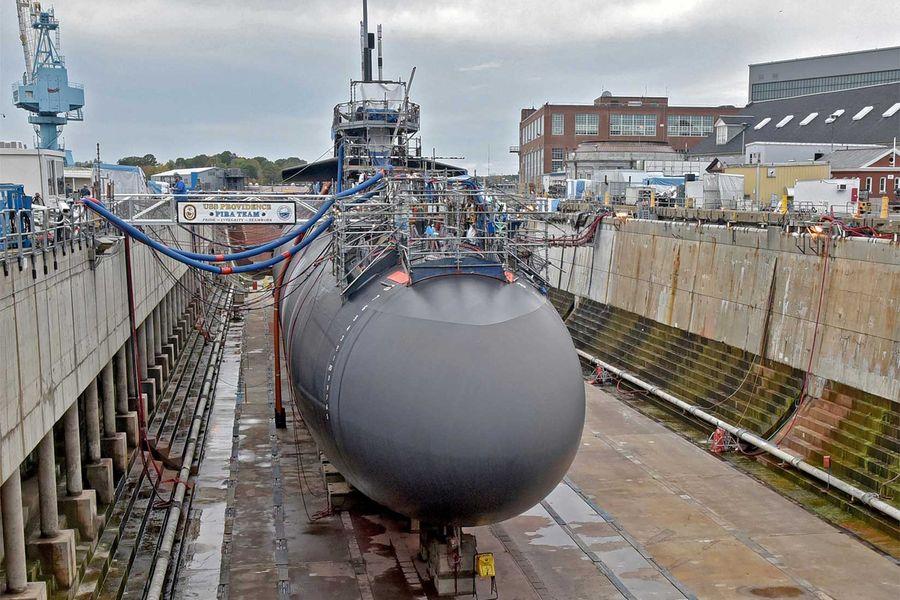
Becoming a trusted partner in an integrated allied submarine maintenance system would be an invaluable alliance contribution by Australia. The U.S. Navy has a severe submarine maintenance backlog, currently forecast to last for decades. This backlog reduces the number of U.S. submarines that can be put to sea. At the end of 2023, of a U.S. Navy combat force of 48 attack submarines, 16 were in maintenance—that is, 33 percent. The U.S. Navy is seeking to reduce that ratio to 20 percent; based on current fleet size, that would make six more submarines available to go to sea. Having access to an additional shipyard in Australia would assist the U.S. Navy in achieving this maintenance goal. The U.S. would have to pay for only labour and material costs for maintaining its own boats, taking advantage of Australia’s capital investment in Henderson for free.
To support the president’s certification, Australia could specially commit to ensuring access to Henderson such that the U.S. Navy could reduce its maintenance backlog by at least three submarines between 2032 and 2038—which is when Australia is due to receive three Virginia-class boats (two refurbished and one new). Then the U.S. would not be reducing its submarine force in honouring its AUKUS commitment. Beyond 2038, Australia could commit to further assisting the U.S. to increase submarine availability. Over the very long term, by 2054 when the U.S. and Australia would be operating a combined force of 74 attack submarines (66 in the U.S. Navy and eight in the Royal Australian Navy), the two nations would between them have five naval shipyards and 22 drydocks for submarine maintenance, including Henderson.
To achieve this goal, Defence would need to cut through regulatory and construction obstacles, ideally aiming to have two operating drydocks ready in the Henderson shipyard by 2032 (perhaps using nuclear-certified floating docks at first, as Britain is seeking to do). Australia should seek to lock in such a treaty, thereby assuring itself of access to Virginia-class boats from 2032, by negotiating a deal with the Trump administration over the next 12 to 18 months.
If Australia does this, and assists the U.S. to boost Virginia production, drives the development and production of the SSN-AUKUS submarine with Britain, extends the life of the Collins–class fleet, builds a proposed East Coast submarine base and acquires uncrewed underwater combat vessels at scale (in the thousands of units), it will become an undersea naval superpower. However, this will require political and bureaucratic leadership and organisational drive that is rarely seen outside of wartime.
Michael Pezzullo is a former deputy secretary of defence and was secretary of home affairs until November 2023.
This article appeared originally at The Strategist (ASPI).

The Army’s AI Cyber Defenders Need a Proven Stand-Down Order
By Gleb Tsipursky • RealClearDefense
After the Silence
By Chase Skylar DeMayo • RealClearDefense
Defense Chip Procurement Needs a Recovery Test
By Percy Yixuanchen Yu • RealClearDefense
FORTRESS America Must Measure Missions, Not Megawatts
By Burak Oktenli • RealClearDefense
After the Midterms, the Right Strategy Against Iran
By Lance Gordon • RealClearDefense
After the Silence
By Chase Skylar DeMayo • RealClearDefense
Underwater Arms Race Puts U.S. Naval Supremacy at Risk
By Tom O'Connor, Newsweek
New Facilities To Pump Out Upgraded F/A-18E/F Super Hornets
By Trevithick, WarZone
U.S. Navy Expands Tomahawk Warhead Production
By Naval News Staff, Naval News
SSN(X) Attack Boat Will be a Swift, Lethal Mothership for Undersea Drones
By USNI N.