
Misaligned by Design: Structuring the U.S. Navy Post-Cold War
Last updated 01:00 AM EST • Read time: 8m
Among the most clamorous debates in the national security community is that surrounding the U.S. Navy’s force structure and shipbuilding plans. Not without reason, critics from both sides of the aisle in Congress, think tankers, and members of the Administration have levied many charges against the Navy’s future force planning. Certainly, the Navy itself has muddied the waters with multiple, overlapping force structure goals.
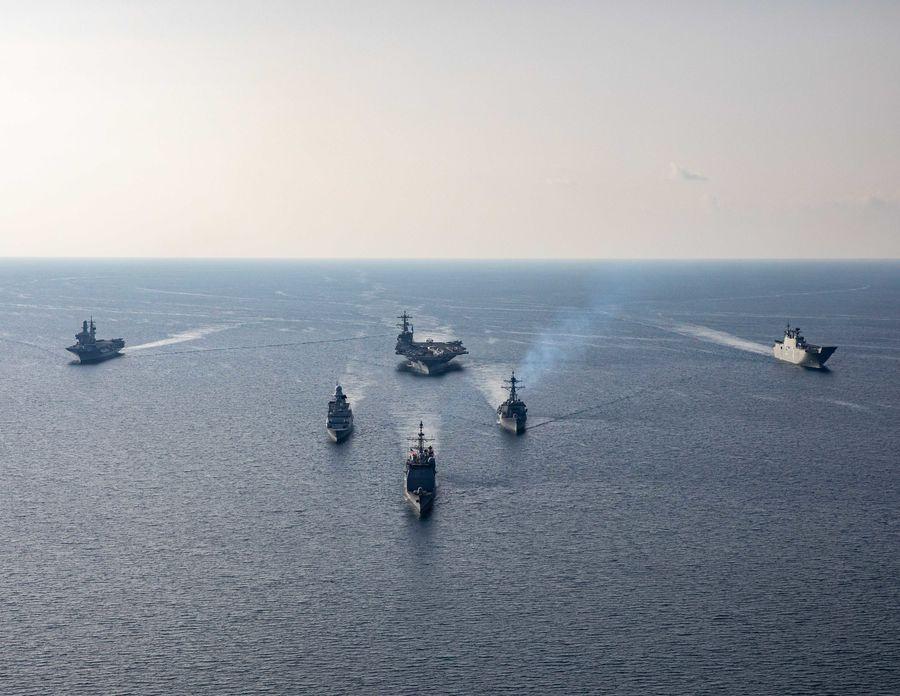
To a degree, one can point to the turmoil of the previous administration and the generally tepid perspective of the current as hampering the establishment of a coherent, long-term plan for naval development. The problem, however, has much deeper roots, dating back at least to the end of the Cold War. Successive presidential administrations, congress, and navy staffs since 1991 have presided over continued naval downsizing whilst attempting to maintain the same scale of deployments and missions the force had before – in some cases, more.
Indeed, today the structure of the Navy is fundamentally misaligned with its missions. Quite simply, there are not enough ships to fulfill them. But just what are those missions and how did they evolve beyond the Navy’s means?
Missions of the Navy
The U.S. Navy has several fundamental, overlapping missions: strategic deterrence, sea control, and projection of power ashore. As then-VADM Stansfield Turner articulated in 1974, these missions are in fact the essential outputs of naval operations. With the notable exception of the Navy’s arm of strategic deterrence, executed exclusively by ballistic missile submarines, the requirements of each generally compliment those of the others.
VADM Stansfield Turner's Interdependent Naval Missions
Sea control is primarily a wartime mission gauged towards denying the enemy and upholding one’s own use of the sea. Projection of power emanates from access to the sea, allowing the exertion of influence back onto land.
In contrast, the presence mission is the peacetime operation of the Navy, denoting the deployment of naval forces abroad and what they do whilst there. It holds the dual value of dissuading adversaries and demonstrating commitment to partners, yielding international political capital. The corresponding potential value of establishing presence is the ability to utilize forwardly positioned naval forces to execute missions short of war as well as rapidly response to crises.
The Navy has long been forward deployed, but it truly became the force’s raison d’etre following the Second World War – perhaps best articulated by Samuel Huntington. At that time, bolstered by the massive constructions of the war period, the Navy was large enough to substantial maintain global presence. As the remaining vessels from the Second World War were increasingly decommissioned in the 1960s and 1970s, the Navy still numbered over 500 ships but was increasingly shrinking. Under Chief of Naval Operations ADM James Holloway, the missions, paralleling those outlined by Turner, were reinforced in SEAPLAN 2000 but with rearticulated rationales. SEAPLAN 2000 emphasized the Navy’s objectives as maintaining stability, containing crises, and deterring global war. Crucially, it directly tied the ability of the Navy to fulfill these objectives to force structure needs, outlining the risks of failing to do so.
The 1980s drive to build the “600 ship navy” was predicated on this notion and the concern that the Navy had atrophied in its ability to fight the Soviet Union should war occur while also sustaining a steady rate of 100 naval vessels forward deployed. But, by 1991, there was no peer competitor to justify such a large force.
The End of the Cold War & Misalignment
As the Department of Defense began reorienting itself for a post-USSR world, it validated presence oriented towards regional response as the naval mission through then-Chairman of the Joint Chiefs Colin Powell’s Base Force, Secretary Les Aspin’s inaugural Bottom-Up Review, and repeatedly in successive Quadrennial Defense Reviews. The Navy embraced presence as its capstone concept through its first post-Cold War strategy documents …From the Sea and Forward…From the Sea, and has continued to do so in its three tri-service maritime documents of the twenty-first century.
That the recodification of the naval presence mission, at its existing scale, did not coincide with a maintenance of fleet size increasingly created a mismatch between the service’s most visible mission and its capacity to execute it. Indeed, the Navy shrunk from 570 ships in November 1990 to 318 a decade later, 288 by 2010, and finally 293 today. Yet Washington and navy commanders, remained enthralled by the flexibility afforded by forward naval forces, leveraging their capabilities repeatedly throughout the Global War on Terror and beyond.
By the early 2010s, however, the cracks in the Navy’s readiness caused by structure-mission misalignment were starting to show. Originally set for a maximum deployment of length of six months, the Navy increasingly diverged from this schema during the Global War on Terror in an effort to make up for constrained capacity. The 2003 Fleet Response Plan, rather than resolving the over-deployment tension, proved ineffectual. The natural result of over-deploying the fleet and missing maintenance requirements was a degradation of platforms and maintenance overruns once ships were finally laid up. Between 2011 and 2014, 29 of 103 surface ships completed maintenance on schedule while only one of the nine aircraft carrier maintenance availabilities was completed on schedule. Redesigning the deployment schema, in the form of the Optimized Fleet Response Plan in 2014, seemingly set the force on-track for the future but nonetheless remains a coping mechanism in attempting to maintain the steady deployment rate without a sufficient pool of platforms to draw upon.
Naval Cognitive Dissonance Today
The issue emanating from the presence mission then, is not that its execution is a flawed operating concept ipso facto but that it no longer fits as the Navy’s primary modus operandi in a strategic operating environment of renewed peer competition. Indeed, one needs a much larger force along the lines of the one maintained throughout the Cold War – never dipping below 500 ships – to maintain both the steady forward deployment rate and surge capacity to be credibly capable of fighting a peer adversary at sea. The Navy, however, has not been sized to execute the latter mission for the last 30 years.
In recent years, progress in enhancing the Navy’s readiness has been made with aircraft mission capable rates and maintenance delays on regular availabilities in private shipyards. Yet it remains questionable if full readiness is possible when the force is attempting to execute two missions that each require a larger force than the Navy has at its disposal.
Until the early 2010s, few in Washington truly believed China was a peer competitor. Certainly, China did not begin to feature prominently as a competitor in national security strategies until the second term of the Obama Administration. Through 2015, the Navy’s assessment of China was ambivalent, stating in the Cooperative Strategy for 21st Century Seapower of that year, “China’s naval expansion into the Indian and Pacific Ocean presents both opportunities and challenges.” The question of China’s naval growth did not have much traction despite growing by almost 100 platforms between 2005 and 2015.
As the gap between the size of the U.S. and China’s navies has widened, to the point where People’s Liberation Army Navy now outnumbers the U.S. Navy by some fifty or more ships, Washington has become interested in shipbuilding in way that it has not since the 1980s. While Congress has made clear that its chief priority is the ability of the fleet to be credibly capable of fighting a war with China, the Administration has been rather ambivalent. Misalignment has only been reinforced by the release of the Biden Administration’s 2022 National Security Strategy and 2022 National Defense Strategy which each endorse the role of the military in campaigning abroad in peacetime but scarcely support the Navy’s shipbuilding efforts or consider the reallocation of resources and missions.
Signed into law on December 23, the compromise National Defense Authorization Act, however, offers an opportunity to right decades of imbalance in the force. The incorporation of the “Gallagher Amendment” (Sec. 913. Clarification of Peacetime Functions of the Navy) and the establishment of the “Commission on the Future of the Navy” (Sec. 1094. National Commission on the Future of the Navy) both portend a changing of the tides. Whereas the former firmly establishes the need for the Navy to operate in – and be resourced for – both peace and war, the latter will offer Congress an opportunity to substantively weigh-in on the force design debates of the past several years. The only issue here is whether it will be too late, given that you only have the Navy today that you planned to build decades in advance.
Benjamin E. Mainardi is an analyst at the Center for Maritime Strategy. He holds a master’s in War Studies from King’s College London. His primary areas of research are in naval affairs, strategic studies, and military history.
Don’t Be Swayed by Tactical Nukes
By Benjamin Giltner • RealClearDefense
How Seoul’s Break With Kyiv Serves Trump’s Russia Turn
By Sang Won Pyo • RealClearDefense
When the Grid Goes Down, the Mission Must Go On. Solar and Storage Can Help.
By John Szoka • RealClearDefense
Data and Communications Technology are the Hidden Keys to Success for Golden Dome
By Eric Velte • RealClearDefense
The Dual Threat: Why Beijing’s Collapse Is Just As Dangerous as Its Rise
By Efraín Vázquez-Vera • RealClearDefense
USS Stout Loses Power During Port Visit Due to ‘Engineering Casualty’
By USNI News
Air Force Lessons Learned From Operation Epic Fury
By Tabitha Reeves, National Defense
Marines Need Nine More Amphibious Warships To Carry Out Its Missions
By TWZ
AFRL, ACC Fly XQ-67A Drone To Test Autonomous Teaming
By Airforce Technology
F-35B Releases Meteor BVRAAM for the First Time
By Parth Satam, The Aviationist