
Nobody Asked Me but…Let's Stick the Seals in the Marine Corps
Published Aug. 18, 2026 • Read time: 4m
The SEALs don’t belong in the Navy.
The first time I saw these furry mammals was when they rode our boat for a James Bond exercise in the Channel Islands. They were different. Shorts-wearing. Tall, tanned, rippling. Half a notch below the USC swim team on the “look like a god” scale.
Our SEALs were stuck up. Wouldn’t chitchat, except with our skipper. Although I did twinge sympathy once. Saw a company‑mate of mine, packmuling most of the gear on board. He was pre‑Trident and had a “don’t have my fish yet” look.
The SEALs are too physically fit. And they shoot guns and jump out of planes. They don’t turn wrenches and tweak micrometers. They don’t belong in the geeky Navy.
SEALs are more Marine‑like than sailor-like. They are elite infantry. The solution follows. Move them to the Corps.
The major benefits are HR-related. The SEALs gain a pool of recruits. Young Marines can become commandos.
Simultaneously, we scrap the direct-to-SEAL pathway. This mirrors the practice in Army special forces. It means SEALs training will build on a baseline of combat arms experience rather than starting from scratch with great athletes.
USMC boot camp and service are relevant. Great Lakes and ship time are not. The extra experience (and filtering) will reduce BUD/S attrition. And rookie SEALs will now be grownups.
Benefits with officers will be especially important. New team leaders will have TBS-ed and (mostly) IOC-ed. They will come to the teams having led a platoon. Writing FITREPs (Fitness Reports), dealing with salty sergeants, bailing E-4s out of San Diego jails … the usual.
Another HR benefit comes from officer SEALs who later transition back to the regular Corps. They gain promotion opportunities and billets.
SEAL officers don’t make sense on teams after O-3. They become a headache, clogging up shore staffs. In contrast, ship, sub, and plane drivers have operational roles all the way through O-6. They go on staffs when they need a break from the sea.
Within USMC, there would be ample opportunities for SEAL officers to “get their twenty” while still being useful.
In combat, there will be moderate benefits. SEALs are light. Connecting with an army‑type organization helps when the combat gets heavy. In Grenada, SEALs got pinned down, requiring rescue. Similarly in Afghanistan. There will be better-coordinated SEAL support for amphibious landings.[i]
Aesthetically, SEALs will upgrade song, sword, and birthday party. Enlisted men will get better-looking dress uniforms, a recruiting advantage.
The SEALs can keep their operating model with a special budget and relationship to USSOCOM. They will have the same name, pitchfork, BUD/S, bases, UDT heritage, etc.
Frowsy hair won’t be a problem. The Army puts up with Delta. SEALs will be off in their spooky world.
Given the added load, some support staff (e.g. JAG, intel) will be adjusted to reduce USN and add USMC FTEs. Executive changes like budgets or USMC slots at USNA will be catalogued and acted on. Administrative details like ID cards or websites will be handled in a corporate-style, 90-day, post-merger integration process.[ii]
SEALs will choose between finishing out obligated service in the Navy or transferring. If they want to keep SEALing, they must go Corps. Few will stop kicking doors to stand watches.
The government will provide initial uniform stipends, a minor cost. The integration office will run short “knife and fork” schools to orient transferring SEALs.
The USMC can wind down MARSOC, merge it into the SEALs, or operate multiple special forces like the Army does. The decision can be made later.
This change will benefit SEALs and the Marine Corps. The Navy will be unharmed and happy. Over time everyone will get used to it. Like Exxon and Mobil employees did.
Since 2006, USMC has been growing a startup. The SEALs will give them a big new business unit with a world-class brand.
Some may say the SEALs don’t belong in the Marine Corps. Well, they don’t belong in the Navy more.
Worried how the Corps would view the imposition, I consulted my Ironman‑doing USMC buddy, Rotorhead. Instead of cavitating, he spoke with a faraway tone ... “Donut…that is not a bad idea.”
Donut Eater is a Mid‑Atlantic civilian who misses Point Loma.
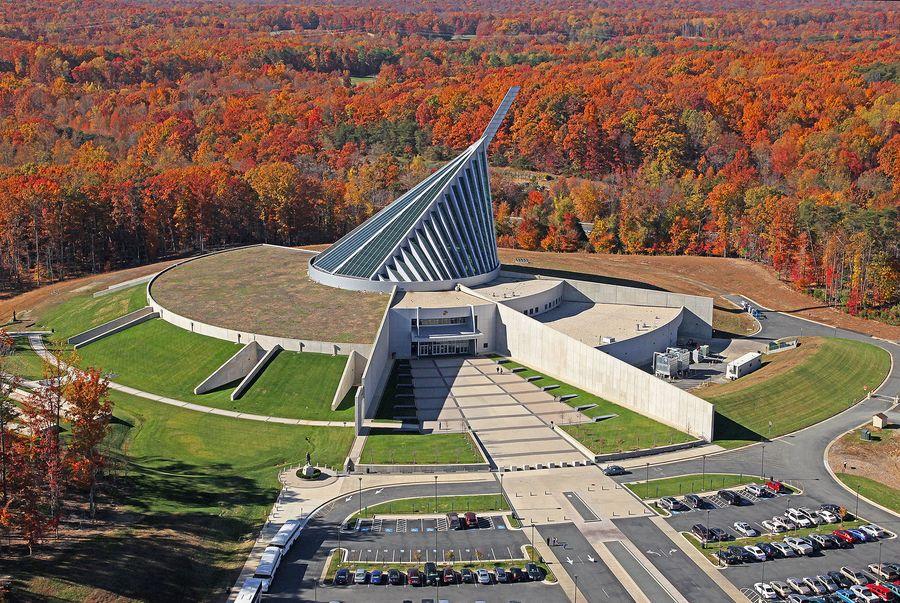
image: The Marine Corps Museum’s monolith looms over Northern Virginia. (Credit: Duane Lempke Wikimedia Commons)
notes:
[i] Ronald H. Cole, Operation Urgent Fury: The Planning and Execution of Joint Operations in Grenada, Joint History Office, Office of the Chairman of the Joint Chiefs of Staff (1997): 4, 5, 44; Ed Darack, Victory Point: Operations Red Wings and Whalers – the Marine Corps’ Battle for Freedom in Afghanistan (New York: Berkley Caliber, 2009).
[ii] USMC slots at USNA can be adjusted by executive policy. See Graduates of the United States Military, Naval, and Air Force Academies, 10 U.S.C. § 541 (2021).

Operation Epic Fury and the Illusion of Victory
By Stephen D. Cook • RealClearDefense
Previewing The Shenzen Summit: A Critical View
By Stephen Blank • RealClearDefense
How to Win Without Military Victory
By Kevin Eyer • RealClearDefense
We Keep Funding ‘Shared Infrastructure.’ Nobody Has Defined It.
By Frederick Gale • RealClearDefense
Congress Must Reauthorize Section 702 of the Foreign Intelligence Surveillance Act
By Bryce G. Poole • RealClearDefense

Five Takeaways From Navy Nominee’s Rocky Hearing
By Seligman & Weisgerber, WSJ
U.S. Air Force Taps Anduril for Containerized Launcher
By Global Defense News
Time To Say Goodbye to the NMESIS and NSM
By Marine Corps Compass Points
HII and U.S. Navy Break Ground on Shipyard Complex
By George Allison, UKDJ
Rare U.S. Air Force Spy Plane Spotted Over the Black Sea
By D. Malyasov, Defence Blog