
Past Decisions Ensure Rough Waters Ahead for Navy Sub Construction
Last updated 05:01 PM EDT • Read time: 5m
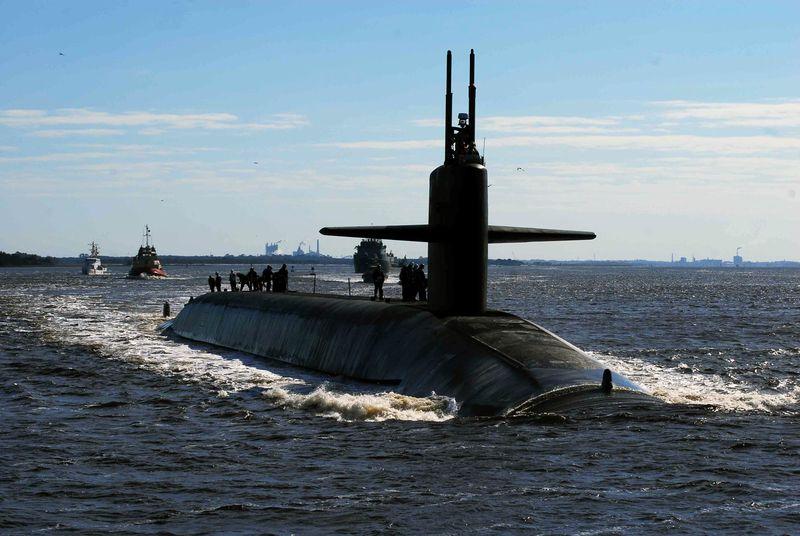
Ohio-class boats are running out of nuclear fuel, and the submarine hulls can only withstand a certain number of long dives at great depths. They require replacement: the Columbia-class submarine.
Earlier this week, the Government Accountability Office noted the U.S. Navy’s cost estimate for its planned Columbia-class nuclear ballistic submarines is overly optimistic, which will likely lead to “cost growth” in the program. Though interpretations of GAO’s report imply mismanagement, the truth is that the consequences of prior short-sighted decisions are rearing their ugly heads today.
14 Ohio-class nuclear ballistic missile subs currently fulfill the Navy’s strategic deterrence mission, with several prowling the oceans at any given time. Part of America’s nuclear triad, these stealthy subs ensure that any nuclear strike against the United States would be met with a massive retaliatory strike. However, Ohio-class boats are running out of nuclear fuel, and the submarine hulls can only withstand a certain number of long dives at great depths. They require replacement: the Columbia-class submarine.
Sound management practices and innovation in this program already saved taxpayers tens of billions of dollars. Navy investments in advanced nuclear propulsion technology mean that the Columbia’s reactor will last the ship’s entire life, which removes the need for mid-life refueling and allows for 12 submarines to do the work of 14. That breakthrough alone saves just under $15 billion. Additionally, the Navy designed Columbia submarines to serve for 42 years, instead of the Ohio-class service life of 30 years, vastly improving the program’s sustainability.
In 2012, the Obama administration delayed the start of construction for Columbia from 2019 to 2021 following enactment of the Budget Control Act, which arbitrarily restrained defense spending. As a consequence, the Columbia program possesses no margin of error in its timeline to replace inexorably retiring Ohio subs. Now, GAO warns that the Navy’s $115 billion cost estimate for the program may be too low.
This cost estimation methodology problem should not surprise anyone; it’s not new to Congress or analysts that the Columbia program cost estimate confidence level is around 50%, meaning there’s a significant chance it costs more than $115 billion. A 10% cost increase would not be shocking. Part of the underlying problem is that “budgetary uncertainty, persistent underfunding, and perverse incentives created by Congress” encourage the weapons acquisition system to under-estimate program costs. Another part of the problem GAO addresses is that cost estimation is very difficult, particularly when building weapons that haven’t been built in four decades. Cost estimation questions include how to project the pace of design work, forecast construction efficiencies, and make assumptions about the learning curve of the workforce. Effective cost estimation is not only about accuracy of assumptions, but also includes weighing the necessity of establishing aggressive targets with the desirability of ensuring Congress possesses a full understanding of the potential program risks.
Unfortunately, prior decisions have appreciably worsened the Columbia program risks. Productivity in submarine construction largely hinges upon the size and expertise of the workforce, as well as the capacity of supplier companies. Officials decided seven years ago to delay the Columbia program, leaving no margin of schedule error and aligning Columbia’s construction with an uptick in Virginia-class attack sub production. This ramp-up comes just as the submarine industrial base faces significant workforce and supplier shortfalls created over three decades of anemic sub production, industrial base consolidation, and planning instability. As Rear Admiral Michael Jabaley explains, “We’ve gone from nothing basically in the late 1990s to one per year Virginia in the early 2000s, to two per year in 2011. Now you’re either going to go to three or four and a half per year” for attack subs. Since each Columbia sub requires the work of two Virginias, sub builders are really being asked to triple their production on an incredibly short timeline.
The minor cost estimation worries raised by GAO pale in comparison to the looming potential for disastrous outcomes in upcoming submarine construction baked in by a decade of bad decisions. Even as Columbia-class construction starts, the Navy also needs to build at least three Virginia attack subs per year to avoid shrinking the fleet from 52 subs today to 42 in a decade. The Trump administration’s proposed 2020 defense budget doesn’t help the situation, injecting extra uncertainty into existing plans and failing to give the submarine industrial base sufficient stability by requesting only two subs per year in the coming years. Without significant down payments for the submarine industrial base and sustained investments in sub production by the Pentagon and Congress, delays and cost overruns will likely become more common.
Learn more:
- Why is the Air Force backtracking on competition in space launch?
- The U.S. military's infrastructure crisis is only getting worse
- How the plan to launder wall funding through the Pentagon hurts the military
Rick Berger is a research fellow at the American Enterprise Institute (AEI), where he works on the defense budget, the National Defense Authorization Act, military appropriations and acquisition reform, as well as on other national security budget-related issues. @bergerrichard
This article appeared originally at American Enterprise Institute (AEI).

Don’t Be Swayed by Tactical Nukes
By Benjamin Giltner • RealClearDefense
How Seoul’s Break With Kyiv Serves Trump’s Russia Turn
By Sang Won Pyo • RealClearDefense
When the Grid Goes Down, the Mission Must Go On. Solar and Storage Can Help.
By John Szoka • RealClearDefense
Data and Communications Technology are the Hidden Keys to Success for Golden Dome
By Eric Velte • RealClearDefense
The Dual Threat: Why Beijing’s Collapse Is Just As Dangerous as Its Rise
By Efraín Vázquez-Vera • RealClearDefense

USS Stout Loses Power During Port Visit Due to ‘Engineering Casualty’
By USNI News
Air Force Lessons Learned From Operation Epic Fury
By Tabitha Reeves, National Defense
Marines Need Nine More Amphibious Warships To Carry Out Its Missions
By TWZ
AFRL, ACC Fly XQ-67A Drone To Test Autonomous Teaming
By Airforce Technology
F-35B Releases Meteor BVRAAM for the First Time
By Parth Satam, The Aviationist