
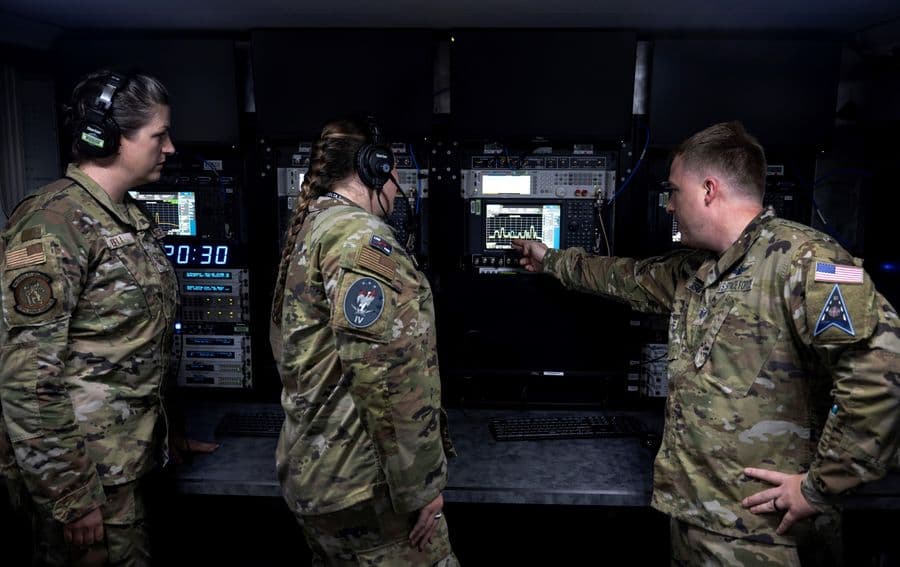
Ensuring U.S. National Security Space Forces Are Ready for Near-Term Conflict
Last updated 07:05 AM EDT • Read time: 6m
The next U.S. President will confront a dramatically worsening international security environment. The growing political, military and technological collusion between the new Axis powers (China, Russia, North Korea and Iran) poses a serious and growing threat to U.S. military forces and America’s vital national interests. The United States faces the very real prospect
of multiple simultaneous, high-intensity military crises or conflicts in Europe, the Middle East, Northeast Asia and the Indo- Pacific. Urgent steps are needed to assure U.S. national security space forces are optimized for near-term high-intensity conflict on a global scale.
There is a growing recognition that U.S. national security space systems, including Department of Defense (Title 10) and Intelligence Community (Title 50) capabilities as well as commercial systems, are essential to America’s security and way of life. Without support from critical space systems, the U.S. ability to protect and defend its global interests would be severely degraded. More pointedly, whether America wins or loses the next war (or wars) may depend on the availability and effectiveness of U.S. space systems.
America’s enemies fully recognize the central role that space systems play in modern warfare and are rapidly developing space and counterspace systems to counter U.S. advantages. Indeed, as noted by then Vice Chief of Space Operations General David T. Thompson, “Russia and China are attacking U.S. satellites every day”. They have conducted jamming and electronic warfare attacks on U.S. Government and commercial satellite communications systems and networks, close approaches of U.S. high value space systems, laser “dazzling” of U.S. photoreconnaissance satellites, destructive and non-destructive tests of ground- and space-based kinetic energy ASAT systems, and cyber operations against space-enabled and -supported networks, among other actions.
In a scenario involving a Chinese blockade or invasion of Taiwan in 2026-27, for example, U.S. government and commercial space systems would be called upon to locate and track Chinese amphibious landing craft and other naval vessels, aircraft, and mobile missiles, provide assured communications to U.S. and friendly forces, enable precision long-range strikes and effective air and missile defense, and much more. The degradation of U.S. space capabilities and services could seriously hinder U.S. military operations and result in much higher casualties among U.S., allied, and friendly military forces and civilians.
In response to such threats, the U.S. has sought to enhance U.S. space resilience. This includes rapid fielding of proliferated low Earth orbit constellations and development of other active and passive measures intended to facilitate continued space operations in the event of enemy counterspace attacks. American Presidents from both political parties have highlighted
the importance of countering adversary space systems and the Department of Defense (DoD) has publicly acknowledged deployment of a U.S. counterspace weapon system.
As important as these steps are, they are not enough. Bold action is needed to ensure U.S. space forces are ready for near- term, high-intensity conflict. The next President should promptly take the following actions:
- Declassify the “fact of” certain U.S. space and counterspace capabilities to bolster deterrence and enhance integration of such capabilities into U.S. war plans and operations. America’s enemies must understand that the U.S. has the capabilities and will to withstand attacks on critical U.S. government and commercial space systems while at the same time counter adversary space systems that are used for targeting American and allied forces.
- Direct the Secretary of Defense (SecDef) and the Director of National Intelligence (DNI) to jointly rationalize governance and align security policies and programs to enable U.S. national security space missions.*
- Strongly urge the Congress to quickly pass the National Defense Authorization Act for Fiscal Year (FY) 2025, the Department of Defense Appropriations Act for FY 2025, and the Intelligence Authorization Act for FY 2025 and submit those bills for your signature. In addition, request that the Congress move expeditiously to pass an Emergency Supplemental Appropriations Act to bolster key U.S. military and intelligence space capabilities, including government and commercial space systems and operations. These bills are urgently needed to strengthen the U.S. defense posture, enhance intra- and inter-regional deterrence, and address gaps in defense and intelligence space capabilities.
- Direct the SecDef to ensure that U.S. Space Force programs, activities and budgets are properly aligned so as to meet the near-term needs of the combatant commanders.
- Conduct a review of U.S. military operations plans and contingency plans for each of the theaters referenced above, including the space warfare aspects of those plans, and provide the SecDef with approvals and pre-delegated authorities needed to conduct timely and effective space and counterspace operations, as appropriate.
- Direct the SecDef to accelerate plans to effectively protect and defend critical U.S, allied, and commercial satellites from adversary attack. In addition, direct the SecDef and the DNI to jointly work with the private sector and allies to strengthen information-sharing on adversary threats to space systems (including space domain awareness data), coordinate on-orbit operations, and rapidly enhance the performance and survivability of U.S., allied, and commercial space systems.
- Direct the DNI to develop options for leveraging Presidential authorities to conduct covert action to enhance the U.S. ability to counter adversary space systems and supporting infrastructure, associated supply chains, and more. Strongly encourage the relevant Congressional committees to rapidly authorize and appropriate funding for any covert action programs.
- Direct the SecDef and DNI to take immediate steps to harden and shield critical U.S. space systems, networks, and components, including those for nuclear command, control and communications (NC3) and intelligence, surveillance and reconnaissance (ISR), from ground- or space-based counterspace threats including deployment and detonation of the Russian nuclear ASAT.**
- Direct the Secretary of State and SecDef to launch a coordinated campaign to work with friends and allies to assure support for U.S. diplomatic efforts to bolster international cooperation on space security, while rejecting unverifiable and counterproductive space arms control measures proposed by Russia and China.
America is entering one of the most dangerous periods in its history. Space will play a decisive role in future conflicts with adversaries who seek to overturn the liberal political and economic order established by the United States and its friends and allies after World War II. A bold vision together with sustained near-term action is needed to assure and enhance the ability of
U.S. space warriors to “fight tonight”.
Chris Williams serves as Chair of the Moorman Center for Space Studies, the independent think tank within the National Security Space Association.
This report is a part of the “Presidential Transition Issue Paper Series”. For more information on this Series and other NSSA Moorman Center activities, please visit us at www.nssaspace.org.
* See “Establish Governance and Align Security Policies and Programs to Enable U.S. National Security Space Missions” https://nssaspace.org/wp-content/uploads/2023/02/pub_2020-10-29.pdf
** See “Russia’s Space-Based, Nuclear-Armed Anti-Satellite Weapon: Implications and Response Options” https://nssaspace.org/wp-content/uploads/2024/05/Russian-Nuclear-ASAT.pdf

The Services Do Not Need a Four-Star Autonomous Warfare Command
By Steven Wills • RealClearDefense
Honor Them While There Is Still Time
By Jeffrey Rosales • RealClearDefense
From Siberia to Fairford: How Operation Spider’s Web Has Changed the Rules of Airpower
By Frank A. Rose • RealClearDefense
Faster Simulations, Better Defense Decisions
By Rut Lineswala • RealClearDefense
Will HASC Have an Oversight Subcommittee in the Next Congress?
By Christopher J. Bright • RealClearDefense
Hegseth Barred Trans Troops. Military Boards Are Rejecting Those Orders.
By NYT
Closing the Sea: Lessons from Ancient Mediterranean Blockades
By DeCasien, CIMSECFrom Siberia to Fairford: How Operation Spider’s Web Has Changed the Rules of Airpower
By Frank A. Rose • RealClearDefenseFaster Simulations, Better Defense Decisions
By Rut Lineswala • RealClearDefense
Bombers Could Have a Major Air-to-Air Combat Role
By Joseph Trevithick, The WarZone