
Why Is the Air Force Backtracking on Competition in Space Launch?
Last updated 05:01 PM EDT • Read time: 8m
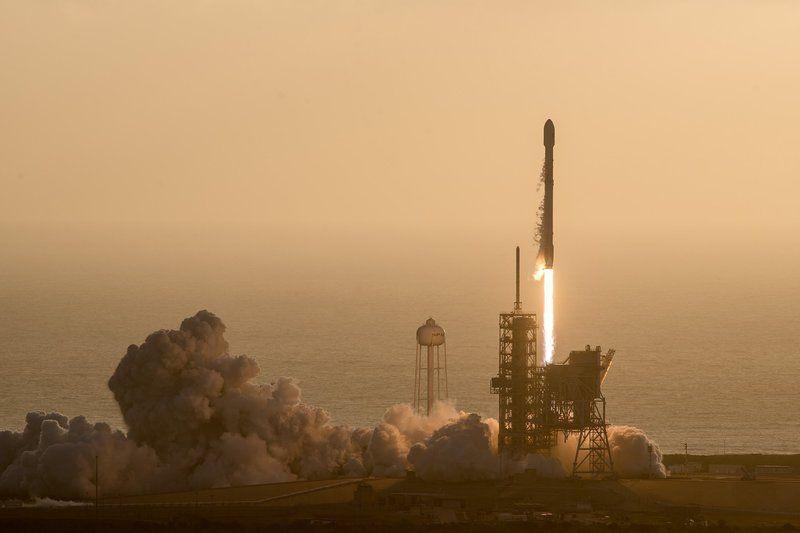
The Air Force will soon announce a competition for its future National Security Space Launch (NSSL) program that will end in its picking two companies out of at least four competitors to launch military satellites over the next five years. Amid the hullabaloo over the creation of a Space Force, a quieter but arguably more important fight is playing out for the future of military space launch. Just as innovation is revolutionizing space launch, the Air Force’s current space procurement will decrease the power of competition. This approach ignores an opportunity to continue driving launch costs down and might result in a space launch industrial base ill-suited to the long-term demands of great-power competition.
Ten years ago, military space launch in the United States qualified as a monopoly. Outside actors, principally Congress and private industry, dragged the Air Force kicking and screaming into space launch competition. Currently, the Pentagon splits its launches between the United Launch Alliance (ULA) and SpaceX. To comply with a congressional deadline to end usage of Russian RD-180 engines used by ULA rockets, the Air Force must design a new space launch program. The military cannot by law be left with only a single provider, in this case, SpaceX.
In October 2018, in a precursor to its NSSL competition, the Air Force awarded $2.3 billion in three developmental contracts to ULA, Blue Origin, and Northrop (formerly Orbital ATK) to tailor their new space launch vehicles to national security parameters, though the companies have self-funded their launch vehicles to varying degrees. This seed funding mitigates risk for the NSSL competition by investing in three different approaches to space launch from three companies with different strengths and different rocket configurations. The fourth viable competitor, SpaceX, did not receive funding, possibly because it did not submit an acceptable bid or because its NSSL solution does not require much more developmental work.
Air Force acquisition executive Will Roper stated that the goal of the developmental funding "is to make sure we have a competitive industrial base...when we get to phase 2," the actual NSSL competition. In that competition, the Air Force intends to only select two companies in 2020 to split five years of launch procurement from 2020-2024 on a 60/40 basis, which will essentially lock out the other two companies until the second half of the next decade. Any company that doesn’t win launches will forfeit all further developmental seed funding.
This sort of managed duopoly exists in the shipbuilding sector, where the combination of industrial base consolidation led to two companies often splitting work 60/40, leaving the Navy with remarkably few levers to pull to influence efficiency. Managing the industrial base in this way makes sense for a shipbuilding sector bereft of relevant commercial opportunities. But given the success of competition in space launch and the explosion of the commercial market, why is the Air Force artificially closing two of the four companies out of military space launch for half a decade?
Speculation has flown from those reading between the lines as the lobbying fight intensifies. Some believe the competition is biased toward incumbents SpaceX and ULA (even though ULA’s building a new rocket) since the new Northrop and Blue Origin rockets will be arguably less mature by the time the winners are picked. Others conclude the Air Force will pick ULA and Northrop because their space launch divisions would go out of business without military work, essentially counting on SpaceX and Blue Origin to subsidize their developmental work with commercial successes.
All that aside, the Air Force believes each competitor will be viable, and any two companies could win. The military's overarching concern is that it has access to at least two launch providers for assured access to space. As such, the Air Force claims that “while we want competition, we also need stability in the launch marketplace” with “well understood partners to work with,” given the demands of mission assurance. Roper also earlier averred that “we need to grow a new industry base” for space launch. And in a recent Senate hearing, Space and Missile Systems Center chief Lt. Gen. J.T. Thompson stated that the slated number of military launches could not support more than two companies. More interestingly, Thompson opened the door to discussions with losing companies about “how we’ll keep them in the game” so that they can compete for phase 3, presumably five years hence.
This approach sounds eminently reasonable but should be subjected to further scrutiny. If the goal is to "grow a new industry base" and improve mission assurance with "well understood partners," why cut two companies out of the five-year launch window? As witnessed in the quest by SpaceX to break into military launches, the familiarity between the Pentagon and industry is paramount. And what if the losing companies decide to go in another direction, rather than hanging around to compete for military space launch in another five years? Losing companies may determine that commercial business is enough. And businesses sometimes take drastic turns; just witness the shuttering of StratoLaunch’s promising aircraft-carried Medium Launch Vehicle, an effort Air Force Secretary Heather Wilson praised only 20 months ago.
The Air Force is understandably wary of another collapse of commercial space launch, which doomed its original late-nineties space launch acquisition strategy. However, the service might be over-learning the lessons of the past, given the burgeoning commercial market. Indeed, only months ago, Air Force Space Command chief Lt. Gen. David Thompson stated, “’In terms of the commercial space industry and its viability, [there's] always a little bit of a concern. Twenty years ago when we started the Evolved Expendable Launch Vehicle program … we were hoping there would be a strong commercial demand signal for launch at that time. It didn’t pan out … I think the situation's a little different today. I think we're more likely to be on the verge of a large commercial breakout.’” For reference, a 2018 Aerospace Corporation report concludes that while current U.S. capacity is approximately 35 launches per year, the demands of planned commercial constellations of anywhere from 13,000 to 20,000 satellites could necessitate up to 128 launches per year in the coming decade, primarily supplied by the four companies involved in military space launch.
Yet, the Air Force’s contracting strategy has not changed to account for those new demand signals in the commercial market. Its "managed duopoly" approach may arguably mitigate short-term risk and save some direct costs by avoiding mission assurance work with a third or fourth company. But it could also erect new walls between a military space launch and the commercial sector that Congress and the launch industry have torn down over time—to the benefit of the military. By choosing only two companies, the Air Force will artificially set a ceiling on the amount of competition in military space launch, which will also result in military adoption of fewer commercial innovations to drive launch cost down.
These are complex questions, and as Lt. Gen. J.T. Thompson has noted, the choices and tradeoffs will become more evident the more the Air Force knows about each company's rocket and business case. If that's correct, why the mad rush to award contracts in 2020? Ostensibly, the Air Force contract award must happen in 2020 so that the Pentagon can meet the legal deadline set by Congress to stop using RD-180 engines. sSeveral of the new launch vehicles under development may not be fully ready by then. The overall policy objective of limiting Russian RD-180 engine usage was to push the Air Force toward fostering domestic competition. With that objective achieved, Congress and the Air Force could work together to soften the legal deadline or more inventively allocate near-term SpaceX and ULA launches. Either would enable the Air Force to push back the NSSL contract award date, allowing more time for all four companies to develop their best offering, for the Air Force to work through more real flight data and for Congress to conduct real debate and oversight over this incredibly important program. House Armed Services Committee chairman Adam Smith (D-WA) just called for such a delay on March 28.
But Congress must lead forcefully on this issue. Air Force leadership remains unlikely to wade into this contentious fight, given the past beating they’ve received over the RD-180 and the current battles over standing up Space Force. Congress could also act upon this problem in several ways in addition to softening the deadline. With more information in hand, lawmakers might even demand that the Air Force maximize NSSL competition by including more than two companies or allowing all four to compete more often than every five years. In lieu of expanding NSSL contracts beyond two companies, Congress could also support industrial base diversity by continuing developmental funding for any losing companies to increase return on the original developmental investment and hedge against future uncertainty.
Maximizing the industrial base’s ability to drive cost down and reliability up requires a combination of commercial pressure with the stringent demands of military launch. Aversion to competition cannot be allowed to further delay the blossoming of a truly diverse and responsive U.S. space launch industry.
Rick Berger is a research fellow at the American Enterprise Institute. Previously, he was a professional staff member at the Senate Budget Committee where he worked on defense, foreign affairs, and veterans’ issues. Follow Rick on Twitter: @bergerrichard

Don’t Be Swayed by Tactical Nukes
By Benjamin Giltner • RealClearDefense
How Seoul’s Break With Kyiv Serves Trump’s Russia Turn
By Sang Won Pyo • RealClearDefense
When the Grid Goes Down, the Mission Must Go On. Solar and Storage Can Help.
By John Szoka • RealClearDefense
Data and Communications Technology are the Hidden Keys to Success for Golden Dome
By Eric Velte • RealClearDefense
The Dual Threat: Why Beijing’s Collapse Is Just As Dangerous as Its Rise
By Efraín Vázquez-Vera • RealClearDefense
USS Stout Loses Power During Port Visit Due to ‘Engineering Casualty’
By USNI News
Air Force Lessons Learned From Operation Epic Fury
By Tabitha Reeves, National Defense
Marines Need Nine More Amphibious Warships To Carry Out Its Missions
By TWZ
AFRL, ACC Fly XQ-67A Drone To Test Autonomous Teaming
By Airforce Technology
F-35B Releases Meteor BVRAAM for the First Time
By Parth Satam, The Aviationist