
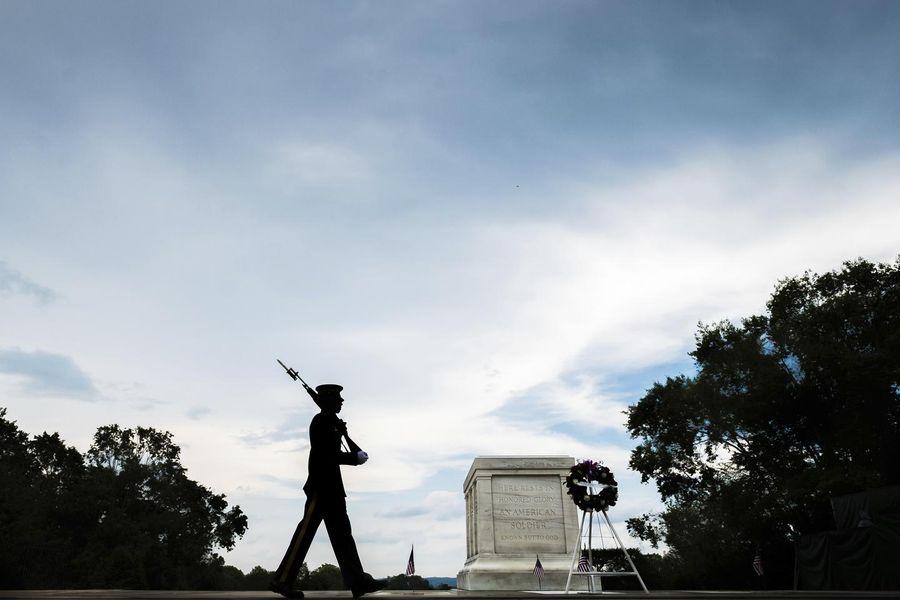
What Do We Owe the Fallen?
Published May 28, 2018 • Read time: 10m
The burden of service is on us, as citizens of this great country
Five years before he became Secretary of Defense, General Jim Mattis was asked during a leadership conference what American society could do to lessen the ‘burden’ on those who serve and fight the nation’s wars. It’s interesting how the question was posed in the somewhat self-evident manner that it was. As another Memorial Day comes and goes, we will, once again, be inundated with articles lamenting that the ‘burden’ of warfighting falls on the shoulders of too few Americans and the supposed “unfairness” of the All-Volunteer Force. This sentiment, which has become highly prevalent, is often accompanied with calls for a return to the draft to diffuse the strain and, perhaps, fight fewer wars in the process.
Gen. Mattis’s response, which is worth listening to in its entirety, can be partially paraphrased as the following: Serving the country is not a burden. It is a privilege, one that few Americans will ever get to experience and that is a pity. We’ve heard similar remarks more recently – White House Chief of Staff Gen. John Kelly, attempting to defend President Trump’s handling of a phone call to the widow of a U.S. soldier in 2017, said the following during a press conference:
We don’t look down upon those of you who haven’t served. In fact, in a way we’re a little bit sorry because you’ll have never have experienced the wonderful joy you get in your heart when you do the kinds of things service men and women do – not for any other reason than they love this country. So just think of that.
If there’s any consensus among Americans today, it’s that those who serve in uniform do in fact comprise a very small percentage – “The Other 1%,” as they’ve been called. Where that consensus is lost is whether that constitutes a ‘burden.’ Two of America’s highest-ranking leaders clearly do not share this view and neither do most veterans. In-depth polling conducted over the years verify this.
In a Washington Post-Kaiser Family Foundation poll from 2015, it was found 89% of veterans, including those currently serving in uniform, would serve in the military again if given the chance. This is consistent with a Pew Research Center poll conducted four years earlier, which showed veterans were overwhelmingly proud of their service, believed it had helped them get ahead in life, led to strong personal development, and would recommend it to young people. While the same polling shows veterans have endured considerable challenges because of their service, such as post-traumatic stress or difficulty adjusting to civilian life. This does not appear to have affected their overall view of the military or even the wars they’ve fought. Polls, of course, never truly speak for themselves and the results must be viewed in the proper context to be well-understood. But prevailing trends among veterans are crystal-clear.
While much is made of the civil-military gap, the Pew poll showed that even the public does not view the military as shouldering an “unfair” burden. In fact, nearly three-quarters considered sacrifices made by servicemembers and their families to be merely a cost of being in the military. This, despite simultaneously conceding that it is servicemembers and their families who’ve sacrificed the most during the post-9/11 era.
What about a draft? Given the incessant calls by advocates, the media, and politicians for the reinstitution of conscription, both veterans and the public alike were shown to be decidedly against such a policy. While it may be easy to dismiss the public’s position as one of ‘privilege’ (of being able to choose not to serve), it speaks volumes those who have served don’t see the draft as any solution. Veterans, given their unique experience, know something of war and likely own a better grasp of what it takes to perform in such demanding environments. Moreover, veterans know all too well the military isn’t for everyone and some are simply not suited for the tremendous responsibilities that come with serving. More recent polling conducted by various sources show opinions of conscription have remained consistent over the years. Coupled with their overall satisfaction with the military, it’s hardly surprising veterans would not be in favor of a personnel policy that would upend the system they see as functioning properly.
Given these responses, it’s safe to say the idea of servicemembers and families as “burdened” is a viewpoint of the vocal minority. Furthermore, there’s very little support for a draft, indicating this policy position, as well, is harbored by a small percentage of Americans who, nonetheless, possess a disproportionate influence on the discourse. This not only highlights the importance of challenging conventional wisdom and those who exploit their command of larger forums and mouthpieces, but also the fact the military and civilian worlds are on the same page more often than appreciated.
Does this mean it’s enough to say, “Thank you for your service,” enjoy the barbeques and social gatherings, and simply move on after every Memorial Day? Should Americans look at these polls and decide all’s well and there’s nothing society owes those who made the ultimate sacrifice? Tempting as it may be to believe, this is the exact opposite Americans should do. While the AVF has largely been a success and service is broadly viewed as something better off as being voluntary, what’s been lost in the process is the understanding that defense of the republic is, ultimately, a national responsibility.
Furthermore, Americans by-and-far admire and support their military. Servicemembers, in turn, accept the gratitude of Americans as genuine. But there’s also a lack of familiarity with the armed forces on the part of the non-serving public. Regardless of how one feels about the AVF, there is no question the military continues to become a world unto itself from which most Americans will never be any part of. And with every culture war battle, be it kneeling during the National Anthem, gun control, or whether America is a distinct nation with traditions and institutions worth preserving and defending, there can also come a sense that those not in uniform are squandering the sacrifices made by those who serve.
Last summer, during a particularly tense moment on the home front, Secretary Mattis addressed troops deployed in Jordan and touched upon this sentiment. Some heard the beloved ‘warrior-monk’ delivering a motivational speech; others heard something potentially sinister. The comments that caused the most consternation was the following:
Keep on fighting… you are buying time. You are a great example for our country. It’s got some problems… problems we don’t have in the military [emphasis mine]. Hold the line until our country gets back to understanding and respecting and showing it… Being friendly to one another.
The worry goes something like this – a failure on the part of the American people to overcome their divisions and tackle national challenges in a civil manner could lead to the military perceiving itself as culturally and morally superior to those they defend. This, critics say, is not only widening whatever gulf presently exists in civil-military relations but could create conditions that contribute to societal decay. Assuming the public’s admiration of the military holds strong, the result could be an America where those charged with defending us are viewed as the only ones capable of preventing the nation from falling apart.
These concerns are as old as the republic and deserve its own debate on the matter. Better yet, we’re not anywhere close to a civil-military crisis and its hoped we’ll never be. After all, the Great American Experiment has proven itself resilient time and again in a variety of situations and there’s little doubt we’ll get through the present malaise. But doing so takes work, vigilance, and a sense of responsibility. These are virtues the military unquestionably possesses, but so should all Americans, in uniform or not.
Which brings us to the question – what do we owe the fallen and others who’ve served? They don’t want us to shoulder more of the burden, because, as far as they’re concerned, there’s none. They don’t believe anyone, and everyone should make these sacrifices. But there may be a sense the public, while appreciative, is failing to uphold its responsibilities by waging vicious culture war battles against its fellow citizens and undermining the institutions and traditions that form the bedrock of a nation. What can be done?
The Steven Spielberg masterpiece Saving Private Ryan is certainly one of the greatest war movies ever and it holds up extremely well 20 years later. It’s a testament not only to the filmmaking talents of its director, but also to what I believe to be the core message of the film. At the risk of spoiling the ending (if you haven’t seen it yet, I implore you to do so), I refer to the moment where Captain John Miller, performed so admirably by Tom Hanks, speaks the final words of his life to Private James Ryan, namesake of the film, and played by Matt Damon. As he struggles to breathe his last breaths, he mutters “Earn this. Earn it,” to Private Ryan.
In the final scene of the film, an elderly Private Ryan speaks to the cross bearing Captain Miller’s name at the D-Day Memorial in Normandy. He tells Captain Miller not a day has passed that he has not thought of what Miller asked of him. He also says he has lived his life the best he could and hopes that is enough to make him worthy of the sacrifices made on his behalf.
The idea of earning the sacrifices others have made is so poignant because one can never repay those sacrifices. How does one sufficiently compensate for lost lives and limbs? Or the damage to one’s physical and psychological health, the pain and anguish war inflicts, and the innocence and time it robs? It isn’t something we can ever sufficiently compensate them for, which is why the burden of service is not on those who serve, but those who are served.
This, I believe, to be the true message of the film. It’s a universal message that speaks through the ages; Captain Miller wasn’t just talking to Private Ryan, but to all of us. Sacrifices are made so others can live happy, free, and without fear. We often wonder if there’s a better way, but until we find it, the men and women of our armed forces hold the line, every day, at great expense to themselves, their families, or their lives. But they ask not for our pity nor our blood. They ask simply that we become worthy of all that’s been done for us.
That’s how we honor the fallen. Not only on Memorial Day but every day, by being the best person we can be. That certainly involves the responsibilities of citizenship, such as upholding and defending the Constitution, obeying the law, and constructively participating in the political process. But it also involves more modest practices – being good parents, siblings, spouses, and friends. It means putting in an honest effort at work each day, whether we love our jobs or not. It means not missing out on opportunities to better ourselves and, when we can, to turn around and help others who seek the same for themselves. It means we look upon our fellow citizens not with hard hearts, but with grace and empathy. Last, but not least, it means we look upon ourselves with both self-respect and humility.
If we commit ourselves to all the above and set the example for future generations to follow, we will have become worthy of those sacrifices.
Edward Chang is a freelance defense, military, and foreign policy writer. His writing has appeared in The National Interest and War Is Boring.

End the Jones Act Waiver
By Mark H. Buzby • RealClearDefense
Prediction Markets Are Becoming a New Frontline for Military Operational Security
By Yang Yunke • RealClearDefense
Can Robots Bring Maneuver Warfare Back?
By Ayeza Areej • RealClearDefense
Buy Smarter, Fly More
By Jeff Kojac • RealClearDefense
Stop Gutting the Conventional Army
By R.D. Hooker, Jr. • RealClearDefense
Hung Cao Facing Contentious Confirmation To Become Navy Secretary
By Konstantin Toropin • Associated Press
U.S. Marines Expand M27 Rifle Contract
By Inder Singh Bisht
Kadena AFB Gets First F-15EX Eagle IIs
By Emily Ryan Miller, Defence BlogHung Cao Facing Contentious Confirmation To Become Navy Secretary
By AP
Fair Winds, Peacoat and Desert Camo: Navy Makes Big Changes to Seabag
By MTimes