
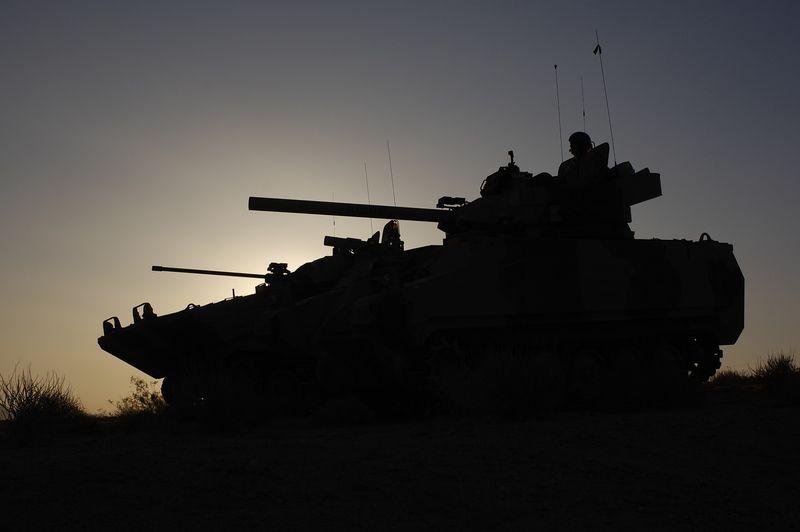
The Reconnaissance and Security Strike Group
Published May 22, 2017 • Read time: 2m
A Multi-Domain Battle Enabler
Introduction
When the U.S. Army reorganized its final armored cavalry regiment (ACR) in 2011, it divested its institutional capability to enable corps maneuver with forceful reconnaissance and security (R&S) at the operational level of war.
Designed as relatively independent brigade-sized formations that included tanks, mechanized scouts, self-propelled artillery and organic aviation, storied units like the 2nd, 3rd, 11th and 14th ACRs became iconic symbols of U.S. military power across the plains of Europe, jungles of Indochina and the deserts of Mesopotamia. Throughout the Cold War and the 1990s, the unique commands employed advanced combined-arms integration to, as stated by BG John Kolasheski, the Army’s 50th Chief of Armor, “fight and win decisively across the full spectrum of conflict as part of the joint force.”
Arguments for the recreation of ACRs typically center on their outsized impact during major combat operations. However, in addition to enabling corps-level attacks across theater depth during multi-domain battle, more expansive arguments can demonstrate how modernized versions of the regiments – perhaps reconceptualized as more dynamic R&S strike groups (RSSG) – could empower joint efforts across the simultaneous phases of shape, deter, seize initiative, dominate, stabilize and enable civilian authority. Combined-arms teams with cross-domain capability could provide enhanced flexibility in diverse operations ranging from military engagement to limited contingency response; defeating adversaries by fighting for information and providing freedom of maneuver will remain critical.
Not Only Robots: Warfare Will Still Need Humans
Precision Strike Missile Leaves Wide Path of Death and Destruction in Iranian City
Why Small Powers Are Not a Walkover
India's Drone Army
Versatile RSSGs would be suited to “penetrate denied areas for the rest of the joint force” while having the agility to “operate in all domains simultaneously,” said GEN Mark Milley, 39th Chief of Staff of the Army. As the vanguard of American landpower, they would supplement armored brigade combat team (BCT) rotations through Europe and East Asia while providing a permanent forward presence to achieve enduring partnership as a primary regionally aligned force (RAF). Second, the concept would augment the Army’s excursion initiative to temporarily task-organize BCTs to serve as dedicated R&S elements. A modernized cavalry force optimized to fight for information and allow freedom of maneuver would achieve deeper expertise as the “eyes and ears” of joint-forces commands.

Why Iran is Not Vietnam
By Kevin Brown • RealClearDefense
Closing the Missile (Defense) Gap
By Jason Camilletti • RealClearDefense
Iron Raven: Remembering Colonel Joseph B. Conmy, Jr.
By Louis Marano • RealClearDefense
Stand Proud of the Force
By Jay Rogers • RealClearDefense
How a Dying Agency Turned Fentanyl Into a Weapon of Mass Destruction
By Barry Angeline • RealClearDefense
Closing the Missile (Defense) Gap
By Jason Camilletti • RealClearDefense
Marine Corps Hero Under Federal Investigation
By Laporta, Burnham & Watson, CBS
A Postmortem of Maneuver Warfare in the U.S. Marine Corps
By Donald Vandergriff
U.S. Putting Weapons in Space: A Strategic Blunder?
By Ajey Lele • RealClearDefense
U.S. Senate Seeks to Exchange Shipbuilding Funds for More Munitions
By Naval News