
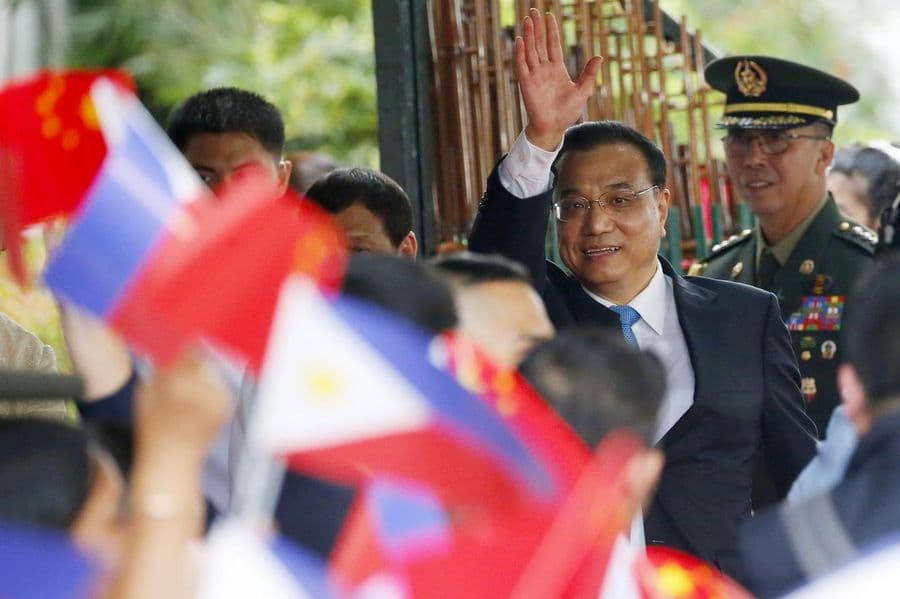
Philippine Troops to China?
Last updated 05:29 PM EDT • Read time: 3m
Imagine this. China builds a military base on the Australian continental shelf off, say, Cairns. Then, according to the Australian prime minister, China threatens a military response should Australia attempt to exercise its maritime rights in accordance with a unanimous international tribunal decision that ruled this Chinese base unlawful.
Next, that same prime minister suggests that Australia is “veering towards China”, and that Australian troops should be trained in China to “balance” the Australian Defence Force’s over-reliance on training in the US. The spokesperson for the prime minister also suggests that Australia should not protest against Chinese actions, but hopes China will hand over the base to Australia eventually.
Impossible? Surreal?
This is current Philippine reality. On 19 February, President Rodrigo Duterte, in a speech to a Filipino-Chinese business grouping, suggested that Philippine troops should be sent to China for counterterrorism training, as a way of balancing against the Armed Forces of the Philippines’ choice to train in the US. On 7 February, presidential spokesperson Harry Roque opined that in the future, the Philippines would thank China for constructing military bases in the Philippine-exclusive economic zone. Last year, on 19 May, Duterte stated that China’s Xi Jinping had told him China would go to war if the Philippines tried to drill for oil in the West Philippine Sea.
If this presidential idea to send Philippine troops to China for training is more than just an utterance to please the crowd (which included the beaming Chinese Ambassador to the Philippines), it will likely become another China-related source of potential friction between the Duterte and the military.
That friction has already been on display. In late 2016, Duterte urged the Armed Forces of the Philippines to procure weapons from China and Russia; so far, however, no such ties have been made. In January 2017, Defense Secretary Delfin Lorenzana (who Duterte has joked is an American agent in his cabinet), issued a formal statement expressing the view that China’s military actions in the West Philippine Sea were “very troubling”. Last April, Duterte cancelled a planned visit to Pag-asa island in the West Philippine Sea at the request of China, which also lays claim to this maritime feature. Two weeks later, Lorenzana visited Pag-asa, promising to refurbish its ageing facilities.
The more President Duterte pushes for closer military relations with China, the more it will put pressure on the Armed Forces of the Philippines and its leaders (who can be changed by the president) to respond positively.
With more than four years remaining in Duterte’s current presidential term, his embrace of China and its implications for the Philippine military is an issue that Australia, and other countries who seek increased security cooperation with the Philippines, should watch closely.
Malcolm Cook is a Nonresident Fellow at the Lowy Institute. From 2003 to 2010, he was the Institute’s inaugural East Asia Program Director. He completed a Ph.D. in International Relations from the Research School of Pacific and Asian Studies at the Australian National University. He also holds a Masters degree in International Relations from the International University of Japan and an honours degree from McGill University in Canada, his country of birth. Before moving to Australia in 2000, Malcolm lived and worked in the Philippines, South Korea and Japan.
This article appeared originally at Lowy Institute's the interpreter.
Beyond Hormuz: What Washington Should Expect from a Frontline Ally
By Daewon Cho • RealClearDefense
Putin, Plague, and the America’s Biodefense Gap
By Ryan Kane • RealClearDefense
Patriot Delays Force a New Air Defense Doctrine on NATO’s Eastern Flank
By Jan K. Varga • RealClearDefense
How the Army Can Turn Plans into Combat Power
By Matt Russell • RealClearDefense
Is It Déjà vu All Over Again: The 2012 Report on Global Zero
By Peter Huessy • RealClearDefense
U.S. Marine Corps Attack Helicopters Set for Major Upgrade
By C. Jones, Defence Blog
How the Iran War Compounded the U.S. Navy’s Maintenance Crisis
By Hartung, NatInt
Fielding Forces for Full Mobilization
By Jon Hoffman, Proceedings
BAE’s New Launcher Lets Warships Deploy and Replenish Missiles at Sea
By NextGenD
Why Is the Navy Spending $19 Billion on ‘Flying Gas Stations’?
By Mark Thompson, RS