
The Strategic Competition We've Neglected: Confronting China in Mexico
Published May 14, 2020 • Read time: 8m
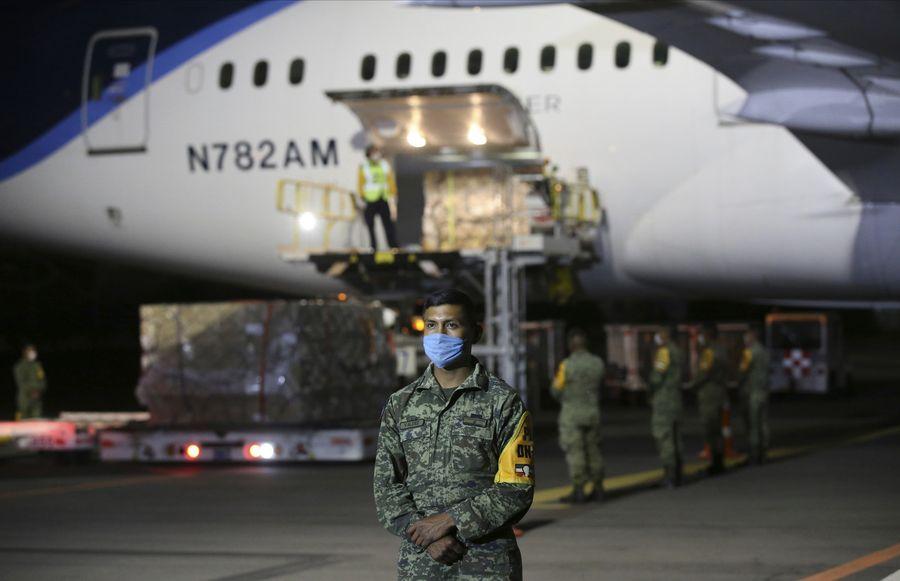
“Thank you China!!!,” Mexican Foreign Minister Marcelo Ebrard posted on Twitter several weeks ago.[1] Ebrard’s effusive message followed China’s delivery of medical supplies to combat Mexico’s novel coronavirus outbreak. While somewhat striking, given China’s own complicity in the pandemic’s spread, Ebrard’s statement captures the effectiveness of China’s medical diplomacy in Latin America. Like all forms of its soft power in the region, China uses medical diplomacy to challenge U.S. predominance in the Western Hemisphere. The United States faces strategic competition far closer than the South China Sea or Eastern Europe. With the U.S. long focused on terrorism, China’s footprint in Mexico has grown considerably. Wielding soft-power influence, China has established its ability to undermine U.S. interests across our Southwest border.
After almost 20 years of fighting terrorism, the Department of Defense is transitioning. The 2018 unclassified synopsis of the National Defense Strategy (NDS) states starkly, “Inter-state strategic competition, not terrorism, is now the primary concern in U.S. national security.”[2] Naming China and Russia first among our strategic competitors, the document identifies two alliance networks as a means to maintain our strategic advantage: Indo-Pacific alliances and NATO. A strong network of U.S.-allied states in the Indo-Pacific region and Europe will support U.S. efforts to balance against a rising China and a revanchist Russia. These alliances, from bilateral relationships to multinational organizations, help deter Chinese and Russian aggression and would prove critical in the event of conventional war with either. But in understanding the value of alliances in today’s inter-state strategic competition, we must not only gaze across an ocean. We must also gaze across our Southwest border.
China’s Revised Mobilization Law and the Expanding Reach of National Defense
America Must Win the Biotech Race Against China
China’s Epic Campaign To Steal America’s Secrets
The Dual Threat: Why Beijing’s Collapse Is Just As Dangerous as Its Rise
The NDS addresses United States-Mexico relations indirectly. “The U.S. derives immense benefit from a stable, peaceful hemisphere that reduces security threats to the homeland. Supporting the U.S. interagency lead, the Department will deepen its relations with regional countries that contribute military capabilities to shared regional and global security challenges.”[3] Violence on our Southwest border poses a persistent threat to the homeland. Criminal organizations regularly conduct drug trafficking and human smuggling into the U.S., with weapons flowing in the other direction. The United States maintains great interest in bilateral security cooperation with Mexico. China’s growing soft power in Mexico should concern us.
Mexico’s ongoing economic crisis will likely exacerbate friction points like Southwest border violence and U.S-bound migration if the 1980s and ‘90s provide any indication.[4] A failure to reach a resolution on these fronts could herald worsening tensions with the U.S., especially if Washington maintains a confrontational stance toward Mexico beyond 2020. Eager to gain ground at the U.S.’s expense, China certainly sees an opportunity in Mexico.
In President Andres Manuel Lopez Obrador (AMLO), China likely hopes to cultivate a receptive partner despite the Mexican economy’s close integration with the U.S. A left-leaning nationalist, AMLO has openly objected to perceived U.S. heavy-handedness. Even in the security realm, AMLO appears wary of his northern neighbor, stating his opposition to U.S. “intervention” on fighting drug cartels.[5] The specter of U.S. encroachment still looms in Mexican politics and civil society. Moreover, popular sentiment toward the United States has deteriorated over the past few years, with 65% of Mexicans expressing unfavorable views in 2018.[6] In early 2020, Mexico figured among several countries worldwide expressing more favorable views of China than the U.S.[7] This declining popular support captures the erosion of U.S. soft power in Mexico.
Boasting the world’s second-largest economy, Beijing is poised to gain ground the U.S. has lost in Mexico. With its Belt and Road Initiative (BRI), formally inaugurated in 2013, China has quickly expanded its investment in the developing world. While ambitious in itself, the BRI’s official mission to “promote the connectivity of Asian, European, African continents and their adjacent seas,” has already proven an understatement.[8] Beijing has extended BRI invitations to Latin America as well, with U.S. partners like Peru and Chile joining. While Mexico has not formally joined the BRI, AMLO has concluded several BRI-related agreements and sent delegates to attend the 2019 Belt and Road Forum for International Cooperation.[9] Moreover, AMLO has vowed to diversify Mexican exports away from the U.S., especially amid the threat of sanctions. At a 2019 G20 meeting, Foreign Minister Ebrard stated plainly, “What we’re interested in is increasing Mexico’s presence in China, Mexico’s capacity to export to China. And China’s investments in Mexico.”[10] At last year’s Forum of Economic Cooperation and Investment between Mexico and China, Undersecretary for Foreign Trade Luz Maria De la Mora opined, “Mexico is a friend and partner to China. We know that with China, Mexico can be stronger, and with Mexico, China can be a stronger country too.”[11] Indeed, China enjoys the status of Mexico’s second-largest trade partner and third-largest export market.[12] Despite U.S. attempts to dissuade Mexican officials from doing business with China, the AMLO administration appears welcome to Beijing’s overtures.
Former Secretary of State Rex Tillerson observed that China “is using economic statecraft to pull [Latin America] into its orbit; the question is at what price.”[13] Indeed, by growing its economic footprint in Mexico, China seeks to challenge U.S. influence in the Western Hemisphere. Fervently opposing U.S. intrusion in what China deems its backyard, e.g., the South China Sea, Beijing may intensify its activity in Latin America. Driven by economic opportunity and geopolitical competition, China has little interest in helping Mexico with its deepest structural problems. The U.S., on the other hand, does.
As the two state stakeholders on our Southwest border, the U.S. and Mexico both hope to stem the region’s unrelenting violence and crime. Washington has long sought to combat narco-trafficking into the U.S., while Mexican officials continue struggling with alarming homicide rates. Deep-rooted corruption and the limited rule of law, however, cripple Mexican governance. Weak governing bodies have ceded swaths of territory to cartels. Mexico needs a more robust security strategy than AMLO’s “abrazos, no balazos” (hugs, not bullets) approach to the cartels. The United States and Mexico should expand their security and law enforcement coordination, with continued close involvement from agencies like the FBI, DHS, and DEA. Increased intelligence sharing and technical assistance will likely help both Mexican and U.S. authorities target criminal organizations, as well as the drugs, money, and weapons they traffic. Such cooperation will continue to prove critical in establishing security on our treacherous shared border.
China, for its part, will surely continue challenging U.S. interests in the region. Its playbook includes reinforcing anti-U.S. regimes like Venezuela and Nicaragua, ingratiating itself with traditionally pro-U.S. states like Argentina and Chile, and applying diplomatic pressure to target Latin American political officials.[14] An established China in Mexico can more freely exploit vulnerabilities on our Southwest border as well.
Restoring our standing in Mexico will help us confront our most formidable strategic competitor in the Western Hemisphere - China. Mexico’s value to the United States exceeds any contribution of “military capabilities to shared regional and global security challenges.”[15] We need Mexico to secure the homeland - first on the list of our defense objectives.[16] Beijing wants nothing less than a weakened United States to achieve global predominance. We ignore a rising China in Mexico at our peril.
Lindsay Gabow is an active-duty captain in the U.S. Army currently stationed at Fort Huachuca. The views expressed are the author’s alone and do not represent the official position of the U.S. Army or the Department of Defense.
Notes:
[1] “'Thank You China!!!' Mexico Grateful for Coronavirus Medical Supplies,” Reuters (Thomson Reuters, April 1, 2020), https://www.reuters.com/article/us-health-coronavirus-mexico-china/thank-you-china-mexico-grateful-for-coronavirus-medical-supplies-idUSKBN21J6U5).
[2] “2018 National Defense Strategy of the United States of America,” https://dod.defense.gov/Portals/1/Documents/pubs/2018-National-Defense-Strategy-Summary.pdf, 1.
[3] Ibid, 9.
[4] Kevin Sieff, “Coronavirus Hits Mexico's Economy Where It Hurts Most: Oil, Tourism, Remittances and Trade,” The Washington Post (WP Company, April 23, 2020), https://www.washingtonpost.com/world/the_americas/coronavirus-mexico-economy-oil-tourism-remittance-trade-amlo/2020/04/22/ed4b7532-7f68-11ea-84c2-0792d8591911_story.html).
[5] Rafael Bernal, “Mexican President Tells Trump 'No Intervention,' Only Cooperation on Combating Cartels,” The Hill (The Hill, November 27, 2019), https://thehill.com/policy/international/472257-mexican-president-tells-trump-no-intervention-only-cooperation-on).
[6] Chicago Council on Global Affairs, “For First Time, Majority of Mexicans Hold Unfavorable View of United States,” Chicago Council on Global Affairs, January 18, 2018, https://www.thechicagocouncil.org/publication/first-time-majority-mexicans-hold-unfavorable-view-united-states).
[7] Laura Silver and Kat Devlin, “Around the World, More See the U.S. Positively than China, but Little Confidence in Trump or Xi,” Pew Research Center (Pew Research Center, January 10, 2020), https://www.pewresearch.org/fact-tank/2020/01/10/around-the-world-more-see-the-u-s-positively-than-china-but-little-confidence-in-trump-or-xi/).
[8] Belt and Road Initiative, accessed April 29, 2020, https://www.beltroad-initiative.com/belt-and-road/).
[9] “Belt and Road in Latin America: A Regional Game Changer?” Atlantic Council, October 17, 2019. https://www.atlanticcouncil.org/in-depth-research-reports/issue-brief/belt-and-road-in-latin-america-a-regional-game-changer/.
[10] Dave Graham, “Mexico Seeks Closer China Business Ties during Testing Time on Trade,” Reuters (Thomson Reuters, June 29, 2019), https://www.reuters.com/article/us-mexico-china/mexico-seeks-closer-china-business-ties-during-testing-time-on-trade-idUSKCN1TU0N6).
[11] teleSUR / MP, “Mexico and China Can Be Stronger Together: Mexican Gov't,” News | teleSUR English (teleSUR, June 5, 2019), https://www.telesurenglish.net/news/Mexico-and-China-Can-Be-Stronger-Together-Mexican-Govt-20190605-0018.html).
[12] Secretaría de Relaciones Exteriores, “Foreign Secretary Marcelo Ebrard Begins Visit to China,” gob.mx, accessed April 29, 2020, https://www.gob.mx/sre/articulos/foreign-secretary-marcelo-ebrard-begins-visit-to-china-207282).
[13] “Latin America Should Not Rely on China: U.S. Secretary of State Tillerson,” Reuters (Thomson Reuters, February 1, 2018), https://www.reuters.com/article/us-usa-diplomacy-latam-china/latin-america-should-not-rely-on-china-u-s-secretary-of-state-tillerson-idUSKBN1FL6D5).
[14] Jessica Ludwig, “We're Underestimating China's Impact on Governance in Latin America: Three Persistent Myths,” Global Americans, November 15, 2019, https://theglobalamericans.org/2019/11/were-underestimating-chinas-impact-on-governance-in-latin-america-three-persistent-myths/).
[15] “2018 National Defense Strategy of the United States of America,” 9.
[16] Ibid, 4.

Iron Raven: Remembering Colonel Joseph B. Conmy, Jr.
By Louis Marano • RealClearDefense
Stand Proud of the Force
By Jay Rogers • RealClearDefense
How a Dying Agency Turned Fentanyl Into a Weapon of Mass Destruction
By Barry Angeline • RealClearDefense
The Pressure Is the Message: What Xi and Putin Faced in Shenzhen
By Emzari Gelashvili • RealClearDefense
China’s Revised Mobilization Law and the Expanding Reach of National Defense
By Muhammad Shoaib • RealClearDefense

Marine Corps Hero Under Federal Investigation
By Laporta, Burnham & Watson, CBS
A Postmortem of Maneuver Warfare in the U.S. Marine Corps
By Donald Vandergriff
U.S. Putting Weapons in Space: A Strategic Blunder?
By Ajey Lele • RealClearDefense
U.S. Senate Seeks to Exchange Shipbuilding Funds for More Munitions
By Naval News
F-35C Completes First Launch and Recovery Trials on a Ford-Class Carrier
By Navy T.