
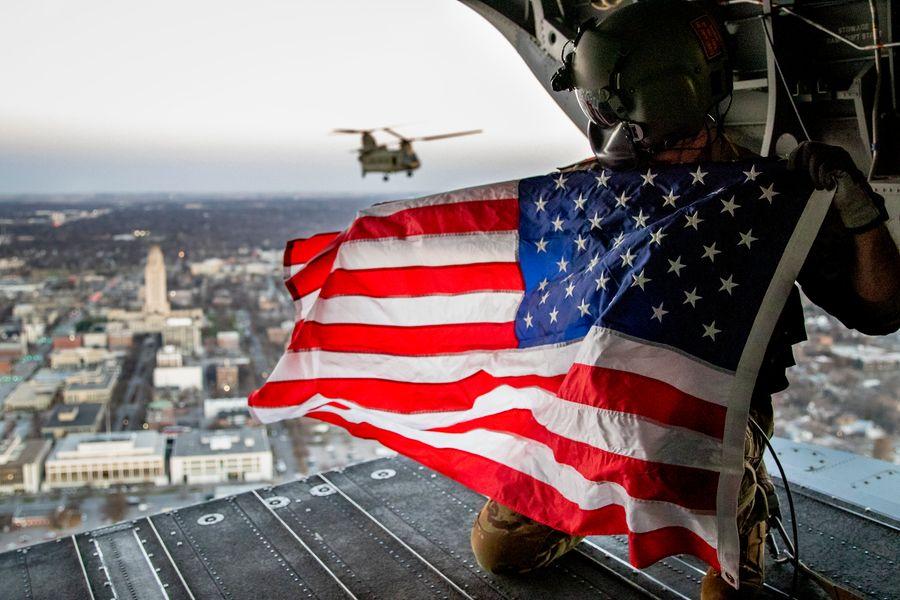
Improve, Don't Replace, Proven Chinook Capabilities
Published June 4, 2021 • Read time: 4m
A commonsense lesson inherent to farmers is that if it isn’t broken, don’t fix it. That’s not to say we don’t upgrade tried-and-true equipment and practices as technology advances. Over the century my family has improved our land in Ethan, South Dakota, by utilizing emerging technology to improve the efficiency of everything from planting and harvesting to crop rotation and soil conservation. Adaptation is key to success, not just in farming but in every aspect of life – including national defense.
Farmers are natural stewards and we work tirelessly to sustainably raise our crops and livestock to optimize yield for its future potential. Maximizing our resources to enhance the land while leaving it better than we found it epitomizes the strategy we employ on our century old farm. Our national defense has benefited from a similar strategy.
A few years ago, the U.S. Army told Congress that upgrading the Chinook helicopter to a modernized Chinook Block II was a priority and dedicated funds to do it. Those upgrades would enable the Chinook to fly farther, carry heavier payloads and perform better at higher altitudes in hot weather conditions compared to its predecessor. The first three of these new aircraft are currently supporting developmental testing as we speak. However, the Army pulled back from its previous commitments, threatening key capabilities like being able to carry the Joint Light Tactical Vehicle or the M777 Extended Range Howitzer. This pullback also impacts the availability and cost of future parts for aircraft which will reduce aircraft availability and the workforce that builds the Chinook.
Stop Gutting the Conventional Army
The Army Needs a Data Logistics Discipline Before the Next Surge
U.S. Soldier Arrested on Suspicion of Espionage Linked to Russia
Partnering Decides Whether Flexible Military Construction Can Work
I flew the Chinook during my deployment to Korea in the 1970s. It was powerful, fast, and versatile. From my point of view, it has only gotten better since that time. Farming is my passion, but it was an honor to serve with others as test pilots to modernize the Chinook following the Vietnam War. The Chinook is invaluable in domestic rescue missions as well as fire suppression. Today’s upgraded Chinook builds on its solid foundation, applies past lessons learned, and features the latest technologies to ensure it’s ready for the demands of the future. The Chinook’s functionality and serviceability provide the most cost-effective way to meet today’s challenging military environment while ensuring our Chinooks have unmatched next-generation capabilities for the future.
The Chinook is one of the best examples of how our nation’s decision makers can integrate cutting-edge technology with proven military platforms while remaining responsive to the evolving needs of our military in a fiscally responsible way.
If Congress doesn’t act soon, there’s a real possibility that the Chinook production line could close, leaving the United States vulnerable to our adversaries. If this happens, our troops would lose the critical capabilities they rely on today while also limiting the introduction of new technologies needed in future wartime situations.
Notably, the Army doesn’t even have a replacement plan for the Chinook should it halt production. That means if the line shuts down, there would be a sizable gap between the Chinook and whatever might ultimately replace it. That’s a risk to our national defense that our friends and family who fight for this country can’t afford.
I’ve made a profession out of farming, but the military taught me that even small mistakes can impact your operation in a big way. Without a planter, combine, or other farming equipment, we can’t raise or harvest the crops that our livelihoods depend upon. Similarly, without steadfast military equipment like the Chinook, successful missions and the lives of our military are at risk. We must be smart and resourceful with what we have. I just can’t for the life of me figure out why the Army is going back on its word with no other options to replace it on the table. How will soldiers move some of their most valuable assets in a fight without the Chinook Block II? I would never invest in a planter or combine without also investing in the most upgraded technology. I want to do the best job possible while producing food, fiber, and fuel and using our resources in the most sustainable manner.
Improving existing infrastructure, products, and programs is often the most economical and operationally sound decision. It prevents capability gaps, preserves money for future investments in emerging technology, and supports job sustainment, creation, and opportunity. The Chinook program isn’t broken, but the promises made to upgrade it have been.
Lewis Bainbridge is a U.S. Army Chinook pilot and third-generation farmer/rancher from South Dakota. He is a plant science graduate of South Dakota State University, a charter member of the South Dakota Corn Association, and has also chaired the Corn Utilization Council and the United Soybean Board. He is the founding member of Farmers Pork Co-op.

Iron Raven: Remembering Colonel Joseph B. Conmy, Jr.
By Louis Marano • RealClearDefense
Stand Proud of the Force
By Jay Rogers • RealClearDefense
How a Dying Agency Turned Fentanyl Into a Weapon of Mass Destruction
By Barry Angeline • RealClearDefense
The Pressure Is the Message: What Xi and Putin Faced in Shenzhen
By Emzari Gelashvili • RealClearDefense
China’s Revised Mobilization Law and the Expanding Reach of National Defense
By Muhammad Shoaib • RealClearDefense

Marine Corps Hero Under Federal Investigation
By Laporta, Burnham & Watson, CBS
A Postmortem of Maneuver Warfare in the U.S. Marine Corps
By Donald Vandergriff
U.S. Putting Weapons in Space: A Strategic Blunder?
By Ajey Lele • RealClearDefense
U.S. Senate Seeks to Exchange Shipbuilding Funds for More Munitions
By Naval News
F-35C Completes First Launch and Recovery Trials on a Ford-Class Carrier
By Navy T.