
DDGs, Lasers and ASCMs: An Analysis
Published Nov. 23, 2021 • Read time: 6m
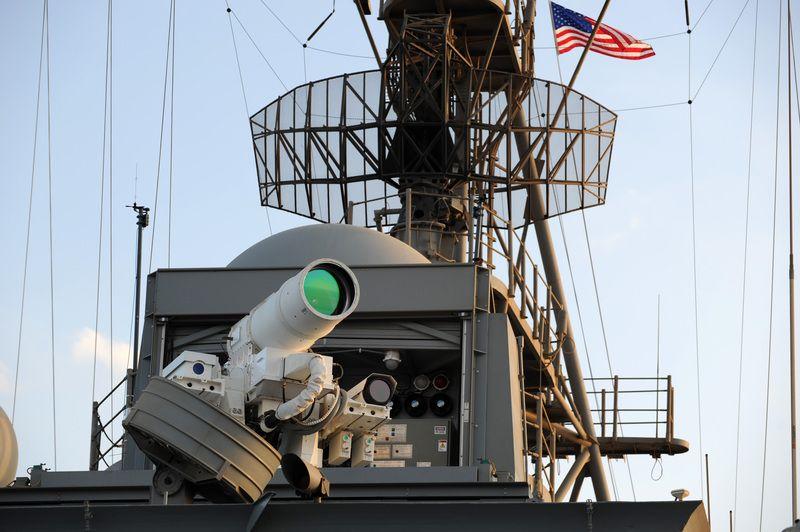
The United States Navy has decided to install a laser weapon system on some of its guided missile destroyers (DDGs).[i] These systems will replace the existing Phalanx Close-In Weapon System (CIWS). The laser system to be installed is the Optical Dazzler Interdictor, Navy (ODIN). The purpose of ODIN is to “dazzle” the sensors of any Unmanned Aircraft System (UAS, more commonly referred to as drones) flying nearby.
“Dazzle” is a technical term, meaning to blind, generally temporarily, a sensor, usually an optical sensor, by shining a high-powered energy stream into it – in this case, laser light. And what a fun term to use! Just say it – “dazzle” – wasn’t that fun?!? And effective, too, as successfully blinding a hostile sensor will render it useless…
…For a period of time. It is certainly possible, if the laser is strong enough and is focused on the sensor long enough, that it might permanently damage or destroy the optical sensor, but generally dazzling is a temporary effect, lasting only as long as the laser is trained on the sensor (and this seems to be true of ODIN[ii]). Of course, as a ship is only equipped with one ODIN, the operational effect is easily defeated by employing a second drone…
But the purpose of this article is not to discuss the operational utility of dazzling UASs; the purpose is to evaluate the operational effect of replacing a CIWS, designed to defeat incoming anti-ship cruise missiles (ASCMs), with a system that is unable to defeat an incoming ASCM.
In conducting this analysis, we will employ the Salvo Equations, developed by the late Captain Wayne Hughes and discussed in detail in Fighting the Fleet: Operational Art and Modern Fleet Combat.[iii] With the Salvo Equations, Captain Hughes…
“…showed how modern naval combat follows a salvo model: opponents apply a pulse of combat power to each other in an instantaneous salvo exchange. A salvo exchange is an interaction of offensive combat power (e.g., mines, torpedoes, bombs, or missiles) and defensive combat power (e.g., surface-to-air missiles [SAMs], jamming, chaff, decoys). Combat power remaining from these interactions is applied against a target’s staying power (the number of hits of a particular weapon that a target can withstand and still be useful for combat purposes).[iv]
The Salvo Equations are presented here for reference and are discussed in great detail in Chapter 1 and Appendix A of Fighting the Fleet:
where:
A = number of units in force A.
B = number of units in force B.
ß = number of well-aimed missiles fired by each B unit.
α = number of well-aimed missiles fired by each A unit.
α1 = number of hits by B's missiles needed to put one A out of action.
b1 = number of hits by A's missiles needed to put one B out of action.
α3 = number of well-aimed missiles destroyed by each A.
b3 = number of well-aimed missiles destroyed by each B.
ΔA = number of units in force A out of action from B's salvo.
ΔB = number of units in force B out of action from A's salvo.
Using the Salvo Equations is fairly straightforward. Parameters and assumptions associated with this analysis include the following:[v]
- All ship and weapon system characteristics were derived from UNCLASSIFIED sources (i.e., Wikipedia).[vi]
- Ship class and weapon systems were based on the ARLEIGH Burke-class DDG.
- “Force A” is represented by a DDG equipped with a Phalanx CIWS.
- “Force B” is representative of a DDG equipped with ODIN.
- Anti-ship weapon loadout for both DDGs consisted of 8 x Harpoon Anti-Ship Cruise Missiles (ASCMs), and all ASCMs are assumed to be "well aimed."
- Unless otherwise indicated, engagements occurred near-simultaneously with similar scouting capabilities. [vii]
- There were no other vessels in the target areas, such that ASCMs did not accidentally strike other vessels instead of the intended target.
- In terms of a3 and b3 (the number of well-aimed missiles destroyed by Force A and B ships, respectively):
- A ship’s defensive Surface-to-Air Missile (SAM) system could defeat two (2) incoming ASCMs.
- A ship’s passive and non-kinetic defensive systems (decoys, jamming, etc.) could defeat two (2) ASCMs.
- The Phalanx CIWS could defeat 2 x ASCMs before its magazine was expended.
- It takes three (3) ASCMs to fully knock a DDG out of action (a1 and b1).
Based on the assumptions outlined above, the Salvo Equations for an engagement between the two DDGs are contained in Figure 1.
Figure 1. Engagement Salvo Equation Results
From this analysis, the reader can see that the reduction in defensive capability of the Force B DDG with ODIN can expect to be knocked out of action more than one time over, while the Force A DDG with the Phalanx CIWS can expect to suffer some significant damage, but will not expect to be knocked out of action.[viii] Eliminating the CIWS system significantly reduces the ability of the ship to defend itself against a salvo of ASCMs – and salvoes are how ASCMs are employed (or should be!).
While the ability to dazzle a drone is certainly of growing operational interest, it seems to be too great a price to pay to so significantly reduce the ability of a DDG to defend itself against attack by ASCMs. It may make more operational sense to modify the ability of existing CIWS – Phalanx, Rolling Airframe Missile (RAM), and SeaRAM – to defeat drones rather than replace them with a system that cannot defeat ASCMs.[ix]
Anthony Cowden is the Managing Director of Stari Consulting Services and co-author of Fighting the Fleet: Operational Art and Modern Fleet Combat.
Notes:
[v] The assumptions presented here are just that – assumptions. The reader is invited – nay, urged! - to come up with their own assumptions and take the Salvo Equations for a spin themselves!
[vii] “Simultaneity” in a salvo exchange exists as long as each force gets off its offensive strike before receiving damage from the other force. Recall that the Japanese aircraft carriers that launched the strike that crippled USS YORKTOWN at the Battle of Midway had been sunk themselves before their pilots returned from their strike.
[viii] For a more complete discussion of what it means to lose 1.33 ships when there is only one ship in the force, please see Fighting the Fleet: Operational Art and Modern Fleet Combat, Chapter 1.
[ix] The Navy is pursuing development of a laser system that can defeat – in a crossing engagement, anyway – an ASCM, called the High Energy Laser Counter ASCM Project (HELCAP), but there is no prediction as to when this system will be operational – if ever. See https://sgp.fas.org/crs/weapons/R44175.pdf, pp. 21-22.

End the Jones Act Waiver
By Mark H. Buzby • RealClearDefense
Prediction Markets Are Becoming a New Frontline for Military Operational Security
By Yang Yunke • RealClearDefense
Can Robots Bring Maneuver Warfare Back?
By Ayeza Areej • RealClearDefense
Buy Smarter, Fly More
By Jeff Kojac • RealClearDefense
Stop Gutting the Conventional Army
By R.D. Hooker, Jr. • RealClearDefense

Hung Cao Facing Contentious Confirmation To Become Navy Secretary
By Konstantin Toropin • Associated Press
U.S. Marines Expand M27 Rifle Contract
By Inder Singh Bisht
Kadena AFB Gets First F-15EX Eagle IIs
By Emily Ryan Miller, Defence BlogHung Cao Facing Contentious Confirmation To Become Navy Secretary
By AP
Fair Winds, Peacoat and Desert Camo: Navy Makes Big Changes to Seabag
By MTimes