
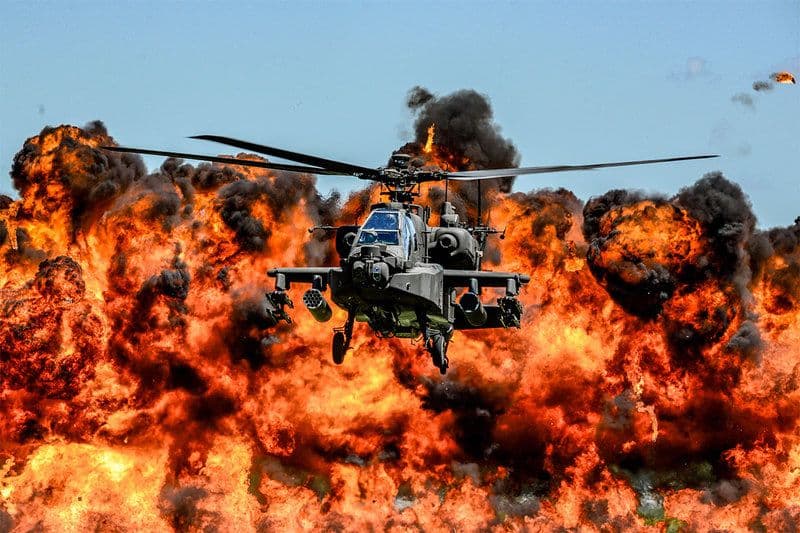
What's the Future of the Apache?
Last updated 02:31 AM EDT • Read time: 7m
In September of 2020, a notable news alert hit the wires – an announcement from the U.S. Army’s Contracting Command-Redstone Arsenal (ACC-RSA) that it was interested in seeing who in the private sector could dismantle hundreds of AH-64D Longbow Apache helicopters. Specifically, the announcement stated, “The USG seeks to identify potential sources that possess the expertise, capabilities, and experience to meet the requirements necessary to depopulate the Apache AH-64D Attack Helicopter, sourced directly to the Government.”[i]According to sources reporting at the time, the work would entail the “depopulation” of approximately three to seven aircraft per month – and that the intended period of performance for the work would commence in January of 2022 and continue on for five years until the end of 2027.[ii]Several months later, in June of 2021, the future of the AH-64 Apache in service to both the active Army and the U.S. National Guard was addressed in a Senate Armed Services Committee hearing.
Given that it is now February of 2022, and there has been little word from the Army on what the status is on several aviation programs, the question remains: Does the Army still intend on “depopulating” – in other words, disassembling – several hundred D Model Apaches? This question is particularly timely given a number of issues that continue to mount in importance.
For one, the President’s budget – already late – is set to be released within a month and the expectations for the Army are expected to be grim (more broadly, our nation’s defense budget is already at a net decrease in buying power when coupled with 7.5% inflation). On another, the Pentagon is also expected to finalize its updated National Defense Strategy (NDS) soon, which in addition to other things, will outline our nation’s force structure across all services, including Army National Guard (ARNG) and Reserves. How the Army envisions the National Guard’s aviation role – for both reconnaissance and attack, missions fulfilled by the Apache – should be addressed to some degree in these two documents.
It is important to note that the present NDS calls for 16-plus Multi-Domain Operations (MDO) capable divisions, which includes the ARNG divisions. But the ARNG divisions are missing three key elements in army aviation to be MDO capable – and two of those elements (given present Active Army fielding and structure) include the Apache. The ARNG is missing four of the required eight Attack Recon Battalions and all eight Cavalry Squadrons. Additionally, the National Guard's four remaining Attack Recon Battalions are still under-strength with 18 helicopters per battalion, a number considerably below the authorized end-strength of 24 each. These are required to make the ARNG combat aviation battalions MDO capable. The other missing element is the Gray Eagle platform, which is supposed to work with the Apache in manned-unmanned teaming in MDO combat operations.
At first glance, these lower numbers may not seem like much, but each one of those assets brings significant firepower to the battlefield and is sorely missed when needed. Until budgets, strategies, and table of organization plans emerge to give a clearer picture of what the Army has in mind, Guard units – as well as State governors, executive cabinets, and legislatures – are left in the dark about what capabilities they’re going to have. Lack of clarity doesn’t make for sound planning, never mind the actual ability to respond to a real crisis.
This situation is the unfortunate result of hard-nosed budget cuts several years back that forced a tough-to-swallow compromise between the active Army and the National Guard, whereupon the Guard would relinquish control of a number of its Apaches to the active Army. As a consolation to the ARNG, those airlift gaps were supposed to be made up with UH-60 Blackhawks – specifically the UH-60V, a new model converted from older UH-60 Alpha and Lima models. As of 2022, the delivery rate of finished UH-60V aircraft is woefully behind schedule.
All of these intertwined issues – the Army’s decision on dismantling Apaches, the status of the UH-60V program, and the fate of the Guard’s role in combat aviation – need to be addressed by policymakers in Washington for several reasons.
First, there are the basic national security concerns. Bluntly speaking, we are not operating at our authorized end-strength – a requirement that has been set forth based on defense needs understood by Congress. And as events between Russia and Ukraine have shown, security conditions can unravel quickly and force difficult decisions fast. When deployed at full strength, assets like the AH-64 Apache can send a striking and definitive signal to aggressive competitors in advance of potentially hostile actions.
Second, there needs to be honest and level-set understanding established between upper echelon leadership in Washington DC and the States about the National Guard's role in the future of our nation's defense. A big part of that discussion needs transparency on what equipment and capabilities Guard units will have to meet their requirements under all activation titles – particularly Title 10. Without clarity, States are left to wonder what the future holds.
Third, the future of the Apache attack helicopter should raise real questions for the taxpayers. If the active Army is planning on dismantling several battalions’ worth of aircraft that may still have considerable service life remaining on the airframes, Congress and the States should be concerned. If the plan is to convert older Apache D model aircraft to the newer, more advanced Echo variant – then that plan needs to be made abundantly clear. Moreover, in cases where older, combat-fatigued models that aren't airworthy and too expensive to extend, cannibalizing parts and demobilization may be a proper course of action. But in either case, the Federal government should be transparent with taxpayers and other stakeholders about plans, costs, and intent.
Ensuring that both active Army and National Guard combat aviation units are fully mission capable with the authorized complement of reconnaissance and attack helicopters is paramount. The world is an increasingly unpredictable and unstable place, with major tension in numerous corners of the globe, and the prospect for both conventional and asymmetric conflict to erupt is high.
And while the Army presses on with the Future Vertical Lift program, those next-generation capabilities will not be fielded in service-wide numbers for at least another decade, assuming the program doesn't hit any major engineering or funding setbacks. The Army hopes to field the first Future Attack Reconnaissance Aircraft (FARA) aircraft in 2028 – and the first Army unit to be equipped with the Future Long-Range Assault Aircraft (FLRAA) platform is supposed to occur in 2030.[iii]
Frankly, a lot can happen in the world over the next ten years – and we need to be prepared for any range of scenarios that might require both active Army and National Guard combat aviation units to be deployed for several enduring rotation cycles. Should the Army decide not to move forth on either the FARA or FLRAA platform – or if either is significantly delayed or the program size reduced – reality will set in quickly regarding the need for a stopgap capability. And in looking at the entire force structure issue and the role of the Apache, we should be working diligently to make the Army (the Total Army) more lethal and more relevant at a time when we face two near-peer threats making alarming moves across the globe.
The Apache is a devastatingly fearsome and lethally effective combat arm with multi-mission capability. With all of these concerns in mind, decision-makers in DC might want to make sure that we aren’t prematurely eliminating what might be a vital enduring capability in the years ahead.
Miguel Alejandro Laborde is a former NCO in the 160th SOAR (A), and a subject matter expert on defense aviation programs, capabilities and platforms, with decades’ worth of experience in the aerospace industry supporting the joint force.
Notes:
[i] https://defence-blog.com/u-s-army-to-retire-hundreds-ah-64d-apache-helicopters/
[ii] https://defence-blog.com/u-s-army-to-retire-hundreds-ah-64d-apache-helicopters/
[iii] https://www.nationaldefensemagazine.org/articles/2021/4/2/army-powering-through-with-future-vertical-lift-programs
The U.S. is Overpaying for Missiles
By Alex Lee • RealClearDefense
The U.S. Nuclear Deterrent Umbrella
By Peter Huessy • RealClearDefense
The Islamic Republic Can Lose the War and Still Win
By Nima Gholam Ali Pour • RealClearDefense
Talent Ecosystems: Building a Scalable National Security STEM Workforce
By Payuna Uday • RealClearDefense
The Underground Cloud
By Ben Poulin • RealClearDefense
U.S. Navy to Begin Testing for USS Lyndon B Johnson (DDG 1002)
By Naval-Technology
Marine Corps Moves To Expand Maven Smart System Account Access
By DefScoop
Navy F/A-18 Spotted With New AIM-174B And AIM-260 Long-Range Missiles
By TWZ
Pentagon’s 6th Generation Stealth Fighter Will Control Drone Swarms
By Warrior M.
Air Force Needs 1,509 Combat-Ready Jets by 2035
By Michael Marrow, Breaking Defense