
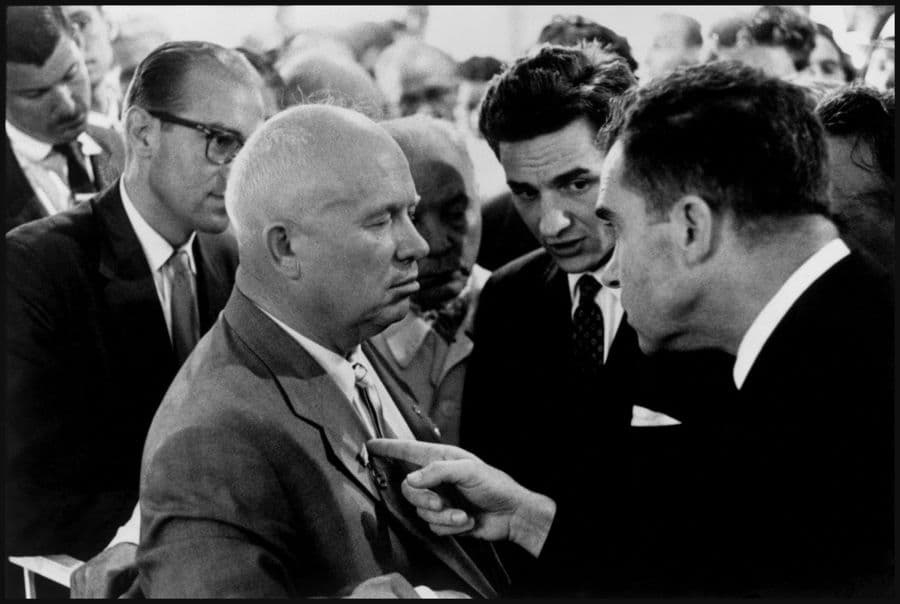
We Could Use a Man Like Richard Nixon Again
Last updated 05:18 AM EDT • Read time: 4m
What passes these days for American statesmanship are glib pronouncements and amateurish diplomacy that in the midst of world crises, could lead this country into a war or wars that no sane person should want and that could reshape global politics in ways very unfavorable to the United States.
As a nuclear-armed Eurasian power wages war against a smaller east European state, the Biden administration signals confusion and disarray--first sounding prudent, then sounding tough; then talking "regime change," only to have spokespersons try to "walk it back," only to have the president state that he's not walking anything back. Meanwhile, on the other side of Eurasia, the leaders of China apply subtle and not so subtle pressure on Taiwan and its neighbors near the East and South China Seas and continue to spread their influence throughout Eurasia-Africa via the Belt and Road Initiative, while America focuses on Ukraine, climate change, human rights and other "woke" priorities.
India--an increasingly important U.S. ally--refuses to join the confused Biden policy towards Russia, while the Saudi regime signals that the U.S. dollar is no longer the world’s indispensable currency. Rarely has American prestige in the world and at home been so low. Each day, it seems, the president and his foreign policy team confirm former Defense Secretary and CIA Director Robert Gates’ negative judgments about Biden’s approach to the world throughout his long Washington career.
In the opening song to the 1970s hit sitcom All in the Family, Archie Bunker (played by Carroll O’Connor) sings, “Mister, we could use a man like Herbert Hoover again.” Today, we could use a man like Richard Nixon again. Nixon was the anti-Biden.
Nixon and his foreign policy team (especially Henry Kissinger) approached the world without sentiment or illusions. Nixon understood that power was the governing force in international politics. He could view the world from the perspectives of America's allies and adversaries, while tailoring his diplomacy and global strategy to reap advantages for his own country. He was, above all, a student of history--an essential qualification for great statesmen that he shared with Winston Churchill, Charles de Gaulle, and a few other giants of the 20th century.
Watergate still partially obscures Nixon’s foreign policy achievements. It shouldn’t. He ended a divisive war in Southeast Asia begun by his Democratic predecessors, reduced Soviet influence in the Middle East, and simultaneously pursued detente with the Soviet Union and the opening to China that positioned the United States closer to both powers than they were to each other. It was called “triangular diplomacy,” and it brilliantly exploited and hardened the Sino-Soviet rift and set the stage for America’s victory in the Cold War.
Nixon reached out to dictators in Yugoslavia and Romania, monarchs in Iran and Saudi Arabia, and autocrats in Nicaragua and elsewhere around the world when it was in America’s interest to do so. The lodestar of his foreign policy was the national security interests of the United States, not Utopian globalist crusades for human rights or to spread democracy around the world.
Writing in Time magazine in 1978, columnist Hugh Sidey described the post-Watergate Nixon as a student of history and power politics, seizing on information and assembling it into “strategies and tactics for international and domestic leadership.” Nixon, he wrote, still possessed that “mental vigor” that enabled him to see the world clearly and imagine policies to promote U.S. interests. Nixon told Sidey that a statesman must know “a great deal about important things.” Nixon did the big things right.
Sidey closed that column with a memorable epitaph for our 37th president in the wake of his resignation from office. “The country has weighed the tragedy of Richard Nixon,” he wrote. “One wonders if there is not another dimension to that disaster that will someday get more attention--the loss of a man to the world . . ., a man who understood the men, the ingredients, the glory, the brutality, the action and reaction of power as well as anyone else of our time.” Oh, how we could use a man like Richard Nixon today.
Francis P. Sempa is the author of Geopolitics: From the Cold War to the 21stCentury, America’s Global Role: Essays and Reviews on National Security, Geopolitics and War, and Somewhere in France, Somewhere in Germany: A Combat Soldier’s Journey through the Second World War. He has written lengthy introductions to two of Mahan’s books, and has written on historical and foreign policy topics for The Diplomat, the University Bookman, Joint Force Quarterly, the Asian Review of Books, the New York Journal of Books, the Claremont Review of Books, American Diplomacy, the Washington Times, and other publications. He is an attorney, an adjunct professor of political science at Wilkes University, and a contributing editor to American Diplomacy.
A Passage to the Middle East: India as a Mediator and Security Partner
By Irina Tsukerman • RealClearDefense
South China Sea is Key to Invigorate Positive U.S.–Malaysia Relations
By Brent D. Sadler • RealClearDefense
The Necropolitics of the Wasteland
By Yunus Emre Tumen • RealClearDefense
AI, Robotics, and Marines
By Gary Anderson • RealClearDefense
The Emerging SQUAD
By Muhammad Shoaib • RealClearDefense
AI, Robotics, and Marines
By Gary Anderson • RealClearDefense
AUKUS Partners Test Autonomous Maritime Systems
By Jangoulun Singsit, Naval Tech
AUKUS: USS Colorado Announced as First Submarine for SRF – West
By USNI News
Navy, Marine Corps Simulate Ship Strikes From Air and Land
By Alex Wilson, S&S
Air National Guard To Stand Up a New Special Tactics Squadron
By Patty Nieberg, T&P