
The United States Needs a Black Sea Strategy
Published June 7, 2023 • Read time: 6m
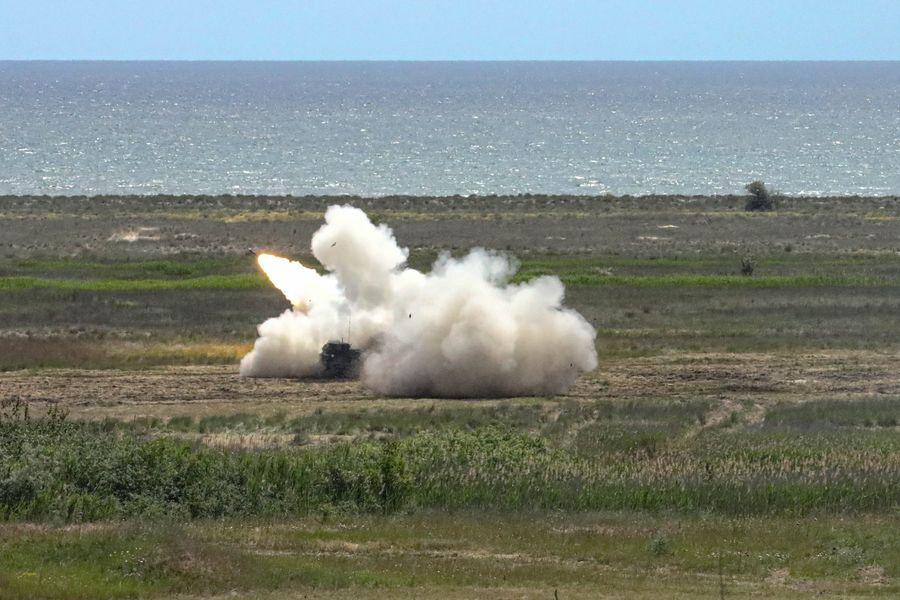
A U.S. M270 Multiple Launch Rocket Systems launches a rocket during a combined live fire exercise in support of Saber Guardian 23 at Capul Midia Training Range, Romania, June 6, 2023. M270 Multiple Launch Rocket Systems were fired in increments of one and five per the Italian, Romanian and United States. DEFENDER 23 is a U.S. Army Europe and Africa led exercise focused on the strategic deployment of continental United States-based forces, employment of Army Prepositioned Stocks, and interoperability with Allies and partners. (U.S. Army photo by Sgt. Alexander Chatoff / 7th Mobile Public Affairs Detachment)
As the Ukraine War runs on into another summer, the United States should face facts: it needs a strategy for the Black Sea to adapt to a long-range period of geopolitical strife. A public articulation of a U.S. Black Sea strategy, along with the tangible kinetic steps to implement it, would greatly improve America’s ability to shore up NATO’s southeastern flank as it comes under sustained Russian pressure, whatever the outcome of the war. This strategy should include U.S. political leadership that enables the Black Sea states, along with their Eastern European partners, to defend themselves and secure shared interests with America.
The Biden administration’s understanding of the Ukraine War has persistently lagged behind battlefield reality. This is not a phenomenon restricted to the current war. During the Iraq and Afghanistan Wars, perceptions in Washington poke along well behind those in CENTCOM’s Tampa headquarters, let alone in Baghdad itself. Distance from a conflict creates an informational gap between those who fight it and those who command.
The best civilian war leaders grasp this phenomenon and give their subordinates latitude to act with dispatch: hence Churchill’s dictum that “the man on the spot” knows best, a conviction he maintained despite considerable resistance from his own military staff.
The Ukraine War’s political realities complicate this detachment. In Iraq and Afghanistan, American forces were engaged actively in combat. This provided political leaders with multiple verifiable points of reference, even if parsing contradictory accounts and cutting through partisan bias remains difficult at best. In Ukraine, by contrast, Washington must generate sound analytical assessments of a conflict another country fights, relying on only fragmentary information and individual impressions.
Nevertheless, the Biden administration’s underlying assumption—that Ukraine and Russia will ultimately exhaust themselves in combat, leading to a negotiated settlement—remains severed from reality. The U.S. first assumed that Kyiv would be overrun in three days. Then, after Ukraine broke the siege, it assumed that Russia might push into the Donbas over the summer of 2022, again biting off a chunk of Ukraine. Subsequently, after Ukraine survived the summer, denying Russia all but one major city, it discounted the possibility of a major counterattack. Finally, after Ukraine’s Kharkiv and Kherson Offensives, the prevailing assumption became that, while Ukraine and Russia would each mount another assault in 2023, the sheer stress of warfare would force an armistice.
This reading of the conflict misinterprets virtually all the military factors at play. Ukraine created a competent doctrine and operational plan for its strategic and political requirements. It has fought successfully enough to defeat Russia multiple times despite being outmatched qualitatively and quantitatively.
Moreover, Russia has adapted since 24 February 2022, despite its heavy casualties: thus, Ukraine’s continued success has flourished against an increasingly competent armed force. There is no reason to doubt that Ukraine, in its upcoming offensive, will make a significant breach in the Russian line, and may well jeopardize Russia’s operational position in Ukraine’s south and east. Crimea likely remains out of reach absent another infusion of American and allied materiel. But with proper support, Ukraine could well liberate all its territory, and deny Russia its greatest source of leverage over NATO’s eastern flank.
The analytical disconnect in American policy also colors U.S. strategic perceptions of Russia. There is no indication that Russia has changed any of its policy objectives since the war began. The Kremlin continues to insist that Russia can only accept negotiations if Ukraine is neutral, and if it negotiates upon current territorial lines. Russia will negotiate only if Ukraine and the West capitulate. This is essentially the position Russia took in December 2021. Hence whatever the end to this war, unless Russia abandons its revanchist ambition, Russia will return to its antagonism with the West and resume its war in Ukraine. And Russia cannot be compelled to change its character – this will occur only after decades of societal shifts.
Given Russia’s fundamental long-term hostility to a stable European security system, the U.S. and its allies must consider how to make that system strong enough to resist Russia. The answer to this question is straightforward: Ukraine must joint NATO and NATO must rearm. Ukraine in NATO bolsters the West’s ability to hold the Black Sea against Russian pressure and prevent Russia from exploiting seams in Europe’s defense architecture. Moreover, Ukrainian NATO membership cannot depend on war termination. This simply encourages Russia to fight indefinitely, even if it only bombards Ukraine after its ejection from Ukrainian territory.
Indeed, the second fundamental issue, beyond a poor military reading of the conflict, is an equally flawed political one. The conviction persists, not just in Washington but also in Paris and Berlin, that Ukrainian NATO membership can be deferred or replaced with nebulous “security guarantees.” These will be tested: there is no reason for the Kremlin to assume the Élysée or the White House are looking for anything other than a way out of a real commitment. A halfway house guarantees another major war.
The only exception is if the United States can articulate and implement a Black Sea strategy that integrates the military and economic power of the Black Sea NATO states with American enabling capabilities—a framework which Yorktown Institute articulates in its forthcoming paper on the Black Sea.
NATO requires the forces to deny Russia the ability to assail its Black Sea flanks, namely by fielding, in Romania, a large-scale air-sea denial force of missile-armed small boats and shore-based anti-air and anti-ship weapons. Moreover, the Black Sea and Eastern European states must combine their defense industrial systems and feed into the Ukrainian market, with the long-term objective of buttressing Ukraine defenses. Meanwhile, the United States can provide specific enabling capabilities – the ISR/T assets and secure communications – to undergird this system, along with naval power to deny Russian expansion in the Mediterranean.Absent Ukrainian NATO membership, another war is exceptionally likely. The best alternative is a Black Sea backstop to Eastern European security.
Seth Cropsey is the founder and president of Yorktown Institute. He served as a naval officer and as deputy Undersecretary of the Navy and is the author of "Mayday and Seablindness."
After the Midterms, the Right Strategy Against Iran
By Lance Gordon • RealClearDefense
The Color Revolution Came Home
By Emzari Gelashvili • RealClearDefense
When Access Becomes the Fight
By Richard Byno • RealClearDefense
What the 2026 Midterm Results Mean for U.S. Strategic Competition with Rivals
By Dean Chen • RealClearDefense
Measurable by Design: Project Meridian
By Alex Willard • RealClearDefense
New USAF Force Design Bets on Technology
By Stephen Losey, Air & Space Forces
DoD Pushes $450M in Loans To Bolster U.S. Space Companies
By Hitchens, BrDefense
The U.S. Navy Needs a New Battlecruiser. Will It Get One?
By Sadler & Ouellette, NatInt
U.S. Army Rehearses Rapid HIMARS Rocket Launcher Deployment
By Global Defense N.
Coding Commander's Intent into Unmanned Systems
By Thomas Baumstark, Proceedings