
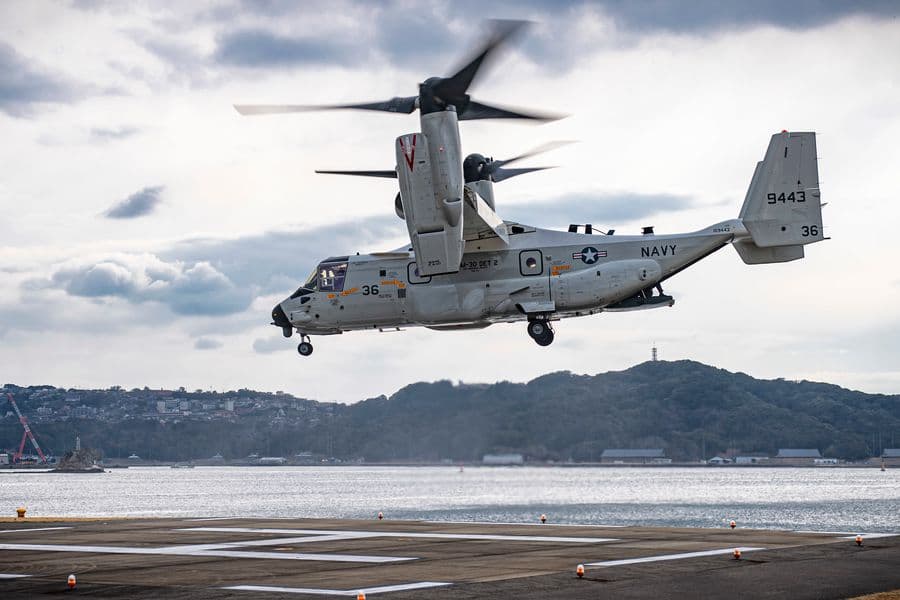
The Navy Needs to Buy More CMV-22B Ospreys
Last updated 08:35 PM EDT • Read time: 6m
For decades, the U.S. Navy has relied on specialized aircraft to move personnel, spare parts, and critical materials to and from its aircraft carriers. Aerial movement of people and material is one of the reasons why the Navy can operate carrier strike groups at sea and in combat for protracted periods.
The Navy’s current platform for the carrier onboard delivery (COD) mission, the tiltrotor CMV-22B Osprey, is a variant of the MV-22 Osprey aircraft that the Marine Corps has been flying successfully for more than fifteen years. The ability of the V-22, the generic version of this platform, to take off and land like a helicopter but fly like an airplane gives it a unique mission profile. Before the Navy turned to the V-22 for the COD mission, the Marine Corps had flown the aircraft for hundreds of thousands of hours and employed it in combat in Southwest Asia. The MV-22 has proven extraordinarily useful to the Marines as a troop transport and resupply platform. With its speed and ability to land on a dime, the MV-22s also are useful for additional missions such as search and rescue and medical evacuation.
The Navy’s CMV-22B has been characterized by at least one knowledgeable source as a “game changer.” This is attributed to the platform’s long range, improved internal fuel storage, aerial refueling capability, and ability to operate from small, unimproved airfields. In addition, because it takes off and lands vertically, the CMV-22B does not impact other flight operations on the carrier’s deck. The CMV-22B obviates the need to reload supplies on conventional helicopters to move material from the carrier to other ships in the battle group.
Once it starts operating its new tiltrotor aircraft in numbers, the Navy will find other uses for this versatile platform. Marines operate their version of the V-22 from large deck amphibious warfare ships. The CMV-22B is particularly valuable because it can provide aerial resupply and personnel movement for virtually any ship on the fleet with a flight deck.
Versions of the V-22 are being used by other services for rescuing downed pilots and medical evacuations. A naval surveillance version has been proposed. Equipped with multispectral sensors, the CMV-22B could provide airborne surveillance for both surface action groups and amphibious ready groups.
The CMV-22B is particularly well-suited to operations in the Indo-Pacific theater, fast becoming the focus of defense department planning for a future high-end conflict. The Navy’s strategy for such a conflict, called Distributed Maritime Operations (DMO), envisions operating the fleet in relatively small mobile formations across vast ocean expanses. These distributed formations will be connected through advanced networking, the Navy’s version of Joint All-Domain Command and Control.
The fleet also will need to be supported by a system of distributed logistics that can continue to function in a contested environment. The CMV-22B, with its high payload capacity, long range, and ability for mid-air refueling is particularly well-suited to the Indo-Pacific environment and to distributed maritime operations. The aircraft can operate from expedient airfields, allowing it to “island hop,” if necessary.
Now, production of the V-22 is about to come to an end. Unless there are new orders from the U.S. or foreign militaries, the production line will cease operations in 2026. While prime contractors and the Department of Defense will maintain the ability to sustain existing fleets of V-22s for decades, the ability to build new aircraft will wither away within a few years. In the event of greater-than-expected attrition or increased demand, it will take many years and billions of dollars to resurrect a cold production line.
The Navy sized its CMV-22B buy based on the smallest number needed to conduct the COD mission. This was determined to be a detachment of three Ospreys per carrier plus a small number of additional aircraft for training purposes and as maintenance reserves. This calculation resulted in a target of 48 CMV-22Bs. However, the Navy is only acquiring 44. This is a small number to support global carrier operations, even in peacetime.
Moreover, it stands to reason that if the Navy is successful in implementing its DMO strategy, the number of at-sea units and land-based resupply points will increase as will the distance between them. This will put additional pressure on naval logistics and on the connectors that will transfer people and supplies to the carriers and between ships.
If there is one essential lesson for the U.S. military from the war in Ukraine, it is the importance of having enough capacity to withstand intense combat and heavy losses. Capacity is a matter of available reserves of supplies, equipment, and platforms and access hot production lines that can be spun up when a conflict begins. Possession of superior capabilities alone is insufficient for victory. As former Soviet dictator Joseph Stalin once observed: “quantity has a quality of its own.”
The U.S. and its NATO allies have found themselves without sufficient capacity to both support Ukraine and rebuild their militaries. This is a matter both of insufficient existent capacity and limited supply chains for new production. In many cases, it will be a matter of years before any new production can reach the field. In some instances, production lines have closed, and supply chains dissipated, resulting in a scramble to redesign older systems and find new means of production.
The Navy intends to operate the CMV-22B into the mid-2050s, at least. With this fact in mind, it makes little sense for the Navy to halt acquisition of the CMV-22B at 44 or even 48 aircraft. This number is not sufficient for the COD mission alone, assuming even modest attrition. In view of the Navy’s desire to implement DMO, with its requirement for distributed logistics, the number is totally inadequate.
At this point in time, with the growing threat of conflict with China in the Western Pacific, the war in Ukraine in its second year, and Iran threatening oil shipping lines through the Persian Gulf, it makes no sense to stop production of this highly flexible and effective platform. If the Navy will not reconsider its decision, Congress needs to step in and ensure that production of the CMV-22B continues.
Dan Gouré, Ph.D., is a vice president at the public-policy research think tank Lexington Institute. Gouré has a background in the public sector and U.S. federal government, most recently serving as a member of the 2001 Department of Defense Transition Team. You can follow him on Twitter at @dgoure and the Lexington Institute @LexNextDC. Read his full bio here.

The Services Do Not Need a Four-Star Autonomous Warfare Command
By Steven Wills • RealClearDefense
Honor Them While There Is Still Time
By Jeffrey Rosales • RealClearDefense
From Siberia to Fairford: How Operation Spider’s Web Has Changed the Rules of Airpower
By Frank A. Rose • RealClearDefense
Faster Simulations, Better Defense Decisions
By Rut Lineswala • RealClearDefense
Will HASC Have an Oversight Subcommittee in the Next Congress?
By Christopher J. Bright • RealClearDefense
Hegseth Barred Trans Troops. Military Boards Are Rejecting Those Orders.
By NYT-500x500.jpg&w=128&q=75&dpl=dpl_Vg2KXuNG7KB9xKwt3ZUN8juCpk1i)
Closing the Sea: Lessons from Ancient Mediterranean Blockades
By DeCasien, CIMSECFrom Siberia to Fairford: How Operation Spider’s Web Has Changed the Rules of Airpower
By Frank A. Rose • RealClearDefenseFaster Simulations, Better Defense Decisions
By Rut Lineswala • RealClearDefense
Bombers Could Have a Major Air-to-Air Combat Role
By Joseph Trevithick, The WarZone