
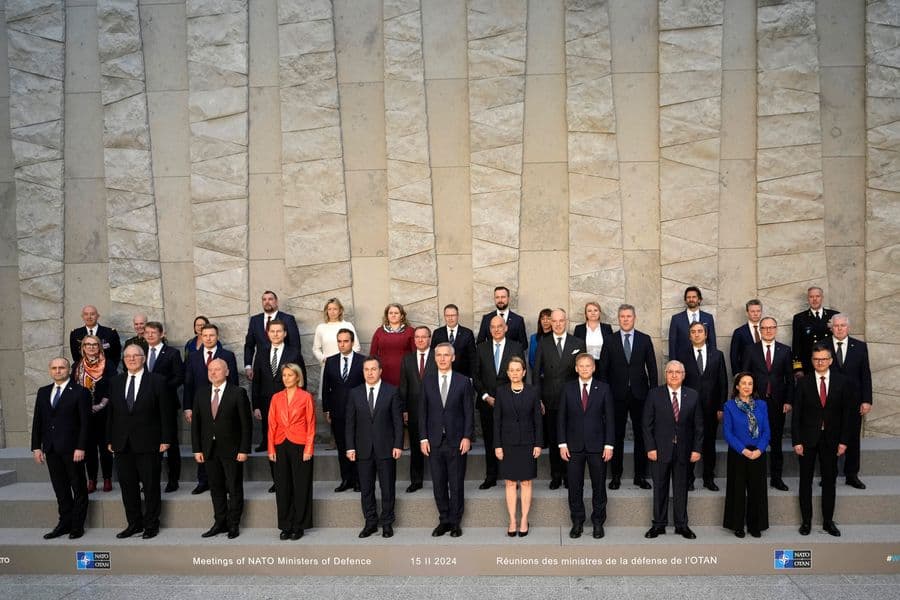
A World Without NATO
Last updated 04:09 PM EDT • Read time: 6m
Speaking in the House of Commons on March 1, 1848, Henry John Temple, better known as Lord Palmerston, Britain’s foreign secretary and later prime minister, said: “I say that it is a narrow policy to suppose that this country or that is to be marked out as the eternal ally or the perpetual enemy of England. We have no eternal allies, and we have no perpetual enemies. Our interests are eternal and perpetual, and those interests it is our duty to follow.” Fifty-two years before Palmerston’s speech, President George Washington in his Farewell Address advised his countrymen that, “It is our true policy to steer clear of permanent alliances with any portion of the foreign world . . .” Instead, if the United States maintained a “respectably defensive posture, we may safely trust to temporary alliances for extraordinary emergencies.”
The wisdom of that counsel guided British and American foreign policies until 1991--the year that the Soviet Union collapsed. The North Atlantic Treaty Organization (NATO) was never intended to be a permanent alliance. Formed in 1949 in the face of the threat of Soviet-communist expansion across the Eurasian landmass in the wake of Europe’s devastation as a result of the Second World War, NATO extended the U.S. security umbrella--including atomic weapons--to France, Italy, Belgium, Luxembourg, Denmark, Norway, the Netherlands, Portugal, the United Kingdom, Iceland, and Canada. Three years later, Turkey and Greece joined. In 1955, West Germany became a member. Spain joined in 1982. It was a defensive alliance against possible Soviet military aggression. The sole reason for the existence of that alliance was to prevent the Soviet Union from militarily overrunning Western Europe. When the Soviet Union collapsed in 1991, NATO’s original mission ended.
But like any huge bureaucracy, NATO sought other reasons to continue its existence and to expand. It intervened in the Balkans during the Clinton administration. It intervened in Afghanistan after the September 11, 2001 terrorist attacks against the United States. It intervened in Libya to overthrow the Qaddafi regime in 2011. It has worked in Iraq to train Iraqi security forces. NATO’s website shows just how far it has strayed from its original purpose. It bills itself as a “crisis prevention and management organization” that can “undertake a wide range of military operations and missions.” It boasts that it is “engaged in operations and missions around the world,” including “cooperation with the African Union,” and “disaster relief operations.” NATO troops remain in Kosovo, and NATO ships provide maritime safety in the Mediterranean and Aegean Seas. The North Atlantic Treaty Organization apparently seeks to extend its reach to the western Pacific and China’s threat to Taiwan.
Coincident with its new missions and operations, NATO has more than doubled in size. Since the collapse of the Soviet Union, 16 more countries have joined the alliance. So as the Soviet threat first receded then ended, NATO got bigger and moved closer and closer to Russia’s European border in a fit of hubris and reckless diplomacy that George F. Kennan called “the most fateful error of American policy in the entire post-Cold War era.” Kennan foresaw that NATO expansion would revive the worst aspects of Russian nationalism and imperialism. And so it did. The tragedy of the Ukraine War has its roots in unfettered NATO expansion.
With new members and expanded missions, NATO’s budget expanded, too. NATO’s civil budget for 2024 is 438 million pounds (nearly 570 million U.S. dollars), while its military budget for 2024 is set at 2.03 billion pounds (nearly 2.6 billion U.S. dollars). NATO has morphed into something well beyond an alliance designed to “keep the Soviet Union out, the Americans in, and the Germans down,” in Lord Ismay’s memorable description.
There are many who claim that Russia’s invasion of Ukraine in 2022 and the continued fighting there prove that NATO is still needed to defend the nations of Western Europe--just as it did throughout the Cold War. But the world of 2024 is far different from 1949. Then, Western Europe was recovering from the devastation of the Second World War. Soviet forces were in eastern and central Europe, including the eastern half of Germany. What followed Soviet troops was the communization of central and eastern Europe enclosed by what Winston Churchill called an “iron curtain.” Throughout the Cold War, the Soviet Union enjoyed a conventional force superiority in Europe that was offset by the American nuclear umbrella. The Soviet threat to overrun Europe was real.
Since 1991, the Soviet and later Russian threat to overrun Europe receded and then disappeared. The notion that a Russian military that is having difficulties holding on to a few eastern provinces of Ukraine poses a threat to Western Europe is absurd (except for the Russian nuclear arsenal). Today, the combined economic and human resources of the European member states of NATO dwarf those of Russia. England and France have a combined total of 550 nuclear weapons--far fewer than Russia but not an insignificant deterrent force. A European NATO made up of 30 countries (soon to be 31) without the United States could afford to build-up that deterrent force to match that of Russia’s.
For decades, NATO member states have created vast welfare states while relying on the military might of the United States to guarantee their security. During the Cold War, we put up with that circumstance because a Soviet-dominated Western Europe would have posed a dangerous geopolitical threat to U.S. national security. That is why NATO was formed. When that threat ended in 1991, so did the reason for NATO’s existence. Russia’s invasion of Ukraine does not affect a vital national security interest of the United States. Meanwhile, there is a gathering storm in the western Pacific that does affect a vital national security interest of the United States. Our most important alliances today are in the Indo-Pacfic (Japan, South Korea, Australia, the Philippines, Taiwan, and hopefully India), not in Europe. NATO accomplished it mission. It was never meant to be a permanent or eternal alliance. Lord Palmerston and George Washington were right.
Francis P. Sempa writes on foreign policy and geopolitics. His Best Defense columns appear at the beginning of each month.
The Dual Threat: Why Beijing’s Collapse Is Just As Dangerous as Its Rise
By Efraín Vázquez-Vera • RealClearDefense
Optimizing Trump’s Strategy to ‘Rot Iran’s Economy’
By Brian G. Chow • RealClearDefense
The AI Scare Is the New Y2K: A Veteran’s Perspective on Hype, Risk, and the Discipline Needed to Modernize Safely
By Kenneth Smith • RealClearDefense
The Pentagon’s AI Rush Needs Adult Supervision
By Michael Aaron Cody • RealClearDefense
ICE Is Not a Four-Letter Word
By Meda Parameswara Reddy • RealClearDefense

Marine Died of Injuries Suffered During Fast-Rope Training on Okinawa
By Brian McElhiney, Stars and Stripes
Drones Built To Look Like Birds Evaded Detection at Air Force Tech Exercise
By T&P
Navy Unfairly Evaluated Saildrone Musv Proposal, Court Finds
By D. Stancy, BrDefense
HII and Thales Demonstrate UUV with End-to-End Autonomous MCM
By Naval News
General Atomics Joins Army-Navy Hypersonic Glide Body Production
By Defence Blog