
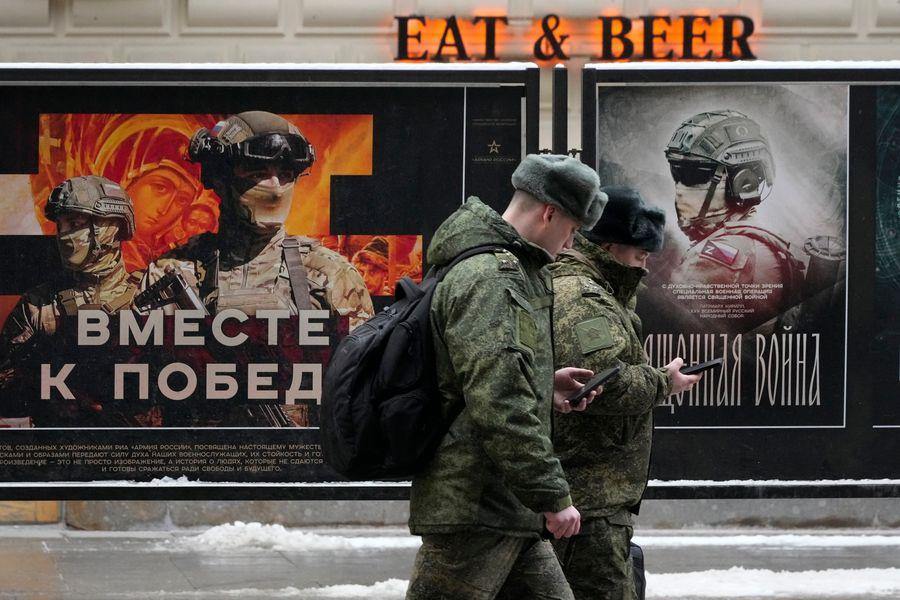
Enduring Defeat: The Cyclical Failures of Russian Military Culture
Published March 10, 2025 • Read time: 9m
Enduring Defeat: The Cyclical Failures of Russian Military Culture from Crimea to Ukraine
Following President Zelensky’s meeting at the White House, global attention should not only focus on Ukraine’s battlefield resilience but also on a crucial question: why has Russia, despite its overwhelming numerical and material advantages, failed to secure victory? This ongoing struggle is not merely a matter of tactical setbacks but a reflection of deeper, systemic flaws and entrenched weaknesses in Russia’s military culture.
Modern warfare demands agility, rapid decision-making, and a high degree of coordination between infantry, armor, artillery, and air power. However, Russia’s armed forces have repeatedly failed to implement these principles, instead clinging to outdated doctrines centered on mass formations, brute force, and hierarchical control. Whether in World War I’s disastrous Brusilov Offensive (1916), the Soviet Union’s initial setbacks in World War II, or the Russian military’s failures in Ukraine, the inability to transition to a more flexible, networked approach to warfare has led to predictable operational collapses.
In autocratic systems, military effectiveness is often subordinated to political control, with leaders prioritizing personal loyalty over professional competence. This has been a defining feature of Russian and Soviet military structures. From Stalin’s purges of the Red Army officer corps in the late 1930s—where nearly 80% of divisional commanders were executed or imprisoned—to Putin’s reliance on political commissars and personal loyalty networks within the modern Russian military, the emphasis on ideological conformity has come at the cost of strategic effectiveness. This top-down control stifles battlefield initiative, slows decision-making, and creates an inflexible command structure that is unable to respond dynamically to evolving threats. The disastrous performance of Russian forces in Ukraine, where junior officers lacked the authority to make critical adjustments in real-time, echoes similar failures in the Russo-Japanese War (1904–1905) and the Soviet invasion of Afghanistan.
Clausewitz’s concept of friction—the inevitable chaos, uncertainty, and disorder inherent in war—further explains why Russia’s structural weaknesses become magnified in combat. All armies experience setbacks, but the ability to adapt and mitigate these disruptions separates successful military organizations from those that unravel under pressure. Russian forces have historically struggled to overcome friction due to systemic inefficiencies in logistics, supply chain management, and operational planning.
For instance, during the Crimean War, Russian forces suffered catastrophic logistical failures, with supply lines breaking down and soldiers lacking basic provisions. Similar problems plagued the Red Army in the Winter War (1939–1940) against Finland, where poor coordination and rigid command structures led to heavy casualties despite overwhelming numerical superiority. These logistical deficiencies have remained largely unaddressed in modern Russian military doctrine. The 2022 retreat from Kyiv was not just a tactical withdrawal but a case study in institutional dysfunction—vehicles abandoned due to fuel shortages, logistical convoys destroyed due to lack of protection, and commanders unable to improvise under battlefield conditions. These failures reflect a broader pattern: the Russian military’s inability to manage the complexity of modern warfare, where precision logistics, rapid adaptation, and decentralized decision-making are essential for success.
The historical trajectory of Russian military adaptation is paradoxical: while the Russian state has demonstrated an ability to reform under extreme duress, these transformations have often been reactive, fragmented, and transient rather than sustained and institutionalized. Unlike Western militaries, where doctrinal evolution tends to be driven by systematic post-conflict reassessment, technological integration, and professional military education, Russian military adaptation has historically been constrained by political centralization, epistemic insularity, and structural path dependencies. The result is a recurring cycle in which Russian forces suffer initial catastrophic failures, adjust tactically under pressure, and ultimately relapse into stagnation once the immediate crisis subsides.
The Crimean War is often cited as a pivotal moment in Russian military history, exposing the structural backwardness of the Tsarist armed forces relative to their British and French counterparts. The logistical deficiencies, command dysfunction, and technological inferiority that plagued Russian forces—particularly at Sevastopol—forced Tsar Alexander II to undertake significant reforms. These included the abolition of serf-based conscription in favor of a more professionalized military service, the establishment of the General Staff Academy to cultivate a more scientifically trained officer corps, and an expansion of the railway network to improve strategic mobility.
Yet, these reforms were fundamentally reactive and incomplete. Unlike the Prussian military reforms of the 19th century, which were deeply embedded in a broader transformation of state administration and war-making institutions, Russian military modernization remained compartmentalized and vulnerable to regression. The officer corps, despite its formal education improvements, continued to be dominated by aristocratic patronage networks, inhibiting the development of a truly meritocratic command structure. Additionally, while logistical and infrastructural upgrades were introduced, they failed to redefine Russian strategic culture, which remained wedded to attritional warfare and mass conscription rather than operational maneuver and force economy.
The Russo-Turkish War (1877–1878) demonstrated some dividends of these reforms, as Russian forces were able to coordinate multi-front operations more effectively than in Crimea. However, the underlying weaknesses of Russian operational art—rigid command structures, an inability to sustain offensive momentum, and a tendency toward siege warfare over mobile engagements—remained largely unresolved. As a result, while the post-Crimean reforms mitigated some of the most glaring inefficiencies, they did not fundamentally reorient Russian military doctrine toward a more flexible and modernized system.
World War II is often framed as a period of extraordinary Soviet military adaptation, where the Red Army transitioned from the disastrous defeats of Operation Barbarossa (1941) to the operational triumphs of Stalingrad (1942–1943) and Operation Bagration (1944). Indeed, the Soviet military’s capacity for rapid learning was impressive: it implemented deep operations doctrine, refined its use of Maskirovka (strategic deception), and improved its logistical efficiency through a centrally coordinated industrial-military complex.
Yet, Soviet military adaptation in WWII was shaped more by sheer strategic necessity than by an inherent culture of doctrinal flexibility. Stalinist military structures, heavily influenced by political paranoia and purges, had eradicated many of the Soviet Union’s most capable military thinkers by the late 1930s. The adaptation that followed was thus not the result of an entrenched institutional capacity for learning but rather a desperate improvisation in response to existential crisis. Unlike the German Auftragstaktik, which emphasized decentralization and initiative at the lower levels of command, the Soviet approach remained highly centralized, with operational autonomy improving only as necessity dictated.
Furthermore, while the Soviet Union’s adaptation in WWII is often lauded, its postwar military structures failed to fully absorb the lessons of maneuver warfare. Instead of embracing a more flexible, combined-arms force, the USSR reverted to mass conscription and artillery-centric doctrines, a reversion that would later shape Soviet military stagnation in Afghanistan and influence modern Russian failures in Ukraine.
Russia’s early failures in Ukraine—stalled offensives, logistical breakdowns, and failure to secure air superiority—exposed systemic weaknesses in force structure, command cohesion, and strategic planning. Yet, despite these setbacks, the Kremlin has demonstrated a capacity for tactical adaptation. By late 2022, Russian forces refined their approach, expanding electronic warfare to disrupt Ukrainian drones and HIMARS, deploying FPV drone swarms for precision strikes, and adopting a defense-in-depth strategy, particularly in Zaporizhzhia, to slow Ukrainian advances.
By 2024, these adaptations intensified. Russian offensives in Eastern Ukraine relied on mechanized-infantry assaults to exploit Ukrainian manpower and artillery constraints. The ‘Turtle Tank’ initiative sought to counter drone warfare with reinforced T-72s and T-80s, though at the cost of mobility. A force expansion of 350,000 soldiers pushed total manpower toward 1.5 million, reinforcing reliance on attritional warfare. Meanwhile, advanced electronic warfare systems disrupted Ukrainian surveillance, while defense spending soared to 7% of GDP, straining the civilian economy.
Yet these adaptations do not reflect genuine strategic evolution. Russia’s military remains constrained by epistemic inertia—its deep resistance to external paradigms and self-critical doctrinal reflection. Unlike NATO forces, which institutionalize battlefield lessons, Russia defaults to attritional warfare, recycling past models and relying on mass mobilization over maneuver.
The chronic underdevelopment of Russia’s non-commissioned officer (NCO) corps—a crucial pillar of modern military leadership—remains a defining weakness. Unlike Western forces, where NCOs enable decentralized battlefield initiative, Russia’s rigid, top-down command structure leaves lower-level officers unable to make autonomous tactical decisions, reinforcing operational inflexibility.
The Soviet model deliberately curtailed NCO authority, delegating leadership responsibilities to junior officers (lieutenants, captains) rather than sergeants, as in NATO militaries. While Western sergeants oversee squad-level tactics, fire discipline, and battlefield coordination, Soviet (and later Russian) sergeants functioned as administrative supervisors, executing orders rather than shaping battlefield decisions. This doctrine stifled small-unit initiative, requiring even platoon- and company-level adjustments to come from officers, slowing reaction times and creating structural rigidity in combat.
The Soviet invasion of Afghanistan exposed how the absence of a professionalized NCO corps crippled unit-level leadership in asymmetric warfare. Mujahideen fighters, operating in small, autonomous groups, exploited the Soviet reliance on officer-led micromanagement. The Battle of Maravar Pass (April 1985) exemplified this vulnerability: a Soviet VDV airborne unit suffered devastating losses after failing to adjust its formation during an ambush. Without empowered NCOs to direct squad dispersal, cover fire, and maneuvering, the unit was bottlenecked in a confined space, unable to react effectively under sustained fire. In Western militaries, these responsibilities would have fallen to sergeants, preventing paralysis in such engagements.
This pattern was widespread. Soviet mechanized and motor rifle units, particularly in mountain warfare, often failed to react dynamically to ambushes, as soldiers lacked the authority to reposition or adapt tactics without officer approval. By contrast, NATO forces in later counterinsurgency campaigns (e.g., the U.S. in Iraq and Afghanistan) relied on NCO-led squads, enabling rapid, independent adjustments to battlefield conditions—an ability the Soviets lacked.
The Russo-Georgian War (2008) further highlighted Russia’s rigid, officer-dominated forward air control (FAC) system, which hindered close-air support (CAS) coordination and slowed battlefield response times. Unlike NATO, where NCO-led FAC teams dynamically direct airstrikes, Russian forces relied on pre-planned targeting grids, making air operations predictable and inflexible. This contributed to significant aircraft losses to Georgian Buk-M1 and Strela-10 air defenses, as poor air-ground integration left Russian pilots vulnerable.
This deficiency persists in Ukraine, where early-war aircraft losses were exacerbated by inadequate CAS integration and an inability to provide real-time air support to maneuvering ground units. As Ukraine increasingly employs NATO-style air-ground coordination, Russia’s Soviet-era doctrine remains a critical liability. Instead of developing robust NCO-led FAC teams, Russia has turned to drone-based target acquisition to compensate for its lack of flexible, embedded air controllers.
Carlo J.V. Caro is a political and military analyst. He holds a master's degree from Columbia University, and he has published numerous articles in the US and Israel on foreign affairs and security.

Operation Epic Fury and the Illusion of Victory
By Stephen D. Cook • RealClearDefense
Previewing The Shenzen Summit: A Critical View
By Stephen Blank • RealClearDefense
How to Win Without Military Victory
By Kevin Eyer • RealClearDefense
We Keep Funding ‘Shared Infrastructure.’ Nobody Has Defined It.
By Frederick Gale • RealClearDefense
Congress Must Reauthorize Section 702 of the Foreign Intelligence Surveillance Act
By Bryce G. Poole • RealClearDefense

Five Takeaways From Navy Nominee’s Rocky Hearing
By Seligman & Weisgerber, WSJ
U.S. Air Force Taps Anduril for Containerized Launcher
By Global Defense News
Time To Say Goodbye to the NMESIS and NSM
By Marine Corps Compass Points
HII and U.S. Navy Break Ground on Shipyard Complex
By George Allison, UKDJ
Rare U.S. Air Force Spy Plane Spotted Over the Black Sea
By D. Malyasov, Defence Blog