
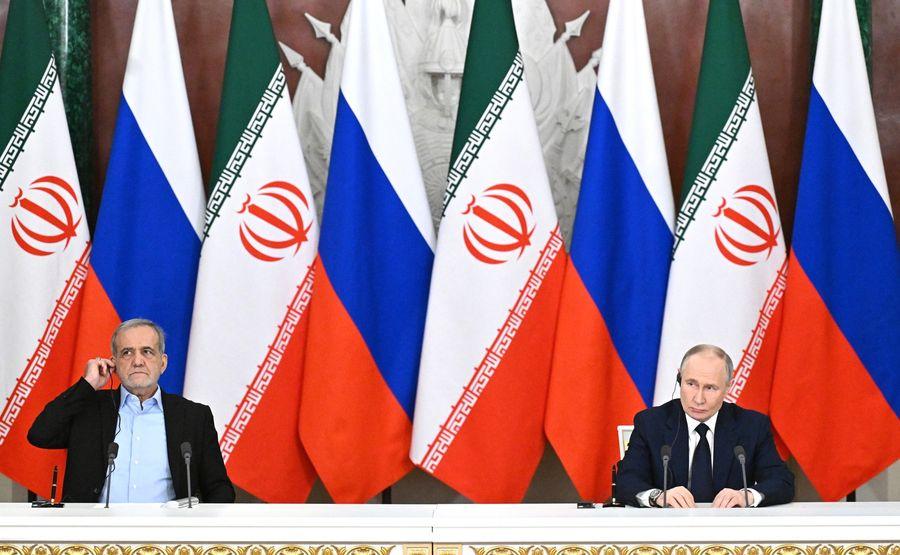
Israel-Iran War Has Exposed Russia's Vulnerability
Published July 3, 2025 • Read time: 5m
The war between Israel and Iran has brought only short-term gains for Russia. Looking to the longer term, we see much bigger negatives.
Ukrainian President Volodymyr Zelensky complained that the war had resulted in a sharp rise in oil prices, benefitting Russia. It also diverted world attention from the war in Ukraine, giving Russia more freedom to launch attacks against the country. Indeed, Russia continues to make gains in Ukraine and is producing four times as much ammunition as NATO is. It is easy to see why some in Russia had welcomed the prospect of a regional war in the Middle East.
Yet this is deceptive. Israel’s ability to attack Iran’s nuclear and missile facilities showed Iran’s vulnerabilities. This is important as Russia and Iran signed an agreement for strategic cooperation in January 2025 and the two countries’ anti-Western positions are very similar.
The overall assessment of Arkady Mil-Man, a former Israeli ambassador to Russia, is that longer-term damage to Russia’s interests outweigh any short-term gains it has accrued from Israel’s war with Iran. Russia needs Iran as a spoiler that threatens the West, but now the battered Iranian regime is in no position to help, Mil-Man told me in an interview.
Furthermore, Moscow has relied heavily on Iran’s supply of Shahed 131 and Shahed 136 drones. Although Russia has set up domestic Shahed production, it probably still wants Iranian supply. Debris recently found in Ukraine suggests that Russia is continuing to benefit from new Iranian technology which is used in its drones. And in 2024 Iran supplied Russia with short-range ballistic missiles for use against Ukraine. Again, Russia presumably has been looking forward to getting more.
The strategic cooperation agreement did not oblige the Russians to come to the defence of Iran, and Russian President Vladimir Putin has made this clear. Yet even if it wanted to do so, Russia is incapable of supporting Iran militarily because it needs ammunition for its own war.
Russia still enjoys close cooperation with China. Indeed, there are worrying indications that China has been increasing its supply of components which are used in Russian drones that have been launched against Ukraine. Yet Russia’s desperate need for munitions forced it into a comprehensive strategic partnership with North Korea. Unlike the agreement with Iran, Russia is committed to providing ‘military and other’ assistance to North Korea in the event of external aggression. Moscow’s increased dependence on the regime in Pyongyang is further illustration of its weakness and leaves it little room for manoeuvre.
Russia has been unsettled by the Israel-Iran war and, unlike the United States, has been unable to do anything. It has had no influence or leverage over the warring parties, making do with condemning the ‘unprovoked aggression that has no justification’. The absurdity and hollowness of such denunciations while it is bombarding civilian populations in Ukraine appears lost on the Russians. Iran’s foreign minister, Abbas Araghchi, visited Moscow for talks with Putin immediately after the US strikes. He thanked Putin for his condemnation of the Israeli and US attacks; yet he left Moscow empty handed.
After Hamas’s 7 October attack on Israel, the Russians believed that Israel’s intelligence and military failure signified a significantly weakened Israel. Yet Russia has had to reassess its view of Israel in the wake of its success against Hezbollah in Lebanon and its attacks on Iran’s military capabilities.
Israel has refrained from sending military supplies to Ukraine, and there is little sign of any change in that policy. Yet Putin may well have convinced himself that Israel’s advanced military capabilities could one day find their way to Ukraine if Russia were to finally supply Iran with the Su-35 fighters that they purchased in 2023. This could explain why the aircraft have not been transferred to Iran.
At the end of 2024, Russia watched helplessly as its Syrian ally, Bashar al-Assad, fell from power. While the collapse of the Assad regime was not as damaging for Russia as it was for Iran, it was still a serious setback for Russian military and commercial interests in Syria. Zelensky was never going to pass up the opportunity to mock Russia’s declining fortunes in the region. In a post on X, the Ukrainian leader wrote: ‘Ayatollah Putin can look at his friends in Iran to see where such regimes end up, and how far into decay they drive their countries.’
Putin has had to watch from the sidelines while US F-35 fighters and B-2 bombers played decisive roles in strikes against Iranian nuclear facilities and ballistic missile capabilities. Elliott Abrams, a former envoy to Iran in the first Trump administration, maintained during a BBC interview that ‘things were done that Putin could not do or come close to doing. Trump believes that Putin respects power and Trump has just exercised power.’
Paradoxically, Donald Trump, the most pro-Russian US president in living memory, may have done more than his predecessors to expose Russia’s vulnerability.
Azriel Bermant is a senior researcher at the Institute of International Relations Prague and a lecturer in International Relations at Anglo-American University in Prague.
This article appeared originally at The Strategist (ASPI).
Operation Epic Fury and the Illusion of Victory
By Stephen D. Cook • RealClearDefense
Previewing The Shenzen Summit: A Critical View
By Stephen Blank • RealClearDefense
How to Win Without Military Victory
By Kevin Eyer • RealClearDefense
We Keep Funding ‘Shared Infrastructure.’ Nobody Has Defined It.
By Frederick Gale • RealClearDefense
Congress Must Reauthorize Section 702 of the Foreign Intelligence Surveillance Act
By Bryce G. Poole • RealClearDefense

Five Takeaways From Navy Nominee’s Rocky Hearing
By Seligman & Weisgerber, WSJ
U.S. Air Force Taps Anduril for Containerized Launcher
By Global Defense News
Time To Say Goodbye to the NMESIS and NSM
By Marine Corps Compass Points
HII and U.S. Navy Break Ground on Shipyard Complex
By George Allison, UKDJ
Rare U.S. Air Force Spy Plane Spotted Over the Black Sea
By D. Malyasov, Defence Blog