
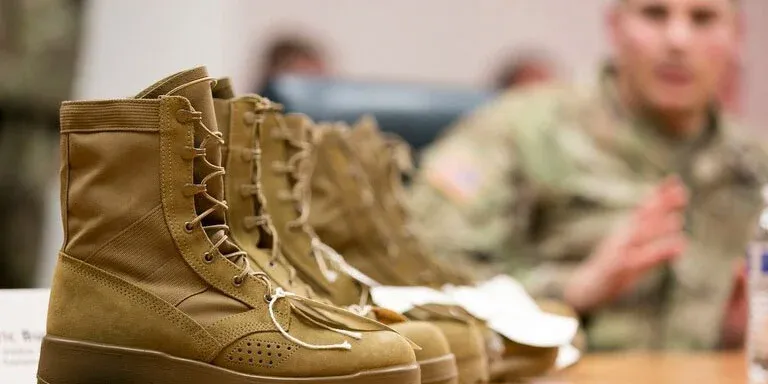
The BOOTS Act: Buying American on the Warfighter's Dime
Published Aug. 27, 2025 • Read time: 4m
Billed under the feel-good umbrella of “buying American,” the Better Outfitting Our Troops (BOOTS) Act has gained swift momentum since its congressional introduction this year. Led by a group of lawmakers from Illinois and Maine, two states that are home to domestic footwear manufacturing plants, supporters of the legislation claim that domestic-made mandates revive our industrial base and reduce reliance on contested global supply chains.
But what sounds patriotic on Capitol Hill could have real consequences for young enlisted servicemembers and their families. Unfortunately for the American warfighter, these policy conversations fail to recognize the risks of granting near-monopolies to a few domestic manufacturers that simply aren’t prepared to scale production.
Don’t take my word for it. The domestic bootmakers are aware of their own limitations. In a July 2024 wargame conducted by the non-profit research organization CNA, several U.S. manufacturers acknowledged their total current production capacity of around 525,000 pairs annually, which is roughly the current demand during peacetime. In the event of war, the wargame suggests demand could nearly double, requiring major federal investment through the Defense Production Act. Inevitably, this means long delays, millions in taxpayer spending, and reliance on more expensive, lower-quality boots in the interim.
Although footwear is already subject to the Berry Amendment requiring the Department of Defense (DoD) to prioritize homegrown production, Marines can access high-quality boots at affordable prices thanks to the Optional Boot Program, which allows the Marine Corps to source boots from both U.S. and allied suppliers under the Trade Agreement Act. This arrangement keeps competition robust, prices reasonable, and innovation steady. It is an example for other services to follow rather than a “loophole” to close.
Buy Smarter, Fly More
The Defense Department's Reorganization Problem Comes to Fightertown
America Needs To Spend More on Defense and Build More With It
The Factory Floor and the Balance Sheet
Limiting competition, as the BOOTS Act would do, leads to higher prices and declining quality. The warning signs are clear: Marine Corps Systems Command’s PM Combat Support Systems recently reported that nearly 25 percent of U.S.-made boots sold at Marine Corps Exchanges were returned to the manufacturer due to quality concerns.
Yet the burden the BOOTS Act would place on our industrial base is nothing compared to the strain it would put on young military families. Junior enlisted service members are issued just two pairs of boots—one for garrison, one for field training—each year, but these boots often wear out long before replacements are covered by their next clothing allowance.
Imagine the 19-year-old Army private or the 23-year-old Sailor with a wife and toddler at home, suddenly forced to pay even more for required boots—often lower quality—just because affordable components from trusted overseas partners are now off-limits. There’s no waiver, no alternative—just another bill competing with groceries and childcare.
Col. Paul Gillikin, who oversees the Marine Corps’ boot program, recently spoke out against the existing challenges that began during COVID-19 and have persisted in subsequent years. He noted that many of our domestic industry partners couldn’t keep up with demand due to staffing shortfalls, access to materials, or quality.
As a new Marine Rifleman in the 1990s, I went through boots and gloves so fast during training that I had to ask my family for replacements as Christmas gifts, just to make it through deployment.
That wasn’t unique to me, and it’s not a thing of the past. Just this week, my best friend’s oldest—who went to preschool with my own children—deployed to Haiti as an Infantry Rifleman. His second child just swore into the Delayed Entry Program, set to follow the same path. My own two boys, now 20 and 17, each only a decision away from joining themselves. The average active-duty salary for Privates in the Marines is little more than $2,000 per month (plus a limited clothing allowance). For families like ours, the struggle to afford basic gear isn’t a memory—it’s an ongoing reality.
To be sure, no one wants our military reliant on a geopolitical foe like China. But the BOOTS Act goes further by blocking components from trusted allies and partners—countries we already count on for critical equipment like Sweden, Germany, or the Philippines. No one is calling for foreign-made boots on every shelf, but cutting off options—even affordable, high-quality parts—is unwise.
Americans are defined by our love of freedom—something our service members defend every day. Yet the BOOTS Act would force young troops and their families to pay more for fewer, often inferior, options, all in the name of a patriotic slogan. In an era defined by great-power competition, compromising choice and readiness isn’t just bad policy—it’s a disservice to those preparing for the future fight. Our troops deserve real options, not empty gestures.
Beau Hornsby is a recently retired infantry Master Gunnery Sergeant who served 30 years on active duty. His assignments ranged from member of a rifle squad to senior enlisted leader of a Joint Task Force within the Office of the Secretary of Defense.

Iron Raven: Remembering Colonel Joseph B. Conmy, Jr.
By Louis Marano • RealClearDefense
Stand Proud of the Force
By Jay Rogers • RealClearDefense
How a Dying Agency Turned Fentanyl Into a Weapon of Mass Destruction
By Barry Angeline • RealClearDefense
The Pressure Is the Message: What Xi and Putin Faced in Shenzhen
By Emzari Gelashvili • RealClearDefense
China’s Revised Mobilization Law and the Expanding Reach of National Defense
By Muhammad Shoaib • RealClearDefense

Marine Corps Hero Under Federal Investigation
By Laporta, Burnham & Watson, CBS
A Postmortem of Maneuver Warfare in the U.S. Marine Corps
By Donald Vandergriff
U.S. Putting Weapons in Space: A Strategic Blunder?
By Ajey Lele • RealClearDefense
U.S. Senate Seeks to Exchange Shipbuilding Funds for More Munitions
By Naval News
F-35C Completes First Launch and Recovery Trials on a Ford-Class Carrier
By Navy T.