
The Two-Front Illusion
Published Oct. 2, 2025 • Read time: 8m
Why a WWII-Style Mobilization Would Break on Today’s Economy and How to Fix It
Consider the nightmare scenario U.S. war planners acknowledge privately but rarely air in public: a simultaneous great-power war in Europe and Asia. In 1942, the United States confronted precisely such a configuration and sustained concurrent campaigns across the European, Mediterranean, and Pacific theaters. That precedent has hardened into a comforting assumption—that America could simply scale to the same challenge again. But the mobilization capacity of the early 1940s was not a reflex of national will; it was the product of an industrial structure, legal regime, and logistical architecture that no longer exist. Absent pre-war reconstruction of critical enablers, a modern two-front mobilization would be slower, more brittle, and vulnerable to collapse under attrition before decisive effects could be generated.
The 1940s economy was vertically integrated with a dense domestic machine-tool base. Foundries, heat-treaters, precision grinders, and tool-and-die shops sat near final assembly plants—from Detroit’s auto factories to the shipyards of the Delaware and San Francisco Bays. The War Production Board’s Controlled Materials Plan allocated steel, copper, and aluminum across programs with uniform specifications that pared duplication. An M4 Sherman’s engine block could be cast, milled, honed, and assembled within a single regional corridor linked by rail to an ordnance depot.
By contrast, the 2025 defense-industrial supply graph is transnational, multi-tiered, and opaque even to the Pentagon. A modern anti-ship missile seeker may pull indium phosphide wafers from Japan, cryocooled infrared detectors from France, and firmware compiled in Taiwan. The Defense Production Act cannot compel delivery from nodes the government cannot see; illuminating today’s chains often requires months of forensic mapping through layers of primes, subcontractors, and commercial-off-the-shelf integration.
U.S. and Australia Should Give ANZUS Teeth
How to Win Without Military Victory
Tailored Deterrence and Nuclear First Use in Europe
When Access Becomes the Fight
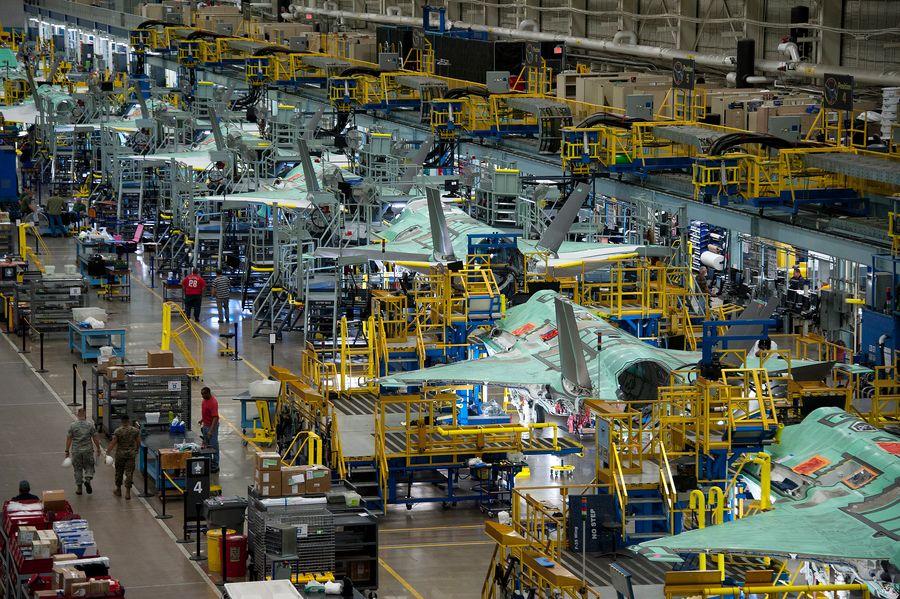
Platforms themselves are far more intricate. In WWII, design-to-production cycles were measured in months, and changeovers could be achieved by retooling jigs, fixtures, and dies. Ford’s Willow Run went from breaking ground to producing a B-24 roughly every hour—about one every 63 minutes by March 1944—in just over two years. Today, an F-35 contains hundreds of thousands of parts, integrates ~8 million lines of onboard code, and draws on suppliers in well over a dozen countries. A mid-production configuration change can trigger months of systems-integration testing, cybersecurity validation, and airworthiness re-certification. This coupling—hardware to software, prime to subcontractor, design to regulator—turns wartime reconfiguration from weeks into fiscal years.
Constraints absent in the 1940s now bite early. Wartime authorities once pooled or overrode patents so blueprints could flow to any qualified plant; today, sensitive designs are entwined with proprietary software, export controls, and classified protections. Even under DPA Title III, extracting proprietary radar algorithms or seeker code requires legal negotiation, foreign-disclosure approvals, and cyber-secure handling. Precision metallurgy compounds this: a modern turbine blade must meet extreme tolerances, survive >1,000°C without creep, and be produced in single-crystal alloys—processes limited to a handful of facilities optimized for narrow lines and unable to change over quickly without re-qualification. Technical IP, certification, and process metallurgy are now binding mobilization constraints.
Redundancy has eroded. In WWII, multiple cities produced artillery fuzes or machine tools; if one plant was bombed, others absorbed the load. Today, solid-rocket-motor capacity is concentrated in a few sites and firms—Northrop Grumman’s Promontory, Utah complex and Aerojet Rocketdyne (now L3Harris) expanding in Camden, Arkansas—leaving output exposed to single-point failures even if “the work” is split across locations. The U.S. also relies on a single primary beryllium producer (Materion), with refining and metal work centered in Utah and Ohio—an esoteric dependency that touches optics, sensors, and aerospace structures.
Finance has shifted too. In the 1940s, the Fed pegged Treasury yields and war bonds funneled household savings into government debt—overt financial repression. Today’s issuance lands in liberalized, globally intermediated markets where demand is deep but not administratively captive, so large emergency borrowing echoes through rates and exchange channels rather than being absorbed by a guaranteed peg.
Secrecy has inverted. In the 1940s, industrial espionage required physical penetration; aerial reconnaissance was rare and costly. Today, foreign intelligence services and commercial analysts track contract awards, scrape supplier data, and monitor plant expansions via ubiquitous commercial satellites, detecting mobilization nodes months before they reach output. Simultaneously, electrified, automated manufacturing is entwined with critical minerals—cobalt, nickel, lithium—whose mining and especially refining are concentrated abroad, with China and Indonesia playing outsized roles. A maritime shock or embargo that tightens these flows ripples into factory uptime long before the first ship of finished goods sails.
History shows how decisive bottlenecks can be. German armaments output under Speer more than doubled between 1942 and 1944 despite bombing, but mobility unraveled once the oil campaign strangled fuel and transport late in 1944; the 1943 Schweinfurt ball-bearing raids caused disruption that Germany mitigated via dispersal and substitution. Imperial Japan sustained aircraft production into late 1944 but could not replace trained pilots or secure enough high-octane fuel after U.S. submarines shattered its tanker fleet. NATO planners, fearing a Warsaw Pact offensive that would outrun Europe’s industry, prepositioned POMCUS stocks to bridge the gap between U.S. mobilization and sustained reinforcement. The lesson is stable: strong bases still fail when fuel, transport, or single-source components are interdicted faster than they can be rebuilt.
A modern two-front war would multiply these risks. A European campaign would consume artillery at Ukraine-style rates—tens of thousands of rounds per month—plus short- and medium-range air-defense interceptors and combat-engineering assets. An Indo-Pacific war would demand LRASMs, Mk 48 torpedoes, AIM-120-class missiles, and aerial refueling sorties on a scale not seen since Vietnam, while sustaining contested logistics across 6,000 nautical miles. Both theaters would compete for upstream choke points: nitrocellulose and other energetics, RDX/HMX capacity, solid-rocket-motor casings and propellant, seeker optics, and “legacy” rad-hard chips. Many are multi-year problems: nitrocellulose is tied to specialized linters and acid plants (Radford remains the primary U.S. NC supplier), and rad-hard microelectronics require protected domestic lines that take time to reconstitute or expand.
The mobilization clock is unforgiving. In the first six months, the United States could expand output only by cannibalizing existing lines and allied stockpiles, stripping non-deploying units for spares, and diverting commercial shipping and aviation. Maintenance standards would loosen to keep partially serviceable systems in use, and production would focus on “good enough” munitions like JDAM kits and GMLRS rockets, rationing more complex systems. From six to twenty-four months, added energetics lines and artillery-shell capacity could come online, pushing 155mm toward ~100,000 shells per month by late 2025—an annualized rate near 1.2 million if sustained—still far below WWII’s tens of millions per year by 1944. Workforce shortages in critical trades would persist, as certification pipelines for nuclear welders, energetics chemists, and NDT inspectors cannot be safely compressed. Only after roughly two to five years would new shipyard capacity, chemical energetics complexes, and microelectronics fabs produce meaningful surpluses—by which point objectives may already be constrained by industrial shortfall.
The answer is not a budgetary surge alone but a rebuilt industrial architecture that compresses the lag between demand and first replacement systems in theater. Maintain a continuously updated, classified bill-of-materials map for every critical munition down to third-tier suppliers; create a national reserve of 5-axis mills, autoclaves, winding machines, and dies in climate-controlled depots and exercise them quarterly; keep mothballed “dark factories” for rocket motors, energetics, and seekers at low idle with retained crews; establish a credentialed civilian reserve manufacturing corps for critical trades; secure trailing-edge semiconductor capacity domestically and with allies via pre-purchased wafers and mask sets; and treat ports, railheads, and merchant crews as weapons systems with pre-allocated wartime slots and trained reserves. Build parallel energetics plants in multiple regions to eliminate single-site dependency, and use alliance-based mirrored tooling so a missile built in the United States can be built without redesign in Japan, Poland, or Australia.
These measures are not glamorous, but they spell the difference between sustaining combat power across two theaters and watching one front collapse for lack of materiel. The currency of industrial war is time: replacing what is lost before momentum reverses. In 1942, geography and scale bought the United States that time. In the 21st century, adversaries will aim to win by severing long-lead bottlenecks before they can be restored. A mobilization plan that treats the home front as a contested battlespace—subject to cyber penetration, financial disruption, and targeted interdiction—is strategic realism.
A two-front war is a possibility, not a certainty. The choice is whether to meet it with nostalgia for a mobilization model that no longer exists, or to rebuild the architecture that made it possible: mapped supply chains, redundant tooling, trained labor, pre-licensed plants, secure mineral and semiconductor access, insulated wartime finance, and rehearsed transport corridors. If those foundations exist before the crisis, the “impossible” becomes merely expensive. Without them, the arsenal of democracy will be a museum piece—remembered but unavailable when most needed.
Carlo J.V. Caro is a strategic analyst trained in international security at Columbia University. He previously served as Vice President of a real estate and sustainability firm, overseeing blockchain-enabled investment systems, green housing finance, and cross-regional procurements across Asia and Latin America.

Iron Raven: Remembering Colonel Joseph B. Conmy, Jr.
By Louis Marano • RealClearDefense
Stand Proud of the Force
By Jay Rogers • RealClearDefense
How a Dying Agency Turned Fentanyl Into a Weapon of Mass Destruction
By Barry Angeline • RealClearDefense
The Pressure Is the Message: What Xi and Putin Faced in Shenzhen
By Emzari Gelashvili • RealClearDefense
China’s Revised Mobilization Law and the Expanding Reach of National Defense
By Muhammad Shoaib • RealClearDefense

Marine Corps Hero Under Federal Investigation
By Laporta, Burnham & Watson, CBS
A Postmortem of Maneuver Warfare in the U.S. Marine Corps
By Donald Vandergriff
U.S. Putting Weapons in Space: A Strategic Blunder?
By Ajey Lele • RealClearDefense
U.S. Senate Seeks to Exchange Shipbuilding Funds for More Munitions
By Naval News
F-35C Completes First Launch and Recovery Trials on a Ford-Class Carrier
By Navy T.