
Trump's 'Golden Fleet' Needs an Industrial Strategy To Match
Last updated 05:16 AM EST • Read time: 6m
America can’t outbuild China alone. Its next fleet must be forged with allies.
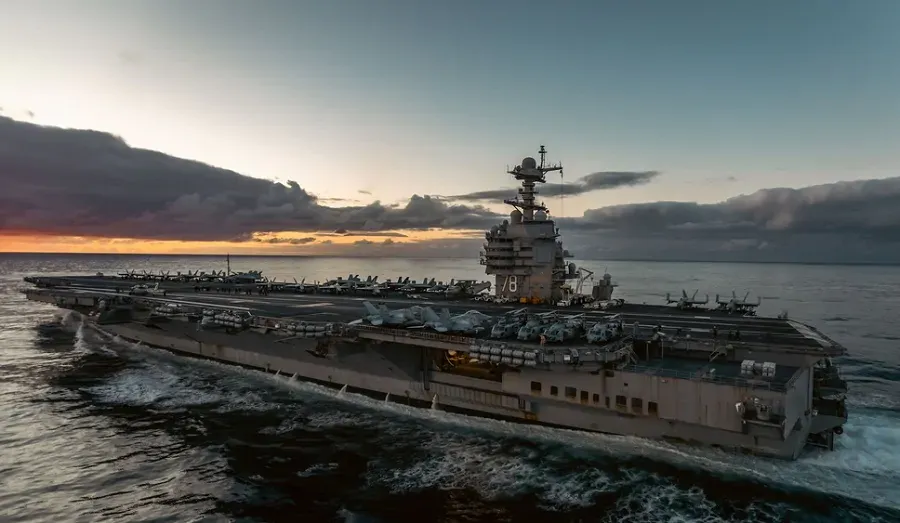
At the Reagan National Defense Forum, Navy Secretary John Phelan confirmed that President Trump has signed off on the Golden Fleet, an ambitious expansion of American seapower whose fate now hinges on whether the United States can rebuild its maritime industrial base.
But the shipyards and rules that once powered U.S. dominance no longer match the mission. China now commands more than half of global commercial shipbuilding; the United States, barely a tenth of one percent. Last year, China’s largest state-owned builder launched more tonnage than the entire U.S. industry has produced since World War II. Phelan also hinted at “one more kind of big, beautiful ship” at the forum, a tease that lands amid ongoing debate about whether the Golden Fleet should include larger, more capable platforms. Aging infrastructure, thin labor ranks, and slow contracting keep American yards off the pace. The choice is stark: build alone and fall further behind or build with allies and regain speed and scale.
Roosevelt’s Great White Fleet signaled the rise of American industrial power. The Golden Fleet may well test whether that legacy can be rebuilt through allied co-production and shared standards instead of isolation. If the Great White Fleet proved what America could build alone, the Golden Fleet will prove what it can build together.
Cooperation is no longer a goal for the future; it has already begun. In Seoul, the United States and South Korea agreed to a $350 billion investment package, including a first tranche for shipbuilding. In Tokyo, the United States and Japan advanced projects under a $550 billion framework and signed a memorandum to expand shipbuilding capacity by aligning investment, procurement, workforce, and technology. Together, these steps aim to match China’s speed with democratic scale, rebuilding through capital and competition rather than subsidies or isolation.
The question now is execution. Turning these commitments into a lasting industrial strategy means aligning policy, precedent, and investment into a plan that delivers measurable results within American rules. The Navy can draw lessons from past mobilizations and modern production systems. It also needs a sequence that builds momentum fast and proves early success.
Thinking right to left, restoring America’s shipbuilding strength begins with a clear outcome. In October, President Trump authorized construction of four Arctic Security Cutters overseas to meet urgent needs, signaling a readiness to innovate under pressure. He directed the Coast Guard to phase production so allied expertise can be absorbed and follow-on cutters are built in U.S. shipyards. Current law bars foreign construction of U.S. naval vessels, though the president may waive the restriction when national security requires it. A new agreement with Finland puts that authority into practice: initial hulls built abroad, skills and technology transferred home, future production shifting to America. Success will be measured by how quickly those lessons deliver a faster, more capable domestic fleet. Defining the goal early and learning fast should guide how the Navy builds.
Speed will return only if the Navy builds modular and builds alongside allies. Phelan has told Congress that U.S. shipyards lag their leading allied counterparts. He reported roughly three times the productivity per shift, less paperwork for workers, and greater use of automation and on-site training. Their edge is not lower wages but smarter methods: standardized blocks built in parallel and joined with precision. There are concerns that this approach could shift work away from American yards, but that risk can be managed through work-share agreements that protect vital industrial interests and keep final assembly at home while allies produce modules under shared standards. The real drag is bureaucracy that rewards paperwork over delivery. Reducing delays, adopting modular practices, and using allied production to accelerate learning will matter more than any single program decision. Every module built with partners should make the next ship built in America arrive sooner, cost less, and perform better.
The Navy should begin where risk is lowest. Auxiliary ship programs offer clearer requirements and less political friction than combatants. A recent partnership between Huntington Ingalls Industries and HD Hyundai Heavy Industries shows what this can look like in practice, establishing teaming arrangements for auxiliary programs and combining complementary strengths. Starting here accelerates learning, upgrades U.S. yards, and builds trust before moving to more complex vessels. This is where the Navy can prove the model, measure results, and build early momentum.
Allied production must reinforce, not undercut, America’s shipbuilding base. Effective cooperation rests on reciprocity and transparency, principles that also anchor U.S. economic and industrial policy in the 2025 National Security Strategy. U.S. and allied firms should compete on equal terms and share cost, schedule, and performance data to ensure measurable value. Evidence-based oversight enables Congress and the Navy to assess how each partnership contributes to domestic capacity, jobs, and skills. Reciprocity ensures American companies gain access to allied programs just as allied partners gain access to U.S. projects. Certain pathways, such as international firms acquiring U.S. facilities and transferring advanced production methods, can expand productivity and create durable workforces. Others risk eroding capacity if work migrates overseas and order books shrink. Cooperation should expand capacity at home, not displace it abroad.
To translate principles into practice, capital must align with outcomes. Strategic financing and workforce development need to reinforce one another, so investments strengthen both U.S. shipyards and the labor forces that sustain them. New sources of capital are already emerging: JPMorgan’s Security and Resiliency Initiative and the partnership between Cerberus Capital and the Korea Development Bank illustrate how financial tools can support modernization. Funding should prioritize throughput gains and the diffusion of advanced production methods, not simply contract volume. When allied firms participate in U.S. projects, their involvement should leave behind skills, processes, and technologies that expand domestic capability. Public and private capital can deliver the infrastructure, technology, and expertise required to rebuild maritime capacity at scale. What matters is coherence: investment aligned to purpose, cooperation structured to build capability at home, and progress measured by the strength of the base that remains.
At the Reagan National Defense Forum, the administration made clear that the Golden Fleet is now a presidential decision, not an aspiration. The challenge is no longer defining the goal but assembling the industrial capacity and allied cooperation required to achieve it. Strategy will matter, but choices about production, sequencing, and scale will matter more. The Golden Fleet will rise or fall on those choices, not on the announcement that introduced it.
Jeffrey M. Voth is an engineering and technology executive focused on strengthening the U.S. defense industrial base and allied cooperation.

ICE Is Not a Four-Letter Word
By Meda Parameswara Reddy • RealClearDefense
The U.S. Can Draw Down in the Middle East Without Going Blind
By Cudi Zerey • RealClearDefense
America Needs a Joseph Directive
By Jeff Ballabon • RealClearDefense
Partnering Decides Whether Flexible Military Construction Can Work
By Matt Russell • RealClearDefense
Eight Months of Epic Fury and Still No Internal Alternative
By Stephen D. Cook • RealClearDefense

GE Aerospace to Supply Engines for Two US Navy Flight III Destroyers
By Defense Post
U.S. Air Force Asks Industry for New Cruise Missile for Ukraine
By Michael Peck, DNews
First Flight II San Antonio-class Amphib Completes Builder’s Trials
By Mongilio, USNI N.
LGM-35 Sentinel ICBM on Track for 2030
By Kris Osborn, Warrior Maven
On American Destroyers, Avoid a Self-Inflicted Wound in Spain
By Defense News