
Before the Next Fight
Published July 17, 2026 • Read time: 15m
How Marine Battalions Should Integrate Unmanned Systems in the Attack
Introduction
The Marine Corps has long distinguished itself as America's most adaptive warfighting institution. The 1934 Tentative Manual for Landing Operations codified amphibious doctrine that proved decisive across the Pacific and reshaped how joint forces project power from sea to shore. A decade later, and amidst World War II, the organic fire team concept pushed maneuver warfare integration to its lowest possible echelon, a structural innovation that still defines Marine infantry today. These were bold doctrinal bets made by leaders who understood that military institutions must keep up with rapidly evolving warfare. Today, the Corps faces a similar inflection point. The proliferation of cheap, lethal, and autonomous unmanned systems demands the same institutional adaptation that produced the landing manual and the fire team. The question is not whether drones will reshape tactical ground combat: they already have. The challenge for Marine Corps leaders is how best to lead that transformation.
The Marine Littoral Regiment, the Stand-In Force concept, and the deliberate divestiture of tanks and bridging assets reflect an institutional calculation that distributed, networked, and lethally precise forces will outperform mass in the maritime littorals. Unmanned systems are already resident in Marine infantry battalions, and deeper integration is a question of when, not if. The Lebanese militant group Hezbollah's Intelligence Surveillance and Reconnaissance (ISR) and strike operations against Israeli forces and Tehran-aligned proxy employment of one-way attack drones against U.S. high-value targets in Iraq confirm that this threat is neither distant nor confined to peer competitors. The Russo-Ukrainian war has provided the most data-rich operational laboratory for tactical unmanned systems since the advent of precision munitions, and its lessons demand institutional attention before the next fight—not during it. This essay proposes a phased concept for employing unmanned systems in the battalion attack, arguing that the Marine Corps can lead the joint force in codifying their integration into ground combat—not as bolt‑on enablers, but as organic elements of a reimagined battalion attack.
What this concept requires, before a single phase is executed, is a deliberate orientation of how Marine leaders conceptualize the employment of unmanned systems. These systems are combined arms enablers capable of denying enemy ground movement, collapsing logistical corridors, and neutralizing the adversary's drone architecture before it can be employed against the assault element. The following four-phased concept is adapted to maximize the effectiveness of unmanned systems for an infantry battalion in the attack and aligns to key tenets of offensive operations found in Marine Corps Warfighting Publication (MCWP) 3-01, Offensive and Defensive Tactics.
Phase 0 — Shaping Operations
Shaping operations—executed during the intelligence preparation window preceding H-Hour—are the most consequential phase of the air- and ground-drone-enabled battalion attack. Failure to execute this phase not only degrades the assault but can also render the attacking force catastrophically exposed before a single maneuver element crosses the line of departure. During this window, the battalion constructs the intelligence architecture on which every subsequent phase depends. A battalion that arrives at H-Hour without a validated target picture, suppressed enemy drone teams, and interdicted enemy reinforcement routes places its ability to generate tactical momentum and achieve maneuver at significant risk.
The battalion's organic and attached unmanned systems are deployed across all assigned sectors in a deliberate, layered reconnaissance effort to develop an in-depth understanding of the enemy's defensive architecture. These missions are targeted; time-sensitive operations designed to identify, locate, and characterize high-value targets throughout the battalion's area of operations. Priority targets include enemy drone team antennas, electronic warfare systems, artillery positions, satellite communications modules, enemy concentration areas, supply routes, and enemy unmanned systems teams, which constitute the most dangerous asymmetric threat to the attacking force.
The identification and suppression of enemy drone teams is a critical mission for the battalion. An enemy drone team that survives Phase 0 represents an existential threat to the assault. The suppression of enemy drone teams through EW, directed energy, or physical destruction is therefore a named essential task of Phase 1, and Phase 0 exists in large measure to generate the target fidelity required to execute it with confidence. This point is doctrinal. MCDP 1-3, Tactics, designates the identification of enemy surfaces and gaps as the essential analytical prerequisite to maneuver.
Phase 0 must further account for the enemy's sustainment and reinforcement architecture. Routes identified in Phase 0 become candidates for aerial interdiction and mining operations, in which unmanned systems deploy anti-tank and personnel munitions or establish loitering-munition ambush positions along corridors the enemy must use to reinforce the objective. Phase 0 also presents a decisive, often underutilized opportunity: the use of unmanned systems to support deception efforts. MCTP 3-32F, Deception, requires that deception operations be planned with the same rigor as fires and be designed to produce a specific effect on enemy decision-making. Drone-enabled deception satisfies this standard at a fraction of the cost of traditional deception operations. Drones can conduct feints along secondary axes, simulate the movement signatures of a main effort when no assault is planned, or broadcast audio to deceive the enemy about friendly disposition and timing. This capability is not theoretical—open-source reporting on Ukrainian operations during the 2024 Kursk attack documented drone-mounted speaker systems broadcasting false movement sounds and voice communications, successfully deceiving Russian defensive forces ahead of the assault.
Unmanned systems are instruments of cognitive warfare capable of shaping the enemy commander's perception before a single kinetic action is taken. Phase 0 is the task executed by unmanned systems at a standoff range. A battalion that skips it has abandoned the logic of maneuver warfare before the fight has begun. Among the most operationally significant of these shaping actions is the forward emplacement of ambush-configured first-person view (FPV) drones—systems that land in concealed positions along enemy logistics routes and wait, dormant, for a target to present itself. These systems are pre-positioned using signals intelligence and reconnaissance drone data to build a precise picture of enemy route timing, equipment, and movement frequency. Fiber optic-controlled variants, which emit no radio-frequency signature and are therefore resistant to electronic detection, can remain in position for hours, offering the battalion a persistent, nearly undetectable interdiction capability along priority reinforcement corridors that activate on the commander's order.
Unmanned aerial systems may be used to enhance the effectiveness of unmanned ground vehicles (UGVs). These ground systems depend on precise, up-to-date terrain awareness. Surface irregularities—including shell craters, anti-tank ditches, and subsidence features—present significant mobility hazards that can mission-kill or immobilize ground platforms if not accounted for in route planning. Consequently, Marines using organic UAV systems provide high-resolution imagery and orthophotography maps, along with granular terrain data, to pre-designate safe transit corridors before deployment.
Phase 0 concludes on the battalion commander's conditions-based assessment: the validation of high-value targets, the identification of enemy drone team locations with sufficient fidelity to prosecute in Phase 1, the establishment of aerial interdiction positions along priority reinforcement routes, and the establishment of deception efforts by the commander. A battalion that transitions to suppression and assault without maximizing its use of drones in the shaping fight has forfeited its most decisive advantage—and assumed a level of risk that fires and maneuver alone cannot mitigate.
Phase 1 — Deployment and Suppression
Phase 1 is contingent upon the battalion commander's successful validation of Phase 0 conditions. Its purposes are unambiguous: systematically degrade the enemy's combat power at depth, interdict his freedom of maneuver, and deny him the ability to reconstitute or reinforce his forward positions before the battalion assault element crosses the line of departure.
Phase 1 is the moment to prosecute a priority identified by Phase 0 intelligence: the systematic degradation of enemy command-and-control nodes, antenna arrays, drone team positions, and retransmission sites. Against hardened or electronically defended targets, the employment of a single FPV is insufficient. Coordinated multi-drone attack, with 10-12 FPV systems approaching the target simultaneously from different axes and angles, overwhelms an enemy operator manning a single jamming system.
Phase 1 continues with longer-range unmanned systems striking the extended depth of the battalion's sector to destroy or to degrade critical drone positions capable of delivering decisive fires against the assault during its most vulnerable phase of movement. Direct support from 60- and 81 mm and artillery assets is synchronized with the drone suppression package to generate simultaneous, multi-axis fires that prevent the enemy from massing his response against any single axis. Beyond nominated target prosecution, the battalion should authorize designated FPV pilots to conduct free-hunting operations within defined sector boundaries against pre-authorized target categories. Free hunting, a tactic refined in Ukraine, empowers trained pilots to self-task against targets of opportunity without coordination with the real-time fires cell. Layered over the nominated high-value target strike package, free hunting saturates the enemy's defensive depth with a volume and tempo of engagement that complements and extends the centrally controlled fires architecture.
As Phase 1 matures, assault UGVs move forward with the leading elements of the attacking force. Assault UGVs carry organic EW systems to deny adversary frequencies in the assault corridor, medium and heavy machine gun payloads to fix enemy fighting positions while infantry maneuvers to advantage, and local air defense assets to protect the force against residual enemy drone threats. The UGV is the forward edge of the assault—designed to absorb initial contact, fix the enemy's attention and fire, limit the enemy’s freedom of movement, and create the conditions that will allow Marines to close with and destroy the enemy.
Phase 1 also activates the dormant ambush positions established during Phase 0 along enemy axes of approach and reinforcement. An enemy reserve force that commits to reconstitute or reinforce its forward positions now does so under active engagement along the route, with ambush-type munitions that deny the enemy force the freedom to shift to an alternate route without significant delay. The cumulative effect is the isolation of the objective, a condition that historically required operational-level air interdiction but is now achievable at the battalion level through organic and attached unmanned systems.
In the final actions of Phase 1, the battalion employs EW drones to the rear of enemy defensive positions via aerial unmanned mothership platforms and extended-range systems. These platforms extend strike range beyond organic UAS limits by combining mothership standoff with the dropped drone's own range. These systems are tasked with two decisive effects: disrupting enemy command-and-control networks and jamming enemy unmanned systems supporting the defense. An enemy commander who enters Phase 2 without reliable communications—and whose drone teams have been blinded or jammed—is operationally paralyzed. This is the condition Phase 1 must deliver at H-Hour: an enemy force that is physically degraded, informationally isolated, and tactically blind.
Phase 2 — The Assault
The assault phase represents the convergence of every action taken in Phases 0 and 1. Overhead drone assets provide battalion and company commanders with continuous digital and visual feeds, enabling situational awareness at the point of contact, rapid re-tasking of fires, and near-instantaneous assessment of enemy reaction. As the assault element crosses the line of departure, UGVs move ahead of and alongside the maneuver element, striking the enemy's first defensive line directly, engaging fighting positions, breaching fighting positions and obstacles, and forcing the defender to reveal their remaining position. In this manner, the UGV and not the marine infantryman absorbs the enemy's initial burst of fire from crew-served weapons and anti-armor systems. Simultaneously, FPV attack drones directly engage point targets UGVs cannot reach-, rooftop positions, reverse-slope fighting holes-ensuring the assault element advances behind a multi-vector wall of suppressive fire similar to creeping barrages used in the First World War. In this phase, reconnaissance drones also fly ahead of the attacking force, providing visibility of the ground immediately in front of the leading squad and identifying enemy positions to the commander that are not visible from ground level. As UGVs reach support-by-fire positions, indirect fires—mortars and artillery—shift from the first defensive line to secondary targets located during Phase 0 or dynamically identified by reconnaissance drones. The overhead drone picture enables the fires cell to execute this shift in near-real time, confirming UGV and assault element positions before redirecting fires, a level of coordination that previously required dedicated forward observers at every echelon.
EW drones maintain and intensify their jamming effort as the assault closes on the objective—sustaining the disruption of communications between enemy forward units and their higher headquarters and continuing to suppress enemy unmanned systems attempting to reconstitute. An enemy leader whose radio is jammed, whose drone team cannot launch, and who cannot receive guidance from his commander is tactically isolated at precisely the moment he needs combined arms coordination most. This isolation is a deliberate condition of the drone-enabled assault, and the EW drone's role in sustaining it through the close fight is as critical as any direct-fire system in the battalion.
The practical realization of this command advantage depends on a deliberate architectural decision made before the first drone launches: the integration of all aerial and ground unmanned systems feeds into a single common operating picture, accessible at every echelon, from battalion down to the assault element. When consolidated into a centralized control element within the S-3 operations cell, this architecture enables the battalion commander to observe the full battlefield context simultaneously. The result is a command-and-control node that functions less as a traditional fire direction center and more as a persistent, all-domain sensor fusion cell—one that compresses the sensor-to-shooter cycle to the point where the commander shapes the battlespace in near real time.
The drone-enabled battalion fundamentally elevates command-and-control fidelity. The commander maintains a persistent overhead feed that provides continuous visibility into the assault's advance, enemy reactions, and the evolving geometry of the fight. Command and control in this construct are faster by an order of magnitude. Phase 2 concludes when the objective is seized. The battalion commander transitions unmanned systems to consolidation tasks by deliberate order. ISR assets reorient toward the front, UGVs shift to cover likely counterattack approaches, and heavier unmanned logistics systems begin resupplying troops in their new positions. FPV teams transition to pursuit and battle damage assessment.
Phase 3 — Consolidation and Counterattack Preparation
Seizing the objective is the transition point between offensive execution and the ensuing fight. In the unmanned systems-enabled battalion, consolidation is a deliberate reorientation of the entire unmanned architecture toward the next threat. Long-range UAVs immediately reorient into the enemy's tactical depth to construct a real-time retrograde picture, tracking withdrawal routes, subsequent battle positions, and the reconstitution of reserve elements. The same drone architecture that compressed the kill chain during the assault now serves a different but equally critical function: denying the enemy the unobserved time he needs to reconstitute, reorient, and counterattack. Persistent ISR forward during consolidation is an active extension of the offensive, sustaining the decision advantage the battalion seized at H-Hour.
The dormant ambush systems emplaced during Phase 0 and activated in Phase 1 retain lethal utility during Phase 3. As enemy forces withdraw along corridors that were mined and seeded in the shaping phase, those systems continue to engage, striking retreating formations, destroying resupply convoys, and attriting counterattacking forces. This is the designed second-order effect of Phase 0 route interdiction, paying its dividend at the moment of the enemy's greatest vulnerability. The battalion that correctly planned its ambush systems in Phase 0 has already shaped the conditions for Phase 3 before the assault began.
Logistics UGVs begin forward resupply immediately upon objective seizure, pushing ammunition, water, and medical materiel to assault elements that have consumed critical supplies. Casualty evacuation is similarly enabled by UGVs operating in contested terrain without exposing additional marines to enemy fire, and the “golden hour” may someday be supported by unmanned helicopters. Assault UGVs reposition to cover likely avenues of approach for a counterattack, establishing an unmanned defensive layer while Marines consolidate and prepare crew-served weapon positions. Organic counter-UAS assets reestablish the local air defense architecture across the new forward line of troops, ensuring the enemy's first reconnaissance of the consolidated position is contested from the moment it is attempted.
Conclusion
Throughout its history, the Marine Corps has maintained its unique culture of innovation and the willingness to adapt faster than the adversary. The 1934 Manual for Landing Operations and the organic fire team were the products of institutional foresight during critical times for the Corps. Unmanned systems now represent similar challenges. While the phased concept outlined in this essay is not a definitive solution, it is intended to aid Marine Corps planners in conceptualizing and developing doctrine for Marines to employ and to defeat enemy unmanned systems on the battlefield. As unmanned systems proliferate among state and non-state actors alike, the likelihood of encountering an adversary that employs drones, ground robotics, and EW in depth, at the scale and sophistication observed in Ukraine and the Middle East, is no longer a remote contingency. It is a near-certainty. How the Marine Corps conceptualizes, trains, and integrates unmanned systems into the battalion offense today will directly determine how that fight ends. The next adversaries will not wait for the debate to conclude. They are already flying.
Jorge Rivero is a Russian and unmanned systems researcher at the Institute for Defense Analyses in Alexandria, Va. He is a retired Marine, a Russian foreign area specialist, and an explosive ordnance disposal technician. Jorge holds a master of arts degree from the Bundeswehr University in Munich and from the George Washington University. He is also an MIT Seminar XXI fellow. His work focuses on the Russian military, Russian strategic weapons, and robotics in warfare.
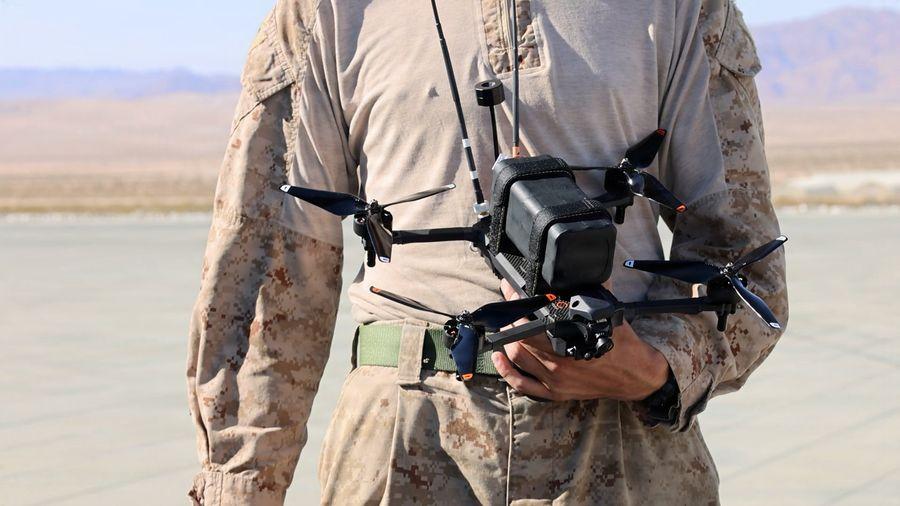
image: A U.S. Marine with 3rd Light Armored Reconnaissance Battalion, 1st Marine Division performs a systems check during a first person view unmanned aircraft system integration exercise with a UH-1Y Venom, assigned to Marine Light Attack Helicopter Squadron (HMLA) 169, Marine Aircraft Group 39, 3rd Marine Aircraft Wing, at Marine Corps Air Ground Combat Center, Twentynine Palms, California, May 13, 2026. The collaborative exercise allowed Marines to determine the feasibility of using FPV UAS from an aircraft and evaluate how to best integrate them to increase combat capabilities and lethality. (U.S. Marine Corps photo by Sgt. Symira Bostic)

Operation Epic Fury and the Illusion of Victory
By Stephen D. Cook • RealClearDefense
Previewing The Shenzen Summit: A Critical View
By Stephen Blank • RealClearDefense
How to Win Without Military Victory
By Kevin Eyer • RealClearDefense
We Keep Funding ‘Shared Infrastructure.’ Nobody Has Defined It.
By Frederick Gale • RealClearDefense
Congress Must Reauthorize Section 702 of the Foreign Intelligence Surveillance Act
By Bryce G. Poole • RealClearDefense

Five Takeaways From Navy Nominee’s Rocky Hearing
By Seligman & Weisgerber, WSJ
U.S. Air Force Taps Anduril for Containerized Launcher
By Global Defense News
Time To Say Goodbye to the NMESIS and NSM
By Marine Corps Compass Points
HII and U.S. Navy Break Ground on Shipyard Complex
By George Allison, UKDJ
Rare U.S. Air Force Spy Plane Spotted Over the Black Sea
By D. Malyasov, Defence Blog