
Meeting the Navy's Demand for 3D Printing
Published July 31, 2026 • Read time: 5m
The United States is entering a historic period of industrial expansion with tens of billions of dollars slated for modernizing the shipbuilding industrial base. However, reversing decades of decline means facing reality. U.S. shipyard output is 600-fold less than its WWII peak and 200 times less than current Chinese production, while maintenance backlogs erode fleet availability.
The fleet of the future will not be built on the industrial base of the past. Industry, with support from the Navy, must adopt new methods of advanced manufacturing to accelerate new builds, clear maintenance backlogs, and claw back from a long period of decline.
3D printing is key to the shipbuilding revival. Where additive manufacturing (AM) has been used by the Navy, production and component lead times have been reduced dramatically, in some cases by up to 75%. In 2025 alone, the Navy reportedly eliminated more than 1,400 cumulative days of delay by applying additive manufacturing to specific programs. As Chief of Naval Operations (CNO) ADM Daryl Caudle described it, “That is not a science project. That is combat credibility gained back from the jaws of inefficiency.”
The Navy’s Fighting Instructions explicitly call to “normalize” advanced manufacturing and make it a “scalable operational capacity.” However, scaling AM will require interchangeability—establishing one-to-one equivalency for parts produced through traditional methods, like forging and sandcasting, and parts produced through additive manufacturing.
South Korea’s Nuclear-Powered Submarines After the Midterms
Why Build a Billion-Dollar Warship if a Cheap Drone Can Sink It?
Hung Cao Facing Contentious Confirmation To Become Navy Secretary
How Digital Twins Can Strengthen Naval Readiness Before a Crisis Begins
Today, only a small number of additively manufactured parts are approved by the Navy as interchangeable with traditionally manufactured parts. In practice, the lack of interchangeability means a 3D-printed part that is structurally and materially equivalent to a pre-qualified part will be subjected to additional testing and a longer approval process because of how it was produced. What OEMs stand to gain in production speed, they risk losing in lengthy approvals.
The Navy has shown it can fast-track approvals for new manufacturing processes. NAVSEA approved 182 additively manufactured parts for use in ships and submarines last year, with more than 600 additional components undergoing engineering review. Another 120 AM parts were put into development. This represents real progress. However, the speed at which industry can scale additive manufacturing will be limited by how quickly and aggressively the Navy develops requirements, specifications, and processes to support interchangeability. Navy leadership, NAVSEA, and the Maritime Industrial Base (MIB) program have been champions in validating additive manufacturing in select circumstances. But moving beyond limited demonstrations will require clear processes for industry partners to apply advanced manufacturing to a variety of parts, materials, and criticalities.
As of today, NAVSEA’s Systems Engineering and Logistics Directorate (NAVSEA 05) has released four military standards for material process combinations covering stainless steel, titanium, and copper-nickel with an additional six materials standards slated for approval in the future. These standards are essential for naval suppliers who are starting to target specific components to be sourced with AM. Successful demonstrations on Level II and Level III submarine parts are proving the reliability of the process. According to Capt. Jason Deichler, who leads the Navy hub for integrating AM into the submarine fleet, the service is beginning to apply 3D printing to multiple Priority I Casualty Reports (CASREPs). As the Navy becomes more confident in the technology, it must clear the way for industry adoption by creating a technical baseline for manufacturers to qualify 3D printed parts.
There is widespread agreement on the urgency of reshaping how the nation produces and sustains its fleet—from the Pentagon and the White House to Capitol Hill and U.S. shipyards. Earlier this year, the Pentagon announced it would direct roughly $1.6 billion in budget reconciliation act funding toward advanced manufacturing, AI, and automation. This includes $450 million in large-scale Wire Arc Additive Manufacturing (WAAM) and machining capacity for the shipbuilding industrial base, as well as another $500 million for maritime industrial base adoption of advanced manufacturing techniques.
How this money is invested matters tremendously, especially if the goal is industrial-scale efficiency. A few laser bed printers in the hands of a supplier may be sufficient to produce some obsolete parts. But scaling AM requires dedicated expertise and capacity. Companies like Lincoln Electric, with robotic WAAM machines capable of laying 100 pounds of metal per hour, exemplify this. Industrial-scale additive manufacturing is a specialized capability, as is producing Navy-qualified parts. The two do not necessarily have to live under the same roof. Just as naval suppliers frequently work with forging shops or casting houses, they now need clearance to do the same with additive manufacturers.
This is another area where policy and Navy requirements have fallen behind technology adoption. The challenge for naval suppliers is not finding willing partners who have 3D printing capacity. The challenge is securing Navy and shipyard approval to use components built by those partners.
The Navy and the MIB have been indispensable partners in advancing industrial AM deployments, showing improvements in production speed and efficiency. Recent years’ pilot programs have positively demonstrated how 3D printing can be used to counter the long-term trends of schedule delays, maintenance backlogs, and declining industrial output. The missing piece is authorization. For industry to realize the benefits of additive manufacturing, it needs the Navy’s immediate support in establishing clear requirements and specifications for parts interchangeability and source approval.
Michael Johnston is the President of Fairbanks Morse Components at Fairbanks Morse Defense, where he oversees strategic manufacturing and parts supply for the maritime industrial base. Michael previously served as Vice President and General Manager of Hunt Valve, leading operations, and supply chain strategies for integrating advanced manufacturing technologies into naval production.
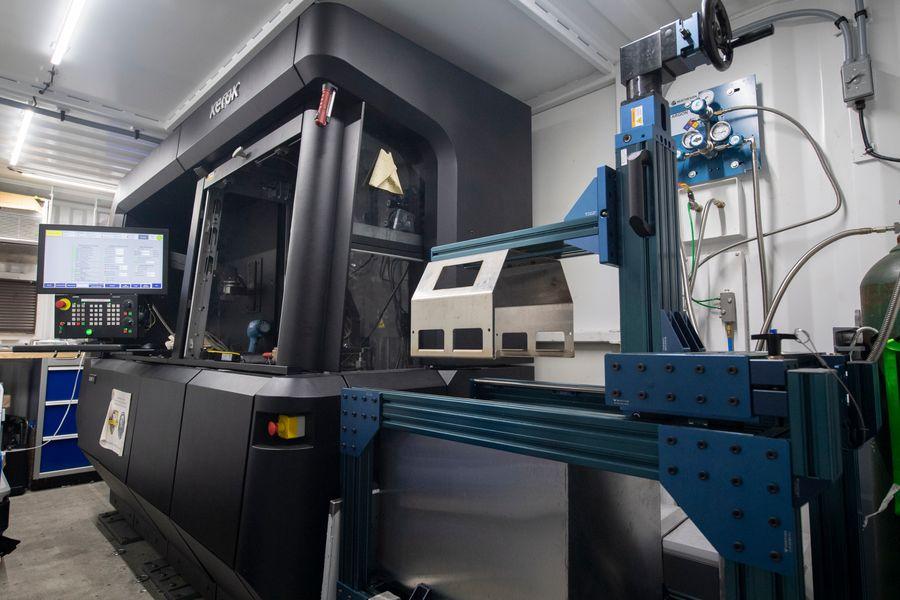
image: ADDiTEC’s ElemX™ 3D liquid metal printer fabricates an aluminum air test fitting onboard USS San Diego (LPD 22), January 18, 2023. San Diego, the only ship homeported in its namesake city, is a San Antonio-class amphibious transport dock ship assigned to Expeditionary Strike Group 3. (U.S. Navy photo by Mass Communication Specialist 1st Class Brandon Woods)

Batteries Can Power a Win for America in Super Intelligence
By Manisha Singh • RealClearDefense
Poland’s Fighter Fleet Is Growing: Can Its Training System Keep Up?
By Bruce Allen Lubbering • RealClearDefense
Why Iran is Not Vietnam
By Kevin Brown • RealClearDefense
Closing the Missile (Defense) Gap
By Jason Camilletti • RealClearDefense
Part of a Larger Secret, Hidden World
RealClearDefense
Closing the Missile (Defense) Gap
By Jason Camilletti • RealClearDefense
U.S. Navy Prepares for Third Zumwalt Hypersonic Upgrade
By C. Johnston, Naval N.
Pearl Harbor Hero Doris Miller Will Stay Namesake of CVN-81
By Mongilio, USNI News
Navy CCA Plans Will Not Wait For F/A-XX Next Generation Fighter
By The WarZone
Navy’s Shipbuilding Plan Would Require Massive Hike in Appropriations
By BrDef