
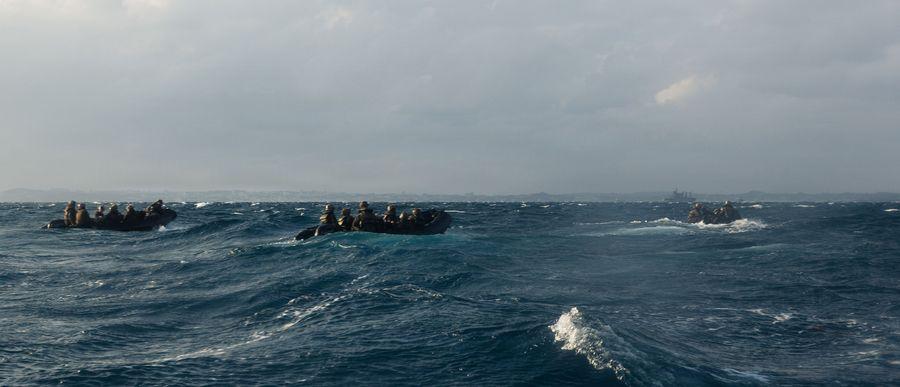
U.S. Marines with India Company, Battalion Landing Team 3rd Battalion, 1st Marine Regiment, 31st Marine Expeditionary Unit, conduct an at sea resupply drill with supplies from an autonomous low-profile vessel during unmanned surface vessel training operations as part of MEU Exercise. The ALPV has the ability to deliver multiple variations of supplies and equipment through contested maritime terrain. (U.S. Marine Corps photo by Sgt. Alora Finigan)
Why Build a Billion-Dollar Warship if a Cheap Drone Can Sink It?
Published Nov. 19, 2026 • Read time: 7m

Since Ukraine's highly publicized USV attacks on the Russian Black Sea Fleet, many have come to believe that swarms of cheap unmanned vessels can replace conventional warships, a belief that could push navies to shift billions in shipbuilding investment. However, current USVs have limits on reliability, range, and ability to gain sea control. Therefore, rather than replacing warships, USVs should be used for what they do best, as tools of distributed sea denial alongside conventional vessels.
The term unmanned surface vessel (USV) refers to any vessel that operates on the water surface without a crew onboard [1]. Although current unmanned vessels can operate with varying degrees of autonomy, most still involve some level of human input and are often operated remotely [2, 3]. In the military domain, USVs are used for direct attacks on ships and ports, surveillance, harassment, decoying, and, in some configurations, anti-air missions [4].
Although military use of USVs dates back to World War II, a large number of USV projects began to appear in the 1990s [1]. Major navies soon showed interest. In 2007, the U.S. Navy published a USV Master Plan that reviewed the available USV types and associated missions [1]. Since then, USVs have moved from planning into real combat. Their use grew from small-scale attacks in Yemen in the 2010s to full-scale operations by Ukraine in 2023 [2]. This trend is not limited to a few countries, since at least 40 states currently have USV programs [2]. The question for navies is no longer whether to adopt USVs, but how to integrate them into their fleets.
The Russia–Ukraine war has brought USVs to the center of public and military attention. Ukraine's strategic use of USVs became a transformative factor in its naval campaign and produced remarkable tactical successes [2], with the most notable example coming in February 2024, when a swarm of Magura V5 drones sank the Russian missile corvette Ivanovets off the coast of Crimea [5]. Across the conflict, Ukraine's kamikaze USVs damaged nearly ten Russian vessels, demonstrating their effectiveness in asymmetric naval warfare [2]. These results did not go unnoticed. Encouraged by this high-profile proof in the Black Sea, navy leaders have begun to adopt an alternative fleet architecture [3].
Several factors make USVs attractive to navies. Although USVs cost far less than large manned vessels [2], they can impose disproportionate costs on high-value warships, ports, and logistics assets that are much more expensive to replace and protect [4]. Beyond cost, USVs can lower the risk to manned forces, multiply the strength of a fleet, and carry out tasks that manned vessels cannot [1]. However, these advantages, together with the strong media attention USVs have received, have fueled an exaggerated view of what these systems can achieve. This view is reflected in the suggestion that USVs are being developed primarily to replace conventional assets, allowing complex missions to be performed with greater accuracy and minimal human cost [2].
One fundamental weakness of the replacement argument is that it relies on technology that has not yet matured. It rests on a fragile assumption that unmanned systems will advance as quickly and reliably as digital technologies such as microprocessors [3]. Intelligence is both the most basic requirement of a USV and its greatest challenge, especially when it must operate in a fast-changing environment alongside human-operated vessels [1]. It is still premature to expect USVs to make complex combat decisions in contested waters without human oversight, particularly under electromagnetic warfare [3]. Building a fleet around this technology today might mean trusting critical missions to systems that are not yet ready for them.
Ukraine's success in the Black Sea is sometimes presented as evidence that a navy can gain the upper hand without a conventional fleet through unmanned systems [2]. However, this reading overlooks a key distinction in naval strategy, which indicates another weakness of USVs. Citing naval theorist Julian Corbett, Raveendran [6] defines sea control as being able to use the sea freely, while sea denial is preventing an adversary from doing the same. The Black Sea campaign showed that USVs are capable of the second, not the first. Drone attacks contributed to the withdrawal of major Black Sea Fleet units, eroding Russia’s operational confidence in a classic example of distributed denial [4]. Yet they did not secure lasting sea control or disrupt Russian operations in a sustained way [3], and Russia still retains submarines, missiles, aviation, and coastal strike systems [4]. Seeing Ukraine's improvised solutions as proof that large, unmanned fleets will work would mean mistaking a short-term tactical fix for a long-term strategic model [3]. USVs can deny the sea to an opponent, but controlling it still requires conventional warships.
USVs also face practical engineering limits. With no maintenance crew, every system must be designed to run continuously on its own. If a vessel has 30 critical subsystems, each with 95% reliability over a two-week mission, the chance that all of them work without failure for that period drops to only about 21% [3]. Stability is another concern, as preventing capsizing remains a major issue [1]. Range and sea state are additional limits, as small, cheap USVs struggle to cover the vast distances of the western Pacific [5]. Together, these limits confine today's USVs to short-range denial rather than power projection. As Admiral Paparo put it, “You can't solve the Indo-Pacific with just drones” [3].
USVs have not changed the older requirements of war; high-end naval assets remain vital for deterrence, command, logistics and strike, but their survival increasingly depends on integration with unmanned platforms [4]. The solution, therefore, is not to choose between manned and unmanned platforms, but to combine them in a way that amplifies the strengths of both [3]. Some states are already moving toward hybrid fleets that operate warships and USVs together [2]. In such fleets, the main value of USVs lies in complicating the enemy's targeting and filling the battlespace with distributed threats [3]. The future fleet, in short, is not unmanned but hybrid.
Ege Can Gün is a naval architect and a Fulbright scholar pursuing a Master of Engineering in Mechanical Engineering at the University of California, Berkeley. He has more than two years of experience in naval ship design, contributing to more than 25 projects with a focus on stability and weight calculations.
notes:
[1] R. Yan, S. Pang, H. Sun, and Y. Pang, “Development and missions of unmanned surface vehicle,” Journal of Marine Science and Application, vol. 9, no. 4, pp. 451–457, Nov. 2010, doi: 10.1007/s11804-010-1033-2.
[2] N. Munawar and I. Farooq, "Transforming naval warfare through unmanned technology: A case study of Ukraine," J. Media Horizons, vol. 6, no. 2, pp. 1131–1138, June 2025, doi: 10.5281/zenodo.15780823.
[3] J. Li, "Autonomy, strategy, and the limits of an unmanned fleet," U.S. Naval Inst. Proc., vol. 152, no. 9, Sept. 2026. Accessed: Sept. 26, 2026. [Online].
[4] R. Moldovan and V. Naumescu, “Distributed maritime denial: Drone warfare in the Black Sea and NATO adaptation in semi-enclosed seas,” Studia Universitatis Babes-Bolyai Studia Europaea, vol. 71, no. 1, pp. 121–161, July 2026, doi: 10.24193/subbeuropaea.2026.1.07.
[5] S. Tangredi, "Replicate ordnance, not cheap drones," U.S. Naval Inst. Proc., vol. 150, no. 3, Mar. 2024. Accessed: Sept. 26, 2026. [Online].
Available: https://www.usni.org/magazines/proceedings/2024/march/replicate-ordnance-not-cheap-drones
[6] J. Raveendran, "Sea denial: The Ukrainian case study and the future of naval warfare," J. Strateg. Secur., vol. 18, no. 4, pp. 96–111, 2025, doi: 10.5038/1944-0472.18.4.2564.
South Korea’s Nuclear-Powered Submarines After the Midterms
By Jihoon Yu • RealClearDefense
Why Build a Billion-Dollar Warship if a Cheap Drone Can Sink It?
By Ege Can Gün • RealClearDefense
Megaspeed Proves: Congress Must Act on Chip Security
By Michael Groen • RealClearDefense
Creating a MEF Insurance Policy
By Steven Bancroft • RealClearDefense
Operation Epic Fury and the Illusion of Victory
By Stephen D. Cook • RealClearDefense
South Korea’s Nuclear-Powered Submarines After the Midterms
By Jihoon Yu • RealClearDefenseWhy Build a Billion-Dollar Warship if a Cheap Drone Can Sink It?
By Ege Can Gün • RealClearDefenseCreating a MEF Insurance Policy
By Steven Bancroft • RealClearDefense
Five Takeaways From Navy Nominee’s Rocky Hearing
By Seligman & Weisgerber, WSJ
U.S. Air Force Taps Anduril for Containerized Launcher
By Global Defense News