
Europe Doesn't Need to Spend More on Defense
Published Aug. 14, 2026 • Read time: 11m
If there is one constant in the 25 years the two of us have worked in transatlantic relations, it is the refrain that Europe needs to spend more on defense. This reached new heights at the 2025 NATO Summit with an almost monomaniacal focus on increasing European defense spending. The calls for Europe to spend more continued at the recent summit in Ankara, but let us consider a somewhat heretical notion: European defense spending does not have to grow beyond current levels because relatively cheap technologies can deter Russia from further adventurism in Europe. Washington would do better to encourage a shift in approach that focuses on a drone-centric defense of Europe. This would, however, demand that the European Union and its member states shelve ambitions of pursuing greater power projection capabilities and focus on a cost-effective deterrence by denial strategy.
There is a basic choice to be made between funding the platforms necessary for expeditionary operations or defense of national territory. European militaries made this switch from a focus on territorial defense to expeditionary capabilities in the 1990s and 2000s. This shift was necessary both for NATO operations at the time and E.U. aspirations to play a larger role on the international stage.
In the current environment, however, it is critical to switch back. There is little need from a NATO perspective for European militaries to focus on expeditionary operations, nor is it particularly significant from an American perspective focused on the Western hemisphere and deterrence of China in which European forces play a marginal role at best. It may be an aspirational goal of the European Union or former colonial powers such as France to have the ability to project power and influence beyond Europe, but that should not interfere with the most vital issue in European defense: deterring further Russian adventurism in Europe. It is not an idle threat and as Michael Kofman notes, one that is likely to remain the main threat to European security even, and possibly especially, when Russia terminates the war in Ukraine and reconstitutes the Russian military.
On its face conventional territorial defense would seem to require a return to Cold War strategies with defense budgets in the range of 5 percent of GDP across Europe as they were in the 1980s, coincidentally precisely what the current US administration would like to see European governments do. But is this necessary to deter Russia given technological advances since the Cold War?
Deterring the Soviet Union in the 1970s or 1980s required massive amounts of American armor and divisions of European infantry ready to slow a full-scale armored advance by the Warsaw Pact across Germany. Today, any Russian military assault on Europe almost certainly would target the Baltic states or Poland in an attempt to quickly seize territory and present NATO with a fait acompli. If we have learned anything from four years of brutal fighting in Ukraine, it is that the Russian military is a cumbersome machine at best whose forward progress can be halted, not with 5th generation aircraft at $100 million each, but rather with massive numbers of inexpensive drones produced for a few thousand dollars or less each, particularly when linked up with real-time satellite intelligence.
There is an ongoing debate between those who argue that drones are a marginal addition and those who argue that drones represent a revolution in military affairs if we can organize to exploit their advantages. Drones cannot substitute for big-ticket manned platforms across the board, nor can they replace artillery or air defense on the flanks. However, drones can loiter, hunt, and pursue targets, and are much cheaper than other big-ticket items. Drones currently account for 60 to 70 percent of Russian casualties, and the integration of drones at scale reduces the need for large numbers of ground forces that are expensive to maintain. Despite being heavily outmanned by Russia, Ukrainian forces have blunted the Russian offensive, even taking back some territory with the help of an integrated drone strategy.
In an era of increasing pressures on European government spending driven by aging and shrinking populations, deciding which defense priorities to fund requires hard choices. European members of NATO should shift priority and funding from expeditionary capabilities to a drone-centric defense. For example, nine NATO allies recently announced a planned acquisition of A400 M transport aircraft. That would be important if the primary goal was still stabilizing Afghanistan or missions in Africa, but is it critical to the defense of Europe now? The A400’s capabilities outshine the smaller C-130 aircraft that is the workhorse of many NATO militaries, but is it the best use of resources to invest in an airframe designed for longer distances and rough runways if the main concern is deterring Russia and moving materiel across relatively short distances with prepared infrastructure? France plans to build a new aircraft carrier at a cost of $12 billion. It will be a major component of French power projection and could no doubt bring airpower to the Baltic, but is it the most cost-effective means to dissuade Russia from engaging in military action against NATO, that is, deterrence by denial?
Deterrence by denial means making any military incursion into NATO or the EU so costly that the aggressor would not dare make that first move. Here drones can play a critical role, forcing an adversary to tread cautiously, while constantly grinding down that force and disrupting its logistical support. Deterrence by denial means convincing an adversary that its aggression would not lead to its preferred outcome, or any outcome better than the status quo. Raising the credible specter of a Russian military bogged down, broken into small formations under constant threat of being picked off, and under paralyzing fear of exposure on open ground, is precisely that.
In a fast-changing environment where new developments in drone technology and deployment are quickly complicated by a new counter-drone tactic, Ukraine is managing to stay ahead of Russian counter measures. In part this is a result of Ukraine relying on more fiber-optic connected drones that get around Russian electronic warfare, and the use of AI to enable autonomous drones capable of targeting without a connection to the operator. In the first half of 2026 alone, Ukraine’s armed forces procured 485,000 drones of various types for $697 million, through its “defense marketplace” program that allows units to directly order drones from a variety of domestic suppliers. This allows for rapid innovation, and a Europe-wide drone initiative could build on Ukrainian innovation and retain the momentum to stay on the leading edge of drone technology.
A drone-centric strategy bends the cost curve down and makes deterrence by denial much more affordable within current defense budget constraints. First-person view strike drones cost between $800 and $2,000 each, fiber-optic interceptor drones cost roughly $1,000, and long-range strategic attack drones average around $55,000. Ukraine reportedly allocated $18 billion last year for drones, and Kyiv’s 2026 production target is 7-8 million drones of various types. Ukraine’s deputy defense minister said in June that Ukraine could produce 20 million drones with sufficient funding. Even if Ukraine could use more drones, what they have used so far has been enough to deny Russia substantial gains, which is the essence of deterrence by denial.
NATO’s border with Russia and Belarus is approximately twice that of Ukraine’s Russian border, thus a back of the envelope estimate suggests the Alliance would need approximately 16-20 million drones available as an initial deterrent. Yet, there are a limited number of places where a Russian miliary assault is likely. The Baltic States of Estonia, Latvia, and Lithuania are potential targets, as is the narrow Sulwaki gap in Poland between the Russian territory of Kaliningrad and Belarus. The figure we offer is based on Ukraine’s usage over its borders and doubled for the purposes of a rough estimate. But those drones could be concentrated on the most likely Russian axis of advance to vastly complicate Russian actions.
The approximate cost of European militaries collectively buying these drones would be on the order of $25 billion to 60 billion depending on the type of drone (offensive, defensive, fiber-optic, long-range, etc.). To put that in perspective, the European members of NATO last year collectively spent almost $700 billion on defense. There would be an additional cost to reconfiguring units, training, and the critical links between ISR and command and control. But all of this could be done in a relatively cost-effective manner compared to costly platforms developed for expeditionary operations.
We are not arguing that this would be a one-time capital purchase, but, in peacetime, having these stockpiles at the ready would be a better use of scarce resources and keep NATO defense industries on the cutting edge of military technology. To implement this strategy, besides shifting $25-60 billion on an annual basis to drones, Europe would need to take a more dynamic and innovative approach to military procurement, as Ukraine has done out of necessity. This approach would give Europe the flexibility to adapt to changes in military technology and stay on the leading edge of the curve. It may be time for Washington to stop pressuring Europe to spend more and rather urge Europe to prioritize resources in critical areas with the greatest value for the primary mission of deterrence by denial.
A recognition of the role that drones could play in European defense is already happening. Announced at the Ankara Summit, NATO’s Drone Edge Strategy is designed to protect the Alliance’s eastern flank through counter drone and operator training. It is a good start, but at an estimated $8 billion per year is only that. What we are pointing to here is not simply more reliance on drones, but rather a drone-centric deterrence strategy that is fully integrated with other platforms. With layers of cheap, attritable drones, Europe can confound any Russian attempt to keep significant numbers of personnel in a contested area. Russia could launch an assault on Estonia, for example, but if Moscow cannot control the territory it takes or advance, is it worth it? Russia’s theory of victory is based on a quick win that presents NATO with a fait acompli, but a drone-centric defense could dramatically slow any Russian advance and preclude the fait acompli scenario. Would Russia want to risk a repeat of its bogged down war in Ukraine in Estonia or Poland? This is the basic question that must be raised in the head of any potential adversary, much the way Clint Eastwood did in Dirty Harry when he asks, “Well punk, do you feel lucky?” Playing this game with Moscow does not require a return to Cold War defense budgets, but it does require a substantial shift in focus and budgetary priorities across Europe.
David Armitage is a visiting scholar at American University’s Transatlantic Policy Center. He recently retired from the U.S. Department of State’s Bureau of Intelligence and Research after spending more than 25 years in analytic and leadership roles focused on understanding political and security dynamics in Europe and strengthening ties with Allies and partners. He is the author of A Comparative Analysis of U.S. Policy Toward European Defense Autonomy: Enduring Dilemmas in Transatlantic Relations (2008) and Europe’s Return: The Impact of the EU’s Newest Members (2009), among other publications.
Zachary Selden is an Associate Professor of Political Science at the University of Florida. He was previously the Deputy Secretary General for Policy at the NATO Parliamentary Assembly in Brussels from 2008-2011 and Director of the Defense and Security Committee of the NATO PA from 2003-2007. Prior to that posting, he was the International Affairs Analyst in the National Security Division of the Congressional Budget Office. His latest book is NATO in the Trump Era: Alliance of Interests? (Routledge, 2026).
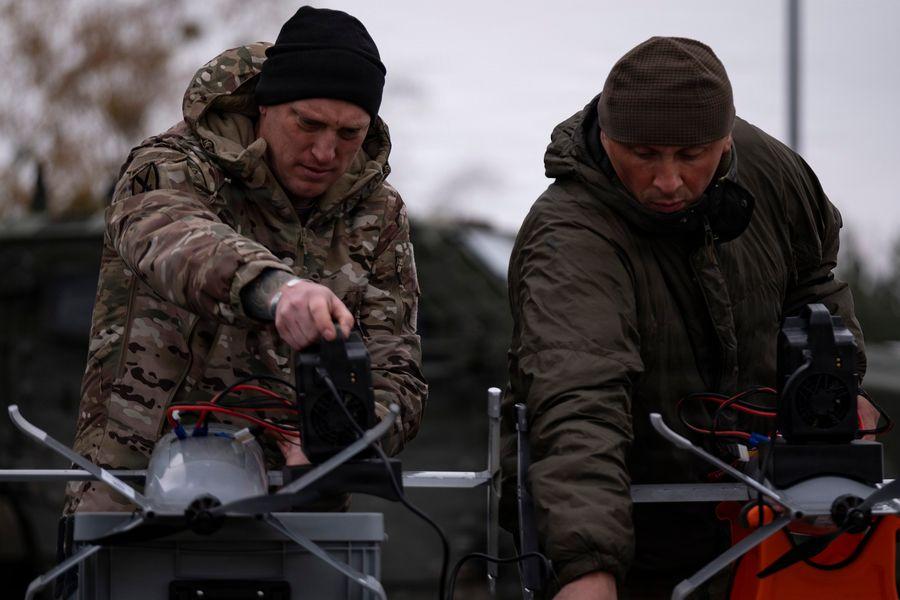
image: Polish and U.S. soldiers are physically checking the counter- unmanned aerial system near Lipa, Poland, Nov. 15, 2025. The intensive 20-day multinational Train-the-Trainer course rapidly qualified 20 students from Poland, Romania, and the U.S., most with no prior military drone experience, in a battle-tested C-UAS system through classroom, practical flight, and night operations, culminating in a successful live-fire demonstration to destroy a jet powered drone, thereby accelerating the fielding of this critical capability along the Eastern Flank Deterrence Line. As the battlefield evolves, we are leveraging U.S. experience and NATO authorities to solve problems for the Alliance. The training occurring at Lipa shows how Allies like Poland and Romania are rapidly procuring and employing systems that are battle-tested in Ukraine to strengthen the Eastern Flank Deterrence Line. This is the EFDL in action. (U.S. Army photo by Sgt. Luis Garcia, 52d ADA Bde)
After the Midterms, the Right Strategy Against Iran
By Lance Gordon • RealClearDefense
The Color Revolution Came Home
By Emzari Gelashvili • RealClearDefense
When Access Becomes the Fight
By Richard Byno • RealClearDefense
What the 2026 Midterm Results Mean for U.S. Strategic Competition with Rivals
By Dean Chen • RealClearDefense
Measurable by Design: Project Meridian
By Alex Willard • RealClearDefense
New USAF Force Design Bets on Technology
By Stephen Losey, Air & Space Forces
DoD Pushes $450M in Loans To Bolster U.S. Space Companies
By Hitchens, BrDefense
The U.S. Navy Needs a New Battlecruiser. Will It Get One?
By Sadler & Ouellette, NatInt
U.S. Army Rehearses Rapid HIMARS Rocket Launcher Deployment
By Global Defense N.
Coding Commander's Intent into Unmanned Systems
By Thomas Baumstark, Proceedings