
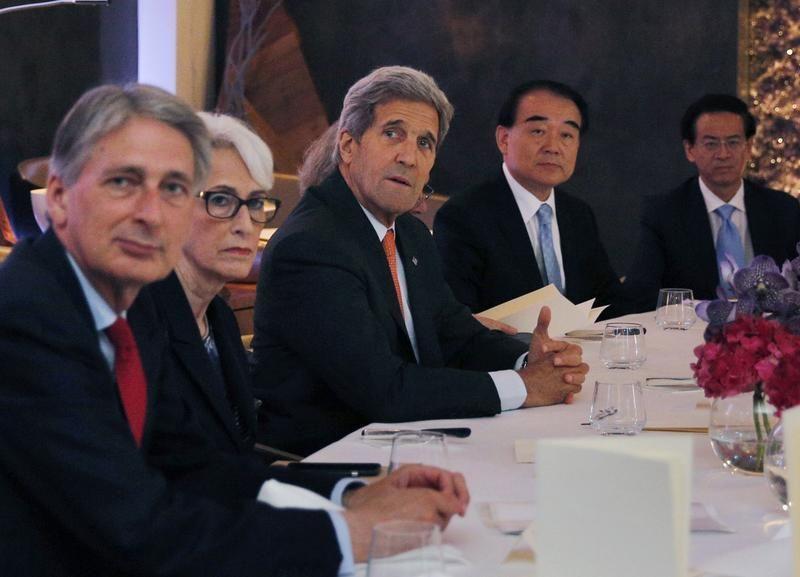
How the Iran Deal Impacts China
Published July 15, 2015 • Read time: 10m
Almost immediately upon agreement of the April 2, 2015 preliminary framework of the Iranian nuclear deal, Chinese officials have engaged in a series of meetings with their Iranian counterparts to reaffirm and bolster its energy and trade deals in anticipation of a June 30, 2015 finalized deal. Since June 30, negotiations have been extended multiple times to enable P5 + 1 countries (U.S., France, Russia, United Kingdom, and China) and Iran to reach a comprehensive agreement.
One Belt, One Road
Tehran holds special significance in Beijing’s “One-Belt-One Road” strategy which Xi Jinping, President of China, announced during a September 2013 visit to Kazakhstan and a month later in Indonesia. These speeches ultimately set the framework for China to boost trade amongst Central Asia, the Middle East, and Europe by land and by sea. This initiative remains the driving force why high-ranking officials and companies alike have leaned hard on their special relationship since early April to achieve a maximum and mutually beneficial outcome for both sides.
Iran has already sent a delegation of Iranian oil officials to China pursuing increased investments and oil exports, according to Reuters. Bijan Zanganeh, Iran’s Oil Minister, is also scheduled to visit China. Iranian officials have desires to double its exports to 2 billion barrels per day (bpd) in two months upon sanctions being lifted. Energy experts, including the next head of the U.S. Energy Information Agency (EIA), Fatih Birol, believe this objective will be difficult to achieve. Xi and Iranian President Hassan Rouhani even met in April 2015 to discuss a multitude of subjects, including joint-ventures.
Such political and economic maneuvers should come as no surprise as China is Iran’s number one oil importer. Iran has slid from being China’s third-largest oil supplier prior to 2011 sanctions to the fifth-largest supplier in 2014. According to a June 2015 report by the EIA, sanctions by the international community from 2011 to 2014 nearly cut Iran’s oil exports in half, from 2,611 bpd in 2011, to 1,408 bpd in 2014. The report further outlined that Iran’s crude oil and condensate exports dropped from 2.6 million bpd in 2014, the majority of which were exported to Asia, led by China in particular at 550,000 pbd, to a median of 1.4 million bpd in 2014. Given this dramatic drop in oil production, Tehran’s economy ultimately has had little choice but to follow suit.
China seeks to capitalize ahead of the upcoming deal with further energy-sector contract wins. Chinese state run oil companies, Chinese National Petroleum Company (CNPC) and Sinopec are poised to continue heavily investing in the Iranian oil sector upon a potential agreement. These Chinese oil companies have deeply invested in Yadavaran oil field, said Iranian Oil Ministry Zamaninia, and work is nearing completion as reported by Harretz. But while the international community awaits potential finalization of a nuclear deal, the two countries continue to finalize prior energy deals. Amid tightening sanctions in 2012, CNPC backed out of its deal to develop the Iranian South Pars natural gas field. Both sides seek to reengage in discussions about the deal.
When Xi signed the $46 billion infrastructure deal known as the China-Pakistan Economic Corridor (CPEC) agreement during his April 2015 trip to Pakistan, he ultimately aided Iran. This agreement aims to connect Iranian and Pakistani pipelines to those located in western China so that their contents could be distributed throughout the country. By choosing this route, it dramatically decreases the amount of time resources travel.
Beijing Plays Power Demographics
Beijing understands that Tehran represents much more than just oil and energy market as over 60 percent of the Iranian population of 73 million as of 2012 is under the age of 30, according to the United States Institute of Peace. Moreover, the median age in Iran is 28, while 89 percent of its population of nearly 81 million is 54 years or younger, according to the 2015 CIA World Factbook. These key demographics are ones from which the Chinese will surely seek to profit.
In May 2015, SAIPA, Iran’s second largest car manufacture partnered with China’s Brilliance Auto to open two assembly lines. Such partnerships between Chinese and Iranian companies have become commonplace since the preliminary nuclear agreement. This particular joint-venture is said to produce about 30,000 cars during this year alone. While this number may appear insignificant, according to the International Organization of Motor Vehicles, last year, Iran produced a total of about 1.1 million vehicles. This number is lower since the onset of sanctions.
While constructing automotive manufacturing plants in Iran may appear to be an innovative strategy given its young demographic, it is a practice from which Chinese automotive companies have previously benefited. Cherry Automotive Company opened a production plant in 2003 in Iran and a second in 2008. Moreover, Iran has held expos in recent years highlighting Chinese industrial products, while China has hosted annual international events like the China International Auto Parts Expo (CIAPE) and the China International Fair for Investment Trade (CIFIT), which Iranian delegations have attended.
Aside from vehicles, Chinese companies have built in Iran highways, railways, and ports. Although Chinese companies constructed in 2004 the highway linking Tehran to Chalus, located along the Caspian Sea, more opportunities like this will ultimately present themselves. The road has reduced travel time between the two points from four and a half hours to one hour and fifteen minutes, and has presumably opened jobs in Tehran to those living outside the capitol.
Boasting the largest population in the Middle East, the city of Tehran has been kind to Chinese companies’ infrastructure projects. Much like bidding for oil contracts, Chinese companies have successfully won contracts for major infrastructure projects. For example, Chinese companies China International Trust and Investment Corporation (CITIC) and Norinco in 2014 agreed to major infrastructure deals including a high-speed rail linking Qom to Tehran and Qom to Isfahan and light rail and subway projects in Tabriz. Given past contracts awarded to Chinese companies have been for hundreds of metro cars, and the desire of city officials to increase the number of metro lines to thirteen by 2020 prior to heavy sanctions, it remains increasingly likely that future “win-win” deals between Tehran and Chinese companies will transpire.
Tehran Joins International Organizations
China has increasingly expressed desire for Iran to join several international organizations which would mutually benefit both countries. In an effort to promote regional cooperation among Central Asian countries principally in the sectors of politics, trade, and security, Beijing became a founding member of the Shanghai Cooperation Organization (SCO) in 2001. Originally formed in 1996 and known as the Shanghai Five, the organization grants official membership to Russia, Uzbekistan, Kazakhstan, Tajikistan, and Kyrgyzstan. Islamabad, Kabul, New Delhi, and Tehran have been granted official observer status. During Xi’s official trip to Pakistan in April 2015, the Chinese President expressed support for Pakistan to become a full SCO member. Moscow has already voiced its support for Tehran to join the SCO as a full member once a nuclear deal is reached and Beijing will certainly follow suit.
Days after the preliminary nuclear deal was reached, Iran became a member of China’s Asian Infrastructure Investment Bank (AIIB). Intended to function in a similar way as the World Bank, AIIB will ultimately support infrastructure development in energy and transportation sectors in Asia and beyond. As of June 15, 2015, the AIIB consists of 57 member states including Taiwan and Israel. Amid initial pressure to its allies to refrain from joining the AIIB from the United States, member states Great Britain, Australia, and South Korea eventually did become members. Tehran membership can only strengthen Beijing’s “One Belt, One Road” policy to grow partnerships in infrastructure and energy sectors. According to the South China Morning Post, Iranian ambassador to China Ali Asghar Khaji voiced that the Chinese-Iranian partnership will continue to prosper as a result of expanding infrastructure projects in railways, roads, ports, and telecommunications.
China does have increasing competition. India, upon agreement of the preliminary April deal, has renewed its desire to develop a shipping port at Chabahar in southern Iran. This project was finalized in 2003, but progress has been hindered by sanctions. In a move to try and undercut New Delhi’s project, Beijing did offer Tehran 60 million Euros, according to the Indian Express, but it proved unsuccessful.
Russia, like India, has positioned itself to profit from opening of the Iranian market. Almaz-Antey, Russia’s largest defense manufacturer, agreed on June 26 to provide non-military supplies to the Iranian Center for Innovation and Technology Cooperation, according to the Islamic Republic News Agency. Given that Moscow lifted the ban in April on defense system deliveries to Tehran, this latest contract should streamline opportunities for reengagement on arms deals once hindered by sanctions. For example, Russian Foreign Minister Sergey Lavrov recently announced that the cancelation of a sale of S-300 missiles to Iran in 2007 due to an arms embargo is currently being renegotiated. Beijing will closely monitor the growing defense relationship between Tehran and Moscow. A recent report by the Stockholm International Peace Research Institute announced China had passed Germany to become the third largest arms supplier in the world, behind the United States and Russia, respectively.
Chinese telecommunications companies have had a monopoly on the Iranian telecommunication market and have inked large deals with Iranian companies while under sanctions. As reported by Reuters, the Chinese-based company ZTE, signed a near 100 million euro contract with telecommunication Co of Iran in 2010 for computer networking equipment. However, this equipment allegedly gave Iranian officials the ability to monitor, watch, or listen to Internet and phone activity of domestic users. According to ZTE’s 907-page “Packing List,” on July 24, 2011, hardware and software items from banned American companies were included on this list. Huawei, another Chinese telecommunications company giant, dominates telecommunications in Iran, and like Shenzhen, has had past difficulties following sanction guidelines. Tehran is not the only country with whom Chinese companies have a strong telecommunications relationship. Huawei has immense control on the Iraqi telecommunications network too.
Given China’s major infrastructure development in other countries which possess large amounts of energy resources, all signs point to Beijing providing greater assistance to Tehran on many projects within these sectors.
Conclusion
As the original June 30 deadline for finalizing the Iranian nuclear deal has continuously been extended, China has strategically positioned itself using official diplomatic visits, key demographics, and international bodies, to maximize its diplomatic, economic, and energy-based relationship with Iran. In recent months, Beijing has laid the foundation for the Iran-China partnership to fully prosper, intensifying efforts to solidify its place amid growing competition in the emerging Iranian market. While it remains unclear if any deal will be finalized, negotiations with the P5 + 1 remain optimistic, extending the deadline multiple times to allow for a proper resolution. If and when a deal is finalized, China will be prepared to fully engage Iran when the moment arises.
Taylor Butch graduated from King’s College London with a Master’s Degree in Middle East and Mediterranean Studies. He earned his Bachelor’s of Arts in History from Elizabethtown College, and speaks Farsi and French.
Iran’s Nuclear and Chemical Weapons Threat
By Ben Ollerenshaw • RealClearDefense
Europe’s Rearmament Paradox
By Daniel Darling • RealClearDefense
Pentagon’s Pursuit of Faster Acquisition
By Ben Harris • RealClearDefense
The Army’s AI Cyber Defenders Need a Proven Stand-Down Order
By Gleb Tsipursky • RealClearDefense
After the Silence
By Chase Skylar DeMayo • RealClearDefense
Hung Cao Facing Contentious Confirmation To Become Navy Secretary
By Konstantin Toropin • Associated Press
The First Surface Drone-v-Drone Fight
By CDR Salamander, CDR Salamander
Air Force Strengthens F-22 Raptor Combat Readiness in the Pacific
By Global DefenseAfter the Silence
By Chase Skylar DeMayo • RealClearDefense
Underwater Arms Race Puts U.S. Naval Supremacy at Risk
By Tom O'Connor, Newsweek