
Perils of Person-Centric Geopolitics: Que Será, Será
Last updated 06:44 AM EDT • Read time: 5m
The wag said that the only certainty about the future is that it is uncertain. Trump follows the wag; he leaps into the future, keeping open the possibility of not only mid-course change but also of a complete turnaround. His successor, if from the Republican Party, may also have to do a few U-turns; many more if he would be a Democrat.
Trump is not the only one to propel geopolitics towards unpredictability, though being the U.S. President, his vacillations have a much larger impact than others on international events. Yet, the pandemic of the person overshadowing the office he holds is there for all to see. The malady that was earlier confined to dictatorships and totalitarian states is now an integral part of democratic governance with the only difference that the leader is elected through transparent elections and has to keep in mind the next elections. The second requirement is absent when there is term-ceiling; Trump knows he is not coming back and may burn his personal bridges.
Even in some of the totalitarian regimes, decisions were not totally personal; the Soviets had the troika, though unanimity was the survival requirement. Putin, however, has one-man rule and has watched Russia slide from the superpower status to almost being a camp-follower of China. With the disastrous consequences of Mao’s hegemony in the Chinese Communist Party (CCP), Deng Xiaoping strengthened the consultative mechanism within the Party and created the two-term limit for the supreme leader. Xi Jinping would have none of it and only his “thoughts” guide Chinese domestic as well as foreign policy with twists and turns that suit his fancy on a given day.
Macron, the founder of La République en Marche, a “catch all” centrist party, rebranded it as Renaissance for his 2022 presidential run. It is built around his personal charisma, lacking a strong grassroot base. The defections in May 2020 showed the perils of the structure being in the shadow of the person. Ironically, but also obviously, Macron’s personal hegemony has deepened the traditional left-right divide and strengthened both. While Macron was the favourite European leader for Merkel, the “Queen of Europe,” her departure put Macron at loggerheads with other “personal rulers” like Trump and Meloni.
Reflecting this trend of geopolitical uncertainties, markets have been bobbing up and down during the negotiations between the U.S. and Iran, the impact being not only on hydrocarbons but also on fertilisers and hence food security for the world’s poor. The consequences of the whims of today’s Nero are not confined to a few warring countries but extend even to nations not otherwise connected to the conflict.
The putative U.S.-Iran deal reminds us of Rumsfeld’s famous quote about “known unknowns” and “unknown unknowns.” We know that a lot remains unknown about the deal and the mechanism of its implementation, but a lot may be “unknown unknowns.” First with the known unknowns; we know that there is no agreement yet on the vexatious nuclear issue and the parties have an extendable 60-days to work out a meeting point; Obama had taken 20 months to work out the semblance of an agreement that Trump tore apart. The $300 billion reconstruction fund has open questions with the U.S. saying it will not be one of the providers. Hormuz remains uncertain with no indication that Iran has finally withdrawn from its position of charging ships a fee for the “unknown” services after the 60-day grace period.
Israel has not asked to sign the deal and Trump had denied Israel’s request for even a peep at the terms before it was signed; nor is Hezbollah a party. Trump may say that he speaks for Israel and Iran may say the same for Hezbollah but that is presumptive and neither Israel nor Hezbollah has given any indication that they would stop attacking each other. The consequences for the deal if these two keep fighting does not find any mention and remains one “unknown unknown” part of this deal though this may be the lynchpin that may still cause the deal to fall apart, in addition to Iran’s insistence on charging a fee for Hormuz transit.
Another “unknown unknown” is the fate of Trump’s promise that “help was on the way” for the Iranians who have remained agitated for a regime change and tens of thousands of who have died during the protests while a larger number remain imprisoned. It seems unlikely that these millions of people, who have lost friends and relatives, will simply reconcile to their fate but the direction this agitation will take after this deal remains anybody’s guess.
Rumsfeld had also talked of “known knowns.” There is one certainty in this universe of uncertainties; given the threat to Hurmuz shipping and to U.S. allies’ critical infrastructure, the U.S. is not going to indulge in large-scale bombing of Iran any time soon. Simultaneously, Netanyahu will certainly do so if Iran attacks it in retaliation to attacks on Hezbollah. As for the policies of successors of Trump and Netanyahu, one can only resort to cheerful fatalism and say que será, será.
R.N. Prasher has studied physics, economics and law and served as an Indian Administrative Service officer for 34 years. He writes extensively on geopolitics and published the 2025 book, “Geopolitics: Impact on Energy Transition and Energy Security.”
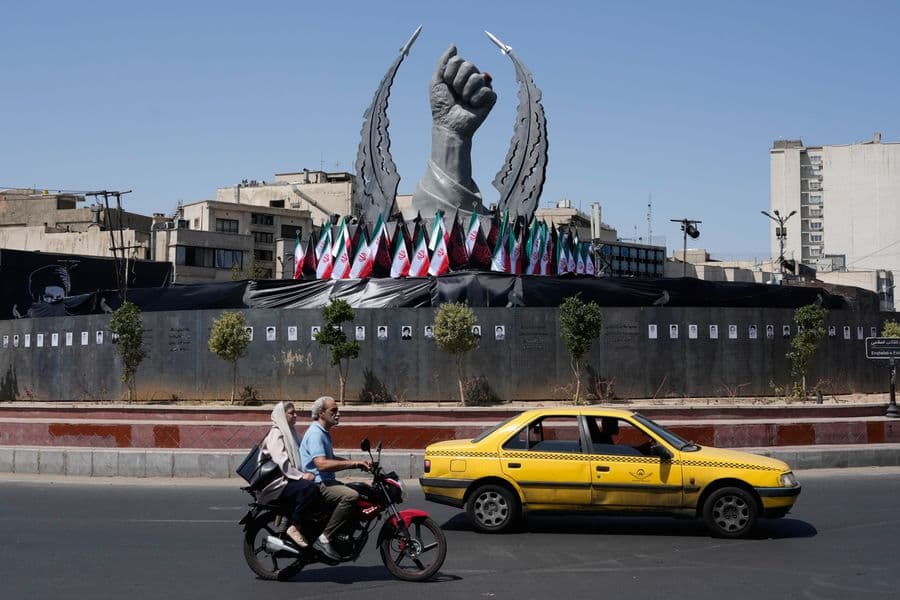
image: Vehicles drive past a monument depicting the clenched fist of the late Iranian Supreme Leader Ayatollah Ali Khamenei in Islamic Revolution Square in Tehran, Iran, Sunday, July 5, 2026. (AP Photo/Vahid Salemi)
The Services Do Not Need a Four-Star Autonomous Warfare Command
By Steven Wills • RealClearDefense
Honor Them While There Is Still Time
By Jeffrey Rosales • RealClearDefense
From Siberia to Fairford: How Operation Spider’s Web Has Changed the Rules of Airpower
By Frank A. Rose • RealClearDefense
Faster Simulations, Better Defense Decisions
By Rut Lineswala • RealClearDefense
Will HASC Have an Oversight Subcommittee in the Next Congress?
By Christopher J. Bright • RealClearDefense
Hegseth Barred Trans Troops. Military Boards Are Rejecting Those Orders.
By NYT
Closing the Sea: Lessons from Ancient Mediterranean Blockades
By DeCasien, CIMSECFrom Siberia to Fairford: How Operation Spider’s Web Has Changed the Rules of Airpower
By Frank A. Rose • RealClearDefenseFaster Simulations, Better Defense Decisions
By Rut Lineswala • RealClearDefense
Bombers Could Have a Major Air-to-Air Combat Role
By Joseph Trevithick, The WarZone