
Stop Blinking at China's NPT Misbehavior
Last updated 06:34 AM EDT • Read time: 5m
Earlier this month, the U.S. State Department released its annual arms control compliance report. What stood out was not what it contained but what it failed to mention — China’s crash ramp-up of its strategic nuclear arsenal and its refusal to negotiate limits to these efforts. Under Article VI of the Nuclear Nonproliferation Treaty (NPT), China is obligated to enter into such talks in good faith. Yet, China has repeatedly rebuffed efforts to engage it in such talks. On this, the State Department report was silent. That’s a mistake.
For years, the State Department has insisted that nuclear disarmament is a key objective of the NPT. Washington renewed its New START warhead limits with Russia last year. American nuclear weapons numbers have fallen from over 30,000 in the mid-1960s to roughly 3,700 today. Yet, as U.S. and Russia’s deployed strategic nuclear weapons numbers have declined — now down to roughly 1,400 on each side— China’s are on the rise.
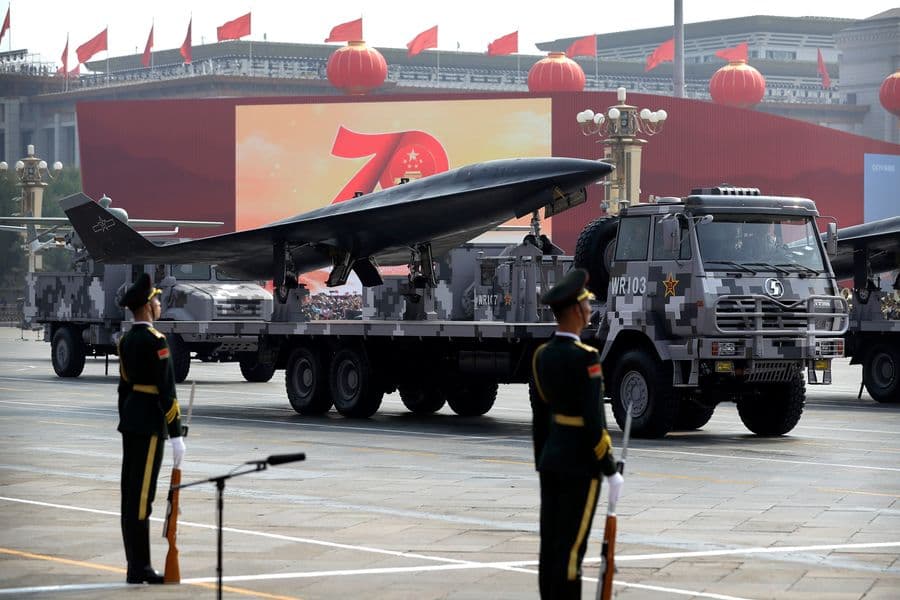
Last November the Pentagon estimated that China will have 700 warheads by 2027 and “at least 1,000” warheads (emphasis added) by 2030. It’s unclear how China will deploy all these weapons. It’s constructed 3,000 miles of underground missile tunnels that could base many hundreds of mobile missile launchers. It’s also building 350 vulnerable missile silos for possible prompt launch and a fleet of submarines that by 2030 could launch hundreds of nuclear warheads or more.
How will China produce the nuclear materials it needs for these weapons? The Pentagon says China could tap its civilian nuclear sector — particularly its fast reactor and plutonium reprocessing systems. These plants cannot produce economic nuclear electricity but are excellent for producing weapons and super-weapons grade plutonium, which is most desirable to expand China’s arsenal.
Beijing agreed with most of the world’s nuclear-powered states to announce annually what its plutonium production activities and holdings are to the International Atomic Energy Agency (IAEA). It stopped reporting in 2017, after which Beijing accelerated a crash plutonium production effort. The State Department report says nothing about this. Then, compounding this inattention, the report voices reluctance to examine further recent, suspect Chinese nuclear testing activities even though these raise concerns about Beijing’s continued adherence to its 1996 nuclear test moratorium commitment.
Of course, as a weapons state under the NPT, China is free to build nuclear weapons. What it is not free to do, however, is ignore its Article VI NPT obligation “to pursue negotiations in good faith on effective measures relating to cessation of the nuclear arms race at an early date.” Yet, it’s shirked this obligation. Even after signing a Permanent Five declaration on January 3rd binding it to uphold its Article VI NPT obligations, China flatly refused Washington’s request on January 4th to join in nuclear arms limitation talks with Washington and Moscow. Before it might do so, Chinese officials insisted, Washington and Moscow must make cuts “until they have reduced to our level.”
Putting aside what China’s “level” is (Beijing has refused to share any of its nuclear numbers), this demand is an evasion, one the United States and like-minded nations should challenge. It may be difficult to pressure China to enter into nuclear talks but failing to try runs the moral hazard of not taking the NPT seriously, much less Beijing’s nuclear buildup and the anxieties it is stoking amongst our allies.
Yet, whatever benefits spotlighting China’s nuclear misbehavior might bring, they would only come if Washington and its nuclear-armed allies — France and the U.K. — abstained from trying to gain greater nuclear superiority over China. After all, one can hardly be credible preaching nuclear restraint drinking from a nuclear barstool.
The U.S., U.K., and France would have to be seen to be promoting new nuclear limits (limits, which could be made contingent on China also agreeing to comply). These might include restricting plutonium production for any purpose, clarifying the terms of the Comprehensive Test Ban Treaty (perhaps at a P-5 Meeting), adopting new nuclear transparency measures (including more reporting to the UN, the IAEA, and IAEA safeguarding of Chinese and nuclear states’ most militarily useful “civilian” nuclear activities), and agreeing not to increase strategic nuclear weapon numbers for some period.
Of course, in all this, care would have to be taken not to embrace positions that might risk losing our closest allies — e.g., by jettisoning missile defenses, America’s extended nuclear deterrence policies, or new discriminate weapons technologies that might push our reliance on nuclear weapons and their possible use further into the background. Certainly, no effective NPT compliance campaign could survive without the support of our allies and of non-nuclear weapon states (e.g., members of the Nonproliferation and Disarmament Initiative or NPDI, the Stockholm Initiative, etc.).
Finally, Washington would need to share even more intelligence on China’s strategic weapons buildup with others and take a more active role in international nuclear control fora in Geneva (at the Conference on Disarmament), Vienna (at the International Atomic Energy Agency), and New York (at the UN First Committee, and the NPT PrepCom and Review Conferences).
This may seem a tall order. But blinking at Beijing’s noncompliance with its arms control treaty obligations would simply cede the ground for a continued Chinese nuclear buildup. And that, like our inattention to German arms control violations in the 1930s, could end quite badly.
Henry Sokolski is the executive director of the Nonproliferation Policy Education Center in Arlington, Virginia. He previously served as deputy for nonproliferation policy in the office of the US secretary of defense during the George H.W. Bush administration and is author of Underestimated: Our Not So Peaceful Nuclear Future (2019).

The Services Do Not Need a Four-Star Autonomous Warfare Command
By Steven Wills • RealClearDefense
Honor Them While There Is Still Time
By Jeffrey Rosales • RealClearDefense
From Siberia to Fairford: How Operation Spider’s Web Has Changed the Rules of Airpower
By Frank A. Rose • RealClearDefense
Faster Simulations, Better Defense Decisions
By Rut Lineswala • RealClearDefense
Will HASC Have an Oversight Subcommittee in the Next Congress?
By Christopher J. Bright • RealClearDefense

Hegseth Barred Trans Troops. Military Boards Are Rejecting Those Orders.
By NYT
Closing the Sea: Lessons from Ancient Mediterranean Blockades
By DeCasien, CIMSECFrom Siberia to Fairford: How Operation Spider’s Web Has Changed the Rules of Airpower
By Frank A. Rose • RealClearDefenseFaster Simulations, Better Defense Decisions
By Rut Lineswala • RealClearDefense
Bombers Could Have a Major Air-to-Air Combat Role
By Joseph Trevithick, The WarZone