
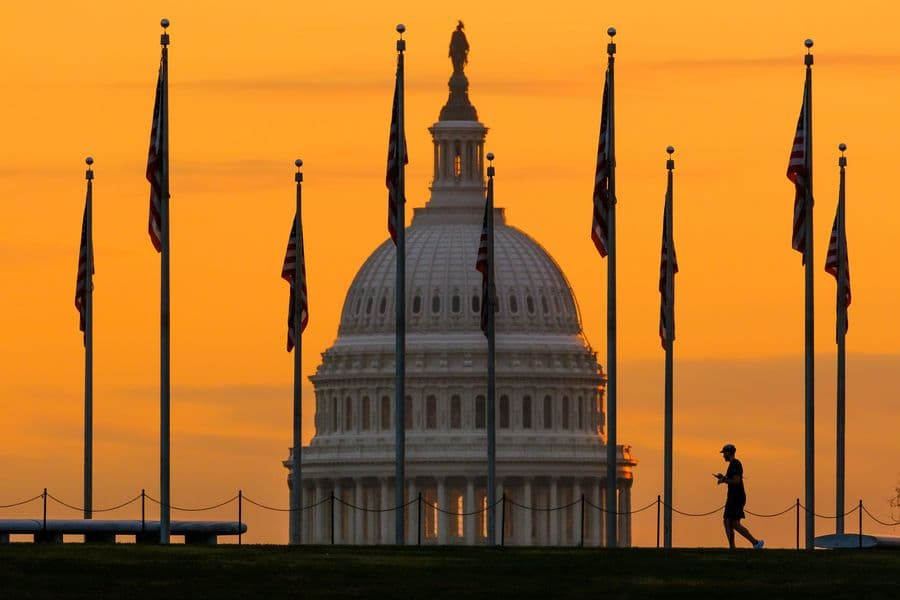
Jamming Unrelated Provisions in the NDAA Is Bad for the Military
Last updated 10:28 PM EDT • Read time: 4m
The Senate and House Armed Services Committee (SASC and HASC) are justifiably proud that this year promises to be the 63rd straight year Congress will pass the National Defense Authorization Act (NDAA) into law. No other committee comes close to matching this track record. However, this success poses the greatest threat to the NDAA’s continued success – both this year and institutionally.
Over the past several years, the collective awareness in Washington that the NDAA is the only guaranteed legislative vehicle has increased attempts from all corners to turn the bill into a gravy train. As a result, members and other committees keep approaching SASC and HASC – or going to the floor - with requests to adopt provisions that don’t belong on the bill, even going so far in previous years as to request the Farm Bill be attached to the NDAA during conference. Members think they have leverage by threatening to derail the NDAA unless it includes their unrelated provisions. This is bad policy.
The NDAA should be about two things: advancing national security and supporting the troops. Nothing else.
One might argue the status of the Lesser Prairie Sage Grouse on the endangered species list has a tangential nexus to military testing grounds – but that doesn’t mean that a controversial public lands and mining dispute should be litigated on the NDAA. In prior years, that particular dispute has sidelined the bill for months.
This year, neither bills on interchange and credit card fees nor controversial social policies should be allowed to endanger the bill. The adoption of similar provisions has often delayed and endangered passage of the bill – depriving the Department of Defense of a timely reauthorization. And if the NDAA is derailed over unrelated provisions, it would be a hit to our national security.
Once the NDAA becomes more about economic or social policy than military policy, Congress will lose focus on what matters most: deterring our adversaries from waging war against America and her allies.
This year’s NDAA will be an important opportunity for Congress to help increase the odds Ukraine defeats Russia and that we prevent China from invading and taking over Taiwan. Providing for the common defense is the most important and one of the few explicit responsibilities of the federal government under the Constitution.
It would be a mistake for members to use the NDAA as a vehicle to fulfill ideas they cannot pass elsewhere. The NDAA is where Congress works at its finest – other members and committees should learn from and emulate SASC’s and HASC’s process of regular order to pass their priorities on other subjects, not seek to co-opt the bill because other committees are broken. That would simply result in an even more dysfunctional Congress than we have today.
If members – of both parties – try to use the NDAA to pass measures unrelated to the military they are unlikely to succeed in these efforts - but they will certainly harm the efficiency and lasting bipartisan consensus surrounding the NDAA, damaging the military and hurting Congress’ ability to use the vehicle for much-needed oversight.
To preserve the vital task of passing the NDAA this year and in the future, Members of Congress should agree that legislation unrelated to national security should not be permitted on the NDAA unless it has the unanimous support of the relevant committees of jurisdiction and that the preponderance of the legislative content to be included is national-security related. Trivial or contrived relationships to that subject should be quickly discounted.
There is only one guaranteed opportunity where Members of Congress can take a victory lap each year: the NDAA. If members of Congress want to continue issuing these press releases – and start regaining the trust of a jaded public - they must observe one simple principle: stop trying to hoist controversial and non-military provisions on the NDAA.
Gabriel Noronha is the Executive Director of Polaris National Security and previously served as the Special Assistant to the Senate Armed Services Committee under Chairmen John McCain and Jim Inhofe.

A Passage to the Middle East: India as a Mediator and Security Partner
By Irina Tsukerman • RealClearDefense
South China Sea is Key to Invigorate Positive U.S.–Malaysia Relations
By Brent D. Sadler • RealClearDefense
The Necropolitics of the Wasteland
By Yunus Emre Tumen • RealClearDefense
AI, Robotics, and Marines
By Gary Anderson • RealClearDefense
The Emerging SQUAD
By Muhammad Shoaib • RealClearDefense
AI, Robotics, and Marines
By Gary Anderson • RealClearDefense
AUKUS Partners Test Autonomous Maritime Systems
By Jangoulun Singsit, Naval Tech
AUKUS: USS Colorado Announced as First Submarine for SRF – West
By USNI News
Navy, Marine Corps Simulate Ship Strikes From Air and Land
By Alex Wilson, S&S
Air National Guard To Stand Up a New Special Tactics Squadron
By Patty Nieberg, T&P