
The U.S. Military Needs More Capital for Capital Assets
Published May 22, 2023 • Read time: 7m
Pentagon leaders have touted record-breaking spending on research and development the past two years. These claims made this year’s shift in marketing more interesting when the pending military request for 2024 was dubbed a “procurement budget.” When measured against the gold standard of procurement budgets near the end of the Cold War, the administration’s request–while striving–is junior varsity by comparison.
President Reagan muscled through double digit increases in defense spending that were not universally popular in the late 1980s. After humiliating foreign and defense policy failures and a hollow force that emerged in the preceding decade, President Carter focused his defense increases primarily on readiness. Reagan followed with budgets that emphasized purchasing new weapons, expanding forces (including strategic), and bolstering capability with a priority on maritime power.
In 1985, a full one-third of the Pentagon’s budget was allocated to spending on weapons and equipment. This administration’s request for the coming fiscal year dedicates a mere fifth of its total spending on procurement, with a plurality of defense dollars allocated to the operations and maintenance account, where civilian pay, healthcare costs, fuel, and a whole manner of other expenses are housed.
Even when compared to their previous budgets, the White House’s request hardly increases procurement’s total share of defense spending. In fiscal year (FY) 2022, 18.6 percent of the budget request was allocated for procurement; in 2023, this grew by 0.3 percent to 18.9. The 2024 request allocates 20.1 percent, which means procurement’s slice of the total defense budget would increase by only 1.3 percent. While the 2024 request technically allocates more funding for this account than previous years, potential gains have been slashed by red-hot inflation.
Buy Smarter, Fly More
The Defense Department's Reorganization Problem Comes to Fightertown
America Needs To Spend More on Defense and Build More With It
The Factory Floor and the Balance Sheet
Aside from topline numbers, the quantities of weapons and platforms are lukewarm also.
In simple terms, the defense budgets of the mid-1980s bought a whole lot of everything. Take aircraft for instance—that year, the U.S. purchased a plethora of different fighter and attack aircraft, amounting to 338 aircraft, with 192 for the Air Force and 146 for the Navy. This total doesn’t even account for the bombers, electronic warfare aircraft, and other planes also purchased by the military. Compare that to the Fiscal Year 2024 request, where the administration is seeking to only 107 fighter and attack aircraft, with 35 for the Air Force and 72 for the Navy. This amounts to about 70% percent less than the same category of aircraft that the military purchased in 1985.
Tracked ground vehicle purchases offer another illustrative example of a focus on quantity and why the military in many ways is still living off the fruits of the Reagan buildup. That year, the military purchased 840 M1 tanks, 655 Bradley Infantry Fighting Vehicles (IFV), 292 Light Armored Vehicles (LAV), and 244 Assault Amphibian Vehicles, later known as the Amphibious Assault Vehicle (AAV). That’s a total of 2,031 tracked ground vehicles.
Today things look much different. Reliant on existing stocks, the President’s budget request for the Army would procure only 91 of the new “Armored Multi-Purpose Vehicle,” and would allocate funding for the upgrade and modernization of 34 preexisting M1 tanks and 128 Bradley IFVs. The Marine Corps sees a similar fate, with no new purchases of the AAV or LAV, and just 80 of the relatively new Amphibious Combat Vehicle requested.
In 1985, the Navy was on course for a 600-ship navy, and the budget’s requested shipbuilding reflects that. President Reagan requested five submarines, three cruisers, a destroyer, and numerous other support vessels, totaling 23 ships. The 2024 request is less ambitious, requesting just three submarines, two destroyers, two frigates and two support ships. There are more ship retirements than new construction in this year’s request, meaning the fleet will actually shrink by one from 294 to 293 ships.
Missiles and munitions also highlight yet another difference when dollars are focused on procurement as opposed to current operations and R&D. The administration is making the right move with an increased focus on “things that go boom,” and planning to gain Congress’s approval in inking multiyear procurement deals for crucial missiles like the Joint Air-to-Surface Standoff Missile—Extended Range (JASSM-ER) and the Long Range Anti-Ship Missile (LRASM).
When it comes to how many we’re actually buying, that’s a different story.
A quick review of the Pentagon’s request for Fiscal Year 2024 reveals that relatively small quantities of needed missiles and munitions are being purchased. A few advanced and capable weapon systems, such as in the case of the aforementioned LRASM, see increases from 83 to 118. These limited increases in production must reckon with the withered state of the organic and private munitions industrial base, as neglect of weapons with long lead times have led to cold production lines which will take years to ramp up and surge.
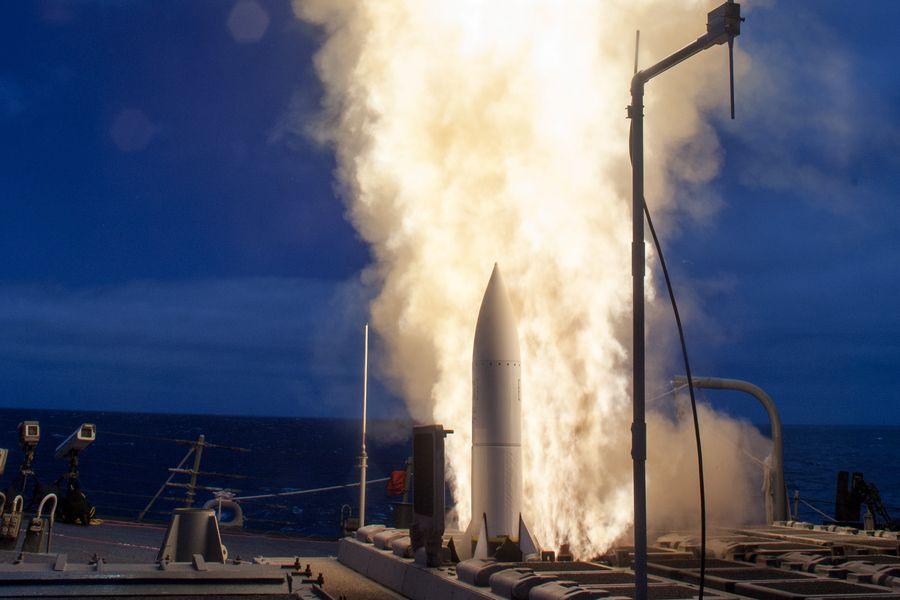
Furthermore, other missiles see their procurement remain stagnant or decline. Buys of the Standard Missile-6, which protects Navy ships from ballistic and cruise missiles, remains flat at 125 from this year to next. The administration is also planning on dropping its Tomahawk missile procurement from 68 this fiscal year down to 34 next year, which is less than half the armament of a single Arleigh Burke-class destroyer.
Munitions procurement is a mixed bag, as the budget request sees only modest increases in quantities of munitions, levying a focus on missiles. Other munitions, such as mortar and artillery shells and fuses, see a 15 percent decline in allocated spending even as the war in the Ukraine has highlighted their high rates of expenditure and importance in ground warfare. More money does not necessarily equate to more stock either, illustrated by armaments like the PATRIOT Missile Segment Enhancement (MSE), which sees a 17 percent increase in procurement allotment, but procurement quantities fall from 252 to 230, and funding for procurement of the PATRIOT PAC-3 missiles sees a reduction of nearly $50 million. Aside from also being recently supplied to Ukraine, PATRIOT batteries would be the backbone of any air and missile defense network in the event of a conflict with another great power, yet the Pentagon’s “procurement budget” places priority elsewhere.
The armed forces are sending up quiet flares for help. As demonstrated in the services and combatant commands’ unfunded priority lists, procurement often tops the list. This year, procurement made up 42.2 percent of unfunded priorities, and last year, made up over half at 53 percent as calculated by Elaine McCusker and John Ferrari. These requests range from amphibious ships to aircraft modifications to ground vehicles.
While the needs of the military have evolved since the Cold War, these numbers highlight that a true procurement budget emphasizes quantities of weapons and platforms bought along with corresponding budget shares and a focus on the services that field capital assets like the U.S. Navy.
Procurement as a share of overall defense spending has been falling steadily since the 1950s. With the exception of the spike in spending due to America’s wars in the Middle East in the early 2000s, procurement spending has hovered around one-fifth of the defense budget since the 1990s. In short, we’re buying much less and emphasizing other priorities like research and development. The ratio of R&D to procurement comes in at 1.17 to 1.00 today, a significant change from 1985 when that ratio was 3.09 to 1.00. Fielding a force large enough to handle global demands, no matter how capable, will demand a more healthy and balanced procurement-to-R&D ratio.
In an era of defense budgets that fail to account for inflation, we can only dream of bringing back the procurement heavy budgets of the Reagan buildup. But, dream as we all may, Congress should start with adjusting the White House’s request to ensure that there’s enough proverbial gas in the tank for a future fight in the Indo-Pacific. Mass and attrition should return as foundational force planning priorities.
Mackenzie Eaglen is a senior fellow at the American Enterprise Institute (AEI), where she works on defense strategy, defense budgets, and military readiness. She is also a regular guest lecturer at universities, a member of the board of advisers of the Alexander Hamilton Society, and a member of the steering committee of the Leadership Council for Women in National Security.

Iron Raven: Remembering Colonel Joseph B. Conmy, Jr.
By Louis Marano • RealClearDefense
Stand Proud of the Force
By Jay Rogers • RealClearDefense
How a Dying Agency Turned Fentanyl Into a Weapon of Mass Destruction
By Barry Angeline • RealClearDefense
The Pressure Is the Message: What Xi and Putin Faced in Shenzhen
By Emzari Gelashvili • RealClearDefense
China’s Revised Mobilization Law and the Expanding Reach of National Defense
By Muhammad Shoaib • RealClearDefense

Marine Corps Hero Under Federal Investigation
By Laporta, Burnham & Watson, CBS
A Postmortem of Maneuver Warfare in the U.S. Marine Corps
By Donald Vandergriff
U.S. Putting Weapons in Space: A Strategic Blunder?
By Ajey Lele • RealClearDefense
U.S. Senate Seeks to Exchange Shipbuilding Funds for More Munitions
By Naval News
F-35C Completes First Launch and Recovery Trials on a Ford-Class Carrier
By Navy T.