
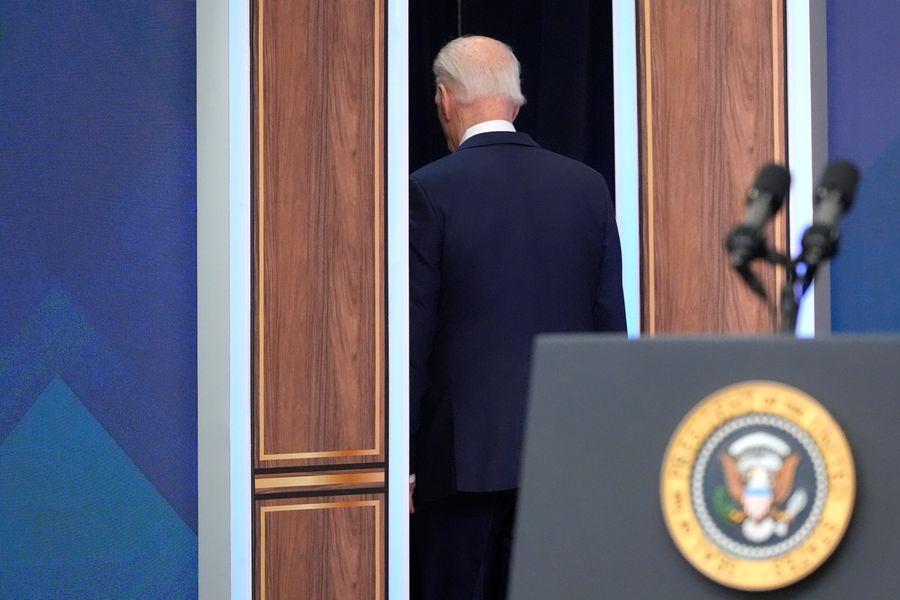
Joe Biden's Dangerous World
Last updated 11:53 PM EDT • Read time: 6m
In the past three years, the Taliban returned to power in Afghanistan, Russia invaded Ukraine, Hamas invaded Israel, China increased its pressure on Taiwan, the China-Russian partnership solidified, Houthi terrorists wreaked havoc on Red Sea shipping, Iran moved closer to obtaining a nuclear weapon, North Korea enhanced its intercontinental missile capacity, China and Russia modernized their nuclear forces, and illegal immigrants flooded the U.S. southern border.
The Biden administration conducted an amateurish withdrawal from Afghanistan that cost the lives of several Americans and many more of our Afghan allies. Biden provided aid to Ukraine and used rhetoric that risked escalating the Ukraine War into a broader European or World War. He conducted a policy toward China that combined “engagement” with a continuation of some of Donald Trump’s more confrontational policies. Biden’s overall Russia policy strengthened the Sino-Russian strategic partnership. His isolated responses to Houthi shipping attacks did nothing to deter those attacks. The administration’s push for a ceasefire in Gaza has hampered Israel’s efforts to defeat Hamas. Its response to Iran’s quest for nuclear weapons was to attempt to resuscitate the flawed nuclear deal. It has pushed for more “arms control” with Russia even as China’s nuclear build-up continues. And it has facilitated rather than prevented the illegal entry of millions into our country.
No president and no administration can control events around the world. The most any statesman can do, in the words of Otto von Bismarck, is to “float with” the current of events and “steer them” in a direction that benefits his or her country. The Biden administration appears helpless to steer events in a direction that favors our country and protects our national interests. It pursues universal goals and multilateral solutions to fix “climate change,” including diminishing the use of fossil fuels and promoting electric vehicles. It has institutionalized “Diversity, Equity, and Inclusion” (DEI) in our armed services, which has diminished recruitment and promoted “wokeness” to the detriment of the mission of our armed forces. It has proposed a defense budget that cuts spending in real terms despite our involvement in two wars and a gathering storm in the western Pacific. It has shrunk our navy at a time when China continues to build warships, including aircraft carriers.
Biden supporters will counter that the president has strengthened NATO in the face of Russian aggression by inviting Finland and Sweden to join the alliance. But increasing the size of an alliance does not always equate with making the alliance stronger. NATO expansion--and this is not just Biden’s fault--has merely increased the geographical acreage that America is pledged to defend with fewer troops, and added to allies that continually fail to meet their own defense needs, yet alone those of the alliance.
More fundamentally, there is little sense that among Biden’s national security team there are strategic thinkers that view the world with cold, hard-headed geopolitical analysis and an appreciation of America’s vital as opposed to peripheral interests. Antony Blinken, Jake Sullivan, and Lloyd Austin lack the gravitas of more recent, and not so recent, national security policymakers. There are no George Kennans, Dean Achesons, John Foster Dulleses, Henry Kissingers, Jim Schlesingers, Jean Kirkpatricks, George Shultzes, Caspar Weinbergers, Richard Pipeses, Zbigniew Brzezinskis, Mike Pompeos, or Elbridge Colbys in the Biden administration. And Biden’s grasp of international politics pales in comparison to Eisenhower, Nixon, and George H.W. Bush. Remember it was Robert Gates, a former CIA Director and Secretary of Defense in both Republican and Democratic administrations who remarked years ago when Biden was vice-president that Biden “has been wrong on nearly every major foreign policy and national security issue over the past four decades.” The last three years confirm the accuracy of Gates’ assessment.
The first few paragraphs of the administration’s 2022 National Security Strategy highlight the challenges of “climate change, food insecurity, communicable diseases, terrorism, energy shortages, [and] inflation.” “These shared challenges,” the strategy asserts, “are not marginal issues that are secondary to geopolitics. They are at the very core of national and international security and must be treated as such.” If these issues are at the “core” of our national security interests, great power competition is either an equal interest or takes a backseat. Therein lies the problem. Foreign policy is about prioritizing national interests in a concrete way. The Biden administration prioritizes ideology over geopolitics.
If there is something called a Biden Doctrine it is the administration’s shaping of policy based on what it views as an existential struggle between “democracy” and “autocracy.” This is the ideological component of its national security policy, which combines Wilsonianism with wokeism. The Biden national security strategy places America at odds with both Russia and China. It eschews efforts to conduct the type of triangular diplomacy of the Nixon-Reagan era that helped us win the Cold War. There is no sense among Biden national security policymakers that they appreciate the enduring wisdom of classical geopolitics, the centrality to global politics of the Eurasian landmass, and the need for the United States to maintain supremacy at sea. The proposed 2024 defense budget will actually shrink the U.S. navy by 13 warships. Alfred Thayer Mahan and Theodore Roosevelt must be turning over in their graves.
Viewing the world through the ideological lens of “democracy” vs. “autocracy” limits American flexibility and loosens the grip of geopolitical restraint. It involves the United States in peripheral conflicts that fit the administration’s ideological worldview. It ignores the wise counsel of John Quincy Adams to avoid going abroad in search of monsters to destroy. It can drain American resources and distract our focus on more important challenges and threats to our interests.
Then there is the unquantifiable elements of American credibility and respect. That is where gravitas comes into the picture. Foreign leaders--both allies and adversaries--must fear American power, trust America’s word, and see that America’s leaders will do whatever it takes to protect this country and to promote its interests. Those globalists who deride the very notion of “America First” fail to appreciate that foreign leaders are Russians First, Chinese First, Germans First, Frenchmen First, and on and on. That is the way the world works. That is why the failures recounted in the opening paragraph of this essay are so important. And that is why we live in such dangerous times.
Francis P. Sempa writes on foreign policy and geopolitics. His Best Defense columns appear at the beginning of each month.

2949 Marine Prisoners, Hostages, and Peacetime Governmental Detainees Since Our Corps' Founding
By Jon Couch • RealClearDefense
America Must Win the Biotech Race Against China
By Rob Maness • RealClearDefense
How Digital Twins Can Strengthen Naval Readiness Before a Crisis Begins
By Carl Napoletano • RealClearDefense
The Uninsured Sky
By Joe Sandri • RealClearDefense
Counterterrorism and the Growing Convergence in Homeland Security and Homeland Defense
By Austin Doctor • RealClearDefense
How Digital Twins Can Strengthen Naval Readiness Before a Crisis Begins
By Carl Napoletano • RealClearDefense
F-16s Build on Iran Combat Lessons to Prepare for China Threat
By Rebecca Grant • Lexington Institute
U.S. Aircraft Evacuated From Second U.K. Base Due to Iran Threat
By Holliday, et al, WSJ
US Marine Corps Acquires Textron’s Ripsaw M3 Uncrewed Ground Vehicles
By DPost
U.S. Navy’s First San Antonio Flight II USS Harrisburg Completes Sea Trials
By GDN