
China's Grey-Zone Provocations: Time To Reciprocate
Published March 21, 2024 • Read time: 5m
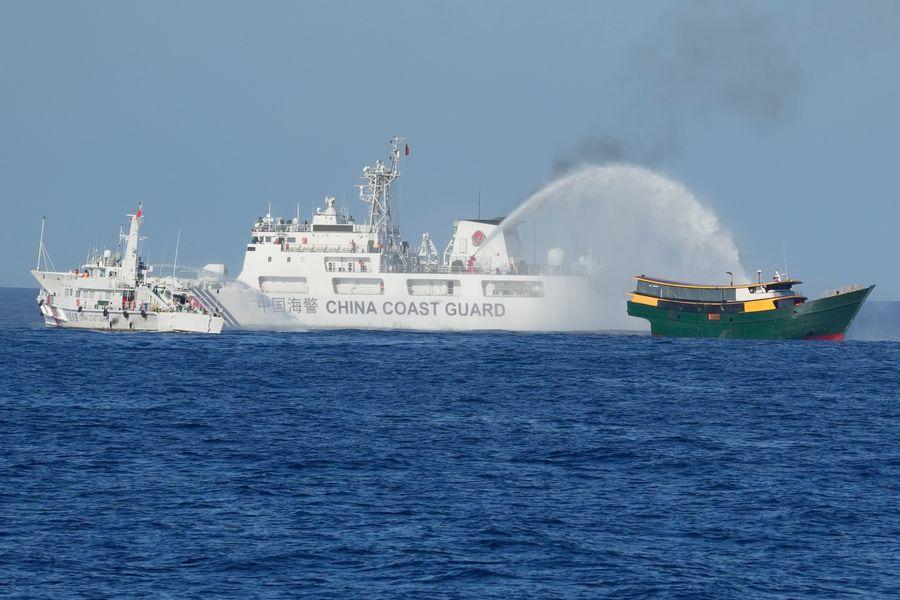
Philippine resupply vessel Unaizah May 4 is hit by Chinese coast guard water canon blast causing injuries to multiple crew members as they tried to enter the Second Thomas Shoal, locally known as Ayungin Shoal, in the disputed South China Sea Tuesday, March 5, 2024. Chinese and Philippine coast guard vessels collided in the disputed South China Sea and multiple Filipino crew members were injured in high-seas confrontations Tuesday as Southeast Asian leaders gathered for a summit that was expected to touch on Beijing's aggression at sea. (AP Photo/Aaron Favila)
Those subject to China’s actions have responded
cautiously. They now need to consider a change in tactics.
It’s time to send a signal to Beijing that a crisis is approaching. China’s use of grey zone tactics is intensifying. This worsening trend line has been evident for several years and seems headed towards an unintended violent incident, a crisis and possibly armed conflict. Attempts need to be made now to persuade China to desist.
China’s grey zone strategy aims to impress and influence others through fear of the consequences if China escalates to using violence. It is a form of carefully scripted brinkmanship designed to gradually accumulate successes while avoiding military escalation. China has carefully controlled its grey zone actions to avoid accidently starting a war it clearly doesn't want.
Inherent in China’s grey zone approach is continually ratcheting up its actions. The nations targeted will be less attentive and less fearful if China’s activities become normalised.
At sea, China and the Philippines have been in a deepening crisis for the last year over ownership of an island group within the Philippines Exclusive Economic Zone (EEZ). China’s latest escalation involves deliberately damaging a Philippine Coast Guard vessel and injuring crew members. China’s previous actions suggest such violence may worsen. For example, China killed some 20 Indian soldiers in its action on the India-China border in 2020.
In the skies, China now daily sends its military aircraft, sometimes armed, into Taiwanese and Japanese Air Defence Identification Zones (ADIZ). Responding to these incursions is taxing for both. China further ratcheted up tensions in late 2022 by firing ballistic missiles over Taiwan into the sea beyond; five impacted in Japan’s EEZ.
Late last year, China started sending balloons over Taiwan; by mid-February 2024, some 26 had overflown at similar altitudes to airliners. In January, China announced it would unilaterally move eastward a mutually agreed civil aircraft flight corridor in the Taiwan Strait. This means Chinese civil aircraft making even minor diversions for weather conditions are now likely to intrude into Taiwan’s ADIZ.
To the north, China is heightening tensions by stationing four warships on the boundaries of an ADIZ which China declared in the East China Sea in 2013. These ships request all non-Chinese civilian aircraft in the ADIZ to immediately leave, threatening “defensive emergency measures” if an aircraft fails to do so. It's another step in turning this international airspace into China’s territorial airspace, with PLA fighter interceptions of transiting civil aircraft possible in the future.
On land, China and India remain at odds over Chinese border incursions. Sensing an opportunity, China is now building housing and roads on territory claimed by Bhutan.
Those subject to, or concerned by, Chinese grey zone actions have in the main been cautious, tried to relax tensions and not respond in kind. While admirable in the abstract, this approach has clearly not been effective. The time is right for a change in tactics.
Grey zone actions are inherently theatrical and consequently, responses should be designed to concern, confuse, or deceive China’s political and military leadership. These responses might be tried first at sea rather than in the air, since ships move slowly and situations develop gradually.
Such responses should involve reciprocating Chinese actions. For example, just as Chinese Coast Guard ships use water cannons against fishing vessels and coast guard ships, nations subject to such actions could do the same. Large vessels might be leased and used to crowd out and block Chinese coast guard or armed militia vessels, just as China regularly does to smaller navies and commercial fishing boats. Sealight, a maritime transparency project at Stanford University, has published a useful Chinese grey zone playbook that sets out numerous Chinese actions that could be reciprocated.
Reciprocation raises concerns over military escalation, but escalation to armed violence would represent a significant Chinese failure. China has not fought a war for more than 40 years; generations of Chinese military personnel have come and gone, and remained deskbound. Nevertheless, any pushback carries risk and needs prudent management.
Reciprocation would hopefully send a strong message to China to wind down its grey zone activities. However, it may not work. China may continue with its current grey zone actions. If so, no one is worse off. Having tried the reciprocation approach, other options might then be considered.
An advantage of reciprocating is that Chinese complaints would appear hypocritical. If an action is good enough for China, surely others can follow in its footsteps? Moreover, Chinese escalation through the use of violence would be hard to justify, since the other nations aren’t escalating, they are simply reciprocating. There would be an argument for publicly warning China that its grey zone actions might be reciprocated. Such uncertainty may in itself induce caution.
Inaction by others has led Beijing towards a strategy that steadily heightens tensions. Now is the time to send a message to China’s to change course before it’s too late. In doing so, China doesn’t have to lose face. It’s not apologising for its past aggressiveness or admitting fault. It is simply no longer doing what it has done in the past and might have continued doing in the future.
Dr. Peter Layton is a Visiting Fellow at the Griffith Asia Institute, an Associate Fellow RUSI (UK) and a Fellow of the Australian Security Leaders Climate Group. A retired RAAF Group Captain, Peter has extensive experience in force structure development and taught national security strategy at the US National Defense University.
This article appeared originally at Lowy Institute's the interpreter.

Iran’s Nuclear and Chemical Weapons Threat
By Ben Ollerenshaw • RealClearDefense
Europe’s Rearmament Paradox
By Daniel Darling • RealClearDefense
Pentagon’s Pursuit of Faster Acquisition
By Ben Harris • RealClearDefense
The Army’s AI Cyber Defenders Need a Proven Stand-Down Order
By Gleb Tsipursky • RealClearDefense
After the Silence
By Chase Skylar DeMayo • RealClearDefense
The First Surface Drone-v-Drone Fight
By CDR Salamander, CDR Salamander
Air Force Strengthens F-22 Raptor Combat Readiness in the Pacific
By Global DefenseAfter the Silence
By Chase Skylar DeMayo • RealClearDefense
Underwater Arms Race Puts U.S. Naval Supremacy at Risk
By Tom O'Connor, Newsweek
New Facilities To Pump Out Upgraded F/A-18E/F Super Hornets
By Trevithick, WarZone