
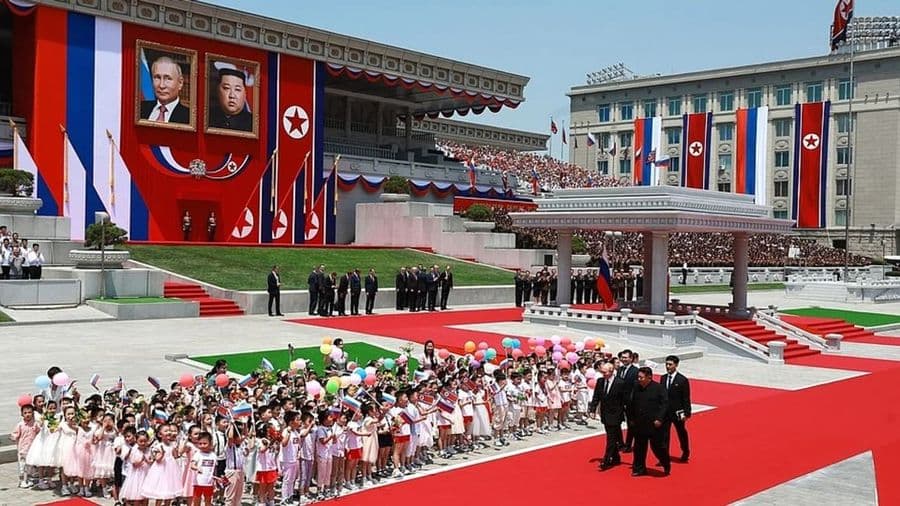
Vladimir Putin on a state visit to North Korea with Kim Jong-un in June 2024 (Vladimir Smirnov, TASS via Kremlin)
Russia’s War Is Connecting Europe and the Indo-Pacific
A Seoul–Kyiv row over North Korean POWs shows how Sino-Russian alignment is bridging geopolitical theatres.
Last updated 03:53 PM EDT • Read time: 5m
The separation of Europe and the Indo-Pacific into distinct strategic theatres is becoming less clear-cut. Russia’s war against Ukraine is drawing Asian actors more directly into European security, while developments in Europe increasingly feed back into Asia. A current dispute between South Korea and Ukraine shows how far these connections now reach.
Seoul is demanding an apology from Kyiv over the public disclosure of the planned transfer to South Korea of two North Korean soldiers captured while fighting for Russia. The men had expressed a wish to resettle in the South, but Seoul intended the transfer to remain confidential, and President Lee Jae Myung has warned that further measures could follow.
The dispute is minor, but the circumstances that have produced it are more significant. North Korean troops are fighting in Russia’s war, with Pyongyang also supplying artillery, missiles, and other weapons. Moscow’s growing reliance on North Korea has been driven primarily by the demands of the war, but China’s tolerance has kept the diplomatic cost low, in a wider strategic environment shaped by Russia’s growing dependence on China. These developments show how security dynamics across Eurasia and the Indo-Pacific are increasingly interconnected.
Sino-Russian alignment does not constitute a formal alliance. Rather, it is an observable pattern of coordination expressed through joint statements, institutional linkages, strategic signalling, and reciprocal diplomatic support. In May 2022, China and Russia jointly vetoed a US-sponsored Security Council resolution that would have imposed additional sanctions on Pyongyang after renewed ballistic missile launches.
Two years later, in 2024, when Russia vetoed the renewal of the UN Panel of Experts that monitored sanctions against North Korea, China abstained rather than opposing Moscow, ending fourteen years of continuous monitoring. The contrast with 2022, when China joined Russia’s veto, hints at an alignment that is real but selective. Beijing’s 2025 military parade placed Kim Jong-un, Xi Jinping, and Vladimir Putin on the same stage, highlighting how closely the three relationships had become entangled in the regional security environment.
The pattern became more visible in 2026. During Putin’s visit to Beijing in May, the China–Russia joint statement opposed sanctions on North Korea. Xi then travelled to Pyongyang in June for his first visit since 2019, where Chinese state media reported calls for closer diplomatic, law enforcement, and military cooperation.
Russia’s wartime needs explain its turn towards Pyongyang. China’s role is less direct, but Beijing’s position has influenced the diplomatic and strategic costs of Moscow’s deepening relationship with North Korea. Putin’s June 2024 visit to North Korea occurred with Beijing’s tacit acceptance, while the China–Belarus military exercise near the Polish border the following month would have been difficult to imagine without Russia’s consent. There appears to be a broader pattern in which Beijing and Moscow give one another considerable latitude to pursue strategic objectives in regions of particular importance to the other. This reciprocal accommodation is one of the ways in which Sino-Russian alignment is creating stronger links between the European and Indo-Pacific theatres.
The relationship has become more asymmetric since 2022, as Western sanctions and international diplomatic isolation have increased Moscow’s dependence on Beijing. China has become centrally important to Russia’s economic resilience, diplomatic positioning, and wider strategic orientation, while North Korea serves a more specific role in supporting Russia’s war-fighting capacity.
North Korea has sent an estimated 14,000 to 15,000 troops to support Russia since 2024, as well as millions of artillery and mortar rounds, ballistic missiles, long-range artillery systems, and multiple-launch rocket systems. North Korean forces are gaining battlefield experience, while the testing of North Korean weapons under combat conditions is providing Pyongyang with information that can be used to refine its missile and artillery capabilities. Russia has also provided North Korea with economic resources and technological support. These gains have direct implications for the military balance on the Korean Peninsula. Better-tested missiles and artillery, together with troops experienced in large-scale modern warfare, will have to be factored into South Korean and allied deterrence planning.
China’s position is more cautious and not uncomplicated. Beijing has reasons to be uneasy about deeper Russia–North Korea military cooperation, particularly where it risks reducing Chinese influence over Pyongyang or increasing instability on the Korean Peninsula. China has nevertheless accommodated the relationship rather than obstructed it, while seeking to preserve its own leverage over North Korea. Its renewed engagement with Kim Jong-un in 2025 and 2026 can therefore be read partly as an effort to reassert influence in Pyongyang, rather than simply as support for Moscow’s closer ties with North Korea.
For Seoul, Tokyo, and European capitals, these developments can no longer be handled separately. The war in Ukraine is reshaping the Korean Peninsula’s strategic environment, while Northeast Asia now helps sustain Russia’s war effort. Sino-Russian alignment remains marked by friction, but it matters because it shapes the choices others face. The prisoner dispute illustrates this point: even a minor quarrel between Seoul and Kyiv now sits within a Eurasian security system. With the UN Panel of Experts gone, the Multilateral Sanctions Monitoring Team, established in 2024 by 11 countries, has assumed some of its monitoring functions. Strengthening cooperation through this mechanism, particularly in tracking sanctions violations and the military capabilities Pyongyang gains from the war, would help address the growing security challenges spanning Europe and the Indo-Pacific.
Dr. Monique Taylor is University Lecturer in World Politics in the Faculty of Social Sciences at the University of Helsinki.
Julie Yu-Wen Chen is Professor of Chinese Studies in the Department of Cultures at the University of Helsinki, where she also serves as Director of the Master’s Program in Area and Cultural Studies.
This article appeared originally at Lowy Institute's the interpreter.
This article draws on themes explored in Julie Yu-Wen Chen and Monique Taylor, “The Sino-Russian Relationship and its Implications Across the Eurasian and Indo-Pacific Strategic Theatres (Opens in new window)”, Communist and Post-Communist Studies (August, 2026).
The Unfinished Reform
By Mark W. Castillon • RealClearDefense
Winning the Data Advantage
By Turin Pollard • RealClearDefense
The Pentagon’s Quantum Race Needs a Warfighter’s Scorecard
By Burak Oktenli • RealClearDefense
The F/A-XX and the AIM-260 Reclaim the Perimeter
By Bruce Allen Lubbering • RealClearDefense
Iranian Cyber Operations
By Michael Groen • RealClearDefense
Winning the Data Advantage
By Turin Pollard • RealClearDefenseThe F/A-XX and the AIM-260 Reclaim the Perimeter
By Bruce Allen Lubbering • RealClearDefenseWinning the Data Advantage
By Turin Pollard, RealClearDefenseThe F/A-XX and the AIM-260 Reclaim the Perimeter
By Bruce Allen Lubbering, RCD
F-22 Pilot Directs CCA in Flight as ‘Airborne QB’
By Stephen Losey, Air & Space Forces