
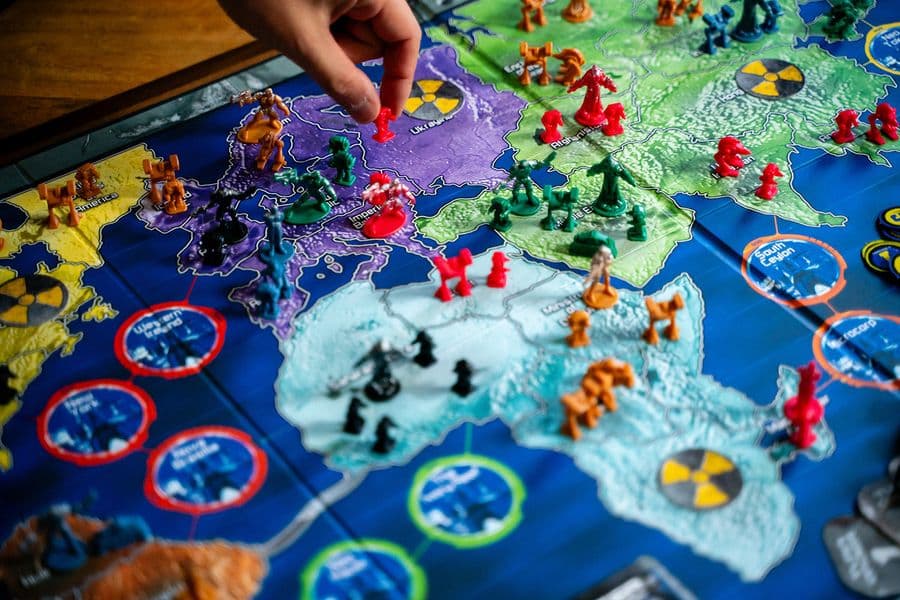
The U.S. Is Playing a Game of Risk With Real Bullets
Last updated 05:47 AM EDT • Read time: 6m
For years American strategists have argued over the extent to which the United States can or should pivot to Asia and retrench from other theaters. That argument now feels quaint. Reality has disrupted the space of discussions. The Trump administration is no longer maneuvering in a theoretical competition with adversaries. It is playing a live, global game of Risk with real forces, real supply chains, and active shooting wars on the all-important Eurasian landmass.
Last month, the United States and Israel launched Operations Epic Fury and Roaring Lion, targeting Iranian military and nuclear infrastructure and triggering the largest Middle Eastern war in decades. The opening campaign hit thousands of targets and decapitated much of the Iranian regime’s leadership structure, including its Supreme Leader. Iran has responded by launching missile and drone attacks aimed at military and civilian infrastructure across the region, hitting US facilities and those of our Israeli and Arab allies.
This is no longer a proxy fight or a twilight war. It is a regional war between Iran and a U.S.–Israeli coalition. And it has suddenly made the strategic map look exactly like a Risk board.
At the center of the board is the Middle East. Israel’s campaign post-October 7th has set the stage for a struggle over the Middle East. The Israelis have degraded Iranian proxies from Hamas to Hezbollah to Hashd al Shaabi, decapitating leadership, destroying rocket and missile magazines and clearing out air defenses on the path to Tehran. Limited strikes in 2024 and 2025 prepared the scene for the massive push we’re seeing in Iran itself. The US and Israeli forces are now exploiting the operational space that Israel's campaign created to finish the job.
From Washington's perspective, the strategic objective is unmistakable: break Iran's ability to threaten the region through missiles, nuclear development, and proxy warfare. The campaign has already reshaped the strategic environment, with Iranian infrastructure hit repeatedly, nuclear facilities damaged, and leadership structures disrupted. But Iran is not defeated. Tehran has retaliated with missile and drone barrages designed to signal that, in this existential fight, it is willing to take the wider Middle East down with it. It is this fight to which every other conflict now connects.
The second fight on the board is taking place in Ukraine, and it is far from over. Even as the Middle East burns, Ukraine remains one of the most strategically crucial. The Trump administration's approach has been inconsistent, offering less ideological commitment than earlier policies and more emphasis on negotiation and burden-sharing. But the basic strategic fact remains unchanged: Ukraine is still in the fight, and that matters.
The war continues to grind down Russia's conventional military capacity, driving enormous equipment losses, catastrophic manpower costs, and diminishing Moscow's ability to project power elsewhere. For Washington, the strategic objective is clear: keep Russia pinned. As long as Moscow remains tied down in Ukraine, it cannot fully align its military posture with China or threaten NATO's eastern flank, and it cannot materially back Tehran beyond intelligence sharing and diplomatic cover. Ukraine’s resolve to keep their contested territory prevents Russia from locking up the European continent.
Further west, checkbooks are finally open as Europe talks about stepping up to defend itself. Germany has launched a massive rearmament effort. Poland is building one of the largest land forces in Europe. NATO members across the continent are increasing defense budgets and expanding procurement of modern weapons.
For decades American leaders have complained about European defense spending. Four years of war on the continent and a recalcitrant US President has concentrated minds in a way prior diplomatic pressure failed. Europe is now concerned that its previous security guarantee might not protect it from further Russian aggression. If this trend continues, Europe could begin carrying a much larger share of its own defense burden, freeing the United States to shift weight to other theaters without leaving Europe uncovered. That would fundamentally change the strategic arithmetic of the alliance.
But rearmament is a decade-long project, and writing checks is the easy part. Converting budgets into combat power requires industrial capacity, procurement discipline, and political will sustained across multiple election cycles. None of that is guaranteed.
On the other side of the world, the Trump administration has begun reinforcing positions closer to home. Latin America had largely disappeared from U.S. strategic thinking over the past two decades, and in that vacuum, China expanded economic influence while Russia cultivated relationships with authoritarian governments. A major gap on the board is now closing.
The Panama Canal remains one of the most critical logistics chokepoints on the planet.
Argentina is emerging as a key democratic and economic partner with major energy and mineral resources. Venezuela is no longer aligned with America's adversaries, and Cuba's realignment is next on the agenda. Re-engaging the Western Hemisphere is not nostalgia for the Monroe Doctrine. It is recognition that the global competition now includes the Americas.
When fighting on multiple fronts, you cannot hold territory without presence. And you cannot sustain presence without ammunition. The United States is fighting a very hot war against Iran, maintaining arms flows to Ukraine, deterring China in the Indo-Pacific, and sustaining global deployments across dozens of bases. The cracks are starting to show.
The wars of the past four years have revealed a hard truth: Modern combat burns through munitions faster than Western industrial bases can replace them. Air-defense interceptors, precision missiles, and artillery shells are being consumed at staggering rates. Production lines built for peacetime efficiency cannot surge fast enough to sustain multiple simultaneous conflicts. The Iran war only amplifies this problem. Missile defense systems protecting Israel and U.S. bases are firing constantly and are running low.
Strategy may look like a board game, but real production and logistics decide the outcome.
In several regions, the United States and its allies hold strong positions. Russia is bogged down in Ukraine. Europe is rearming. Israel has shattered much of Iran’s proxy network and has taken the fight to the head of the octopus. And Washington has begun reinforcing influence in the Western Hemisphere. Those are real strategic gains.
But the most important battle, the one now raging in Iran, is still unresolved and is the biggest move on the board. If the Iranian regime collapses or loses its ability to project power across the Middle East, the geopolitical map of the region could change overnight. Iran’s proxy network would fully unravel. Oil chokepoints would stabilize. And one of the world’s most aggressive revisionist regimes would disappear from the board.
If the war drags on, however, the opposite risk emerges: economic disruption, global energy shocks, and a prolonged conflict that drains American resources while China watches carefully from the sidelines. That is the reality of playing Risk with real bullets. The United States has spread its pieces across the map. The opening moves have been bold. But the outcome will depend on two things every experienced player understands: whether you can reinforce faster than your opponent and whether you can win the fight where it matters most.
John Ferrari is a nonresident senior fellow at the American Enterprise Institute (AEI), where his work focuses on the defense budget, defense reform and acquisition, and the U.S. military.

Eight Months of Epic Fury and Still No Internal Alternative
By Stephen D. Cook • RealClearDefense
The Readiness Cliff: Pacific Lessons Drawn from the Middle East
By Brian McSorley • RealClearDefense
The Pentagon’s Real Modernization Problem Is Time, Not Technology
By Bruce Allen Lubbering • RealClearDefense
The World His Mother Opened
By Carlo J.V. Caro • RealClearDefense
Wake Island Lessons for Expeditionary Advanced Base Operations
By Brian J. Dunn • RealClearDefense
Wake Island Lessons for Expeditionary Advanced Base Operations
By Brian J. Dunn • RealClearDefense
U.S. Navy Expands Unmanned Mine Hunting
By Global Defense News
MRF-SEA Will Maintain Continuous Presence in the Philippines
By Mahadzir, USNI News
Space Force Weighs Proliferated Cislunar Satellite Constellation
By C. Albon, A&SF
America-Class Amphibs Enable New Ship-to-Shore Attack Strategies
By Warrior M.